

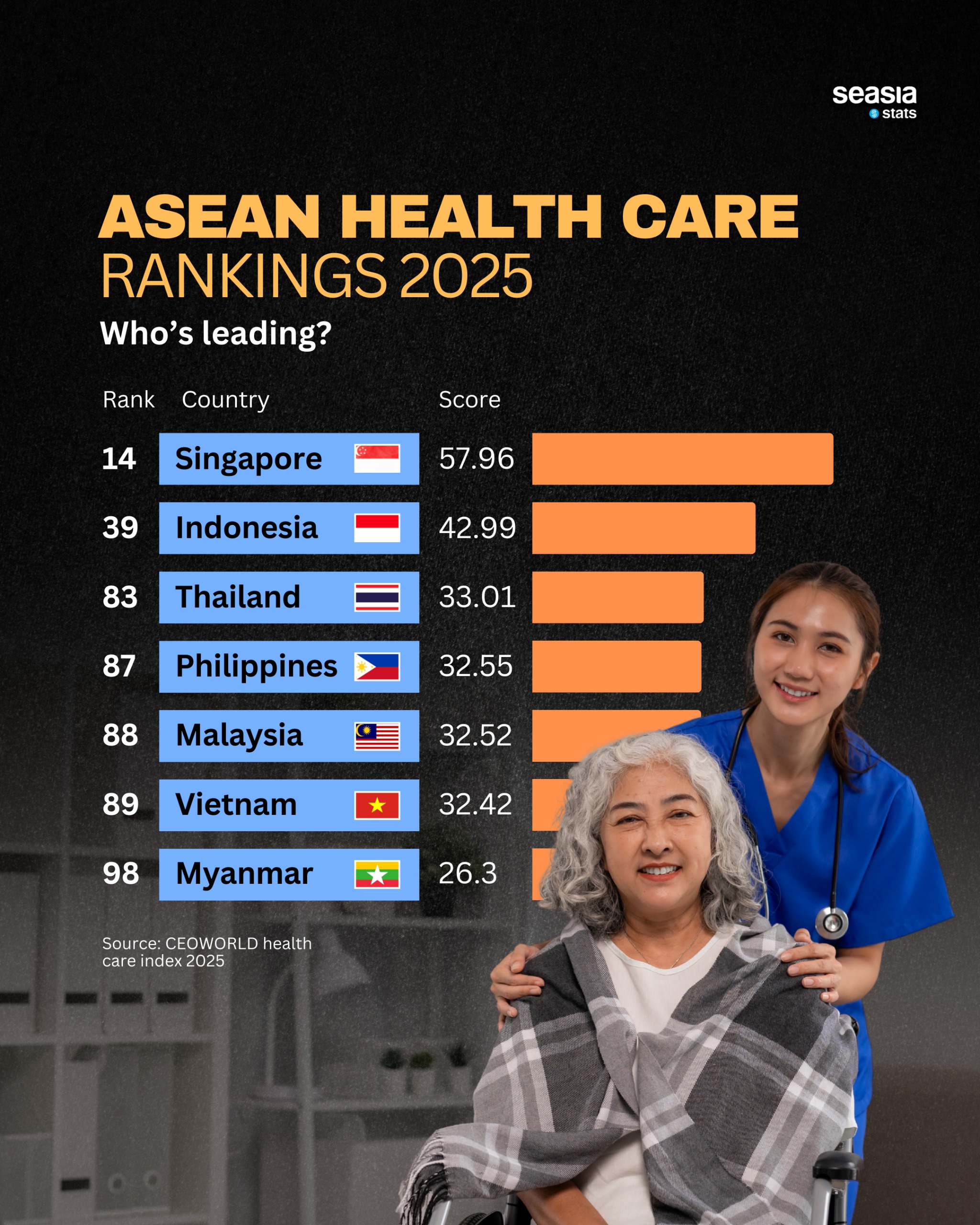
Healthcare systems across Southeast Asia are evolving rapidly, shaped by aging populations, rising incomes, and growing public expectations. The ASEAN Health Care Rankings 2025, based on the CEOWORLD Health Care Index, offer a revealing snapshot of how the region’s systems compare globally—highlighting both standout performers and areas where reform remains urgent.
Singapore: ASEAN’s Clear Healthcare Leader
At the top of the regional table is Singapore, which ranks 14th globally with a strong score of 57.96. Singapore’s healthcare model is frequently cited as one of the most efficient in the world, combining universal coverage, disciplined cost controls, and world-class medical infrastructure. Heavy investment in digital health, preventive care, and workforce training has helped the city-state consistently outperform much larger economies.
Beyond outcomes, Singapore’s system is known for its balance between public responsibility and individual accountability—an approach that many ASEAN neighbors are studying closely.
Indonesia: Scale Meets Steady Progress
Ranked 39th globally with a score of 42.99, Indonesia stands as the second-highest performer in ASEAN. Given its vast geography and population of over 280 million, Indonesia’s position reflects notable progress rather than perfection.
The country’s national health insurance program (Jaminan Kesehatan Nasional) has significantly expanded access over the past decade. However, challenges remain around rural healthcare delivery, hospital capacity, and workforce distribution—issues common in large archipelagic nations.
Thailand: Strong Foundations, Regional Influence
With a global rank of 83 and a score of 33.01, Thailand remains a healthcare heavyweight in Southeast Asia. Thailand’s universal healthcare scheme is widely praised for affordability and coverage, and the country has built a strong reputation in medical tourism.
Despite this, rising costs, demographic aging, and staffing pressures have affected its overall ranking. Still, Thailand’s public health achievements continue to serve as a reference point for neighboring countries.
The Middle Cluster: Philippines, Malaysia, and Vietnam
A tight grouping follows closely behind. The Philippines ranks 87th (32.55), Malaysia ranks 88th (32.52), and Vietnamranks 89th (32.42).
These three systems share similar challenges: uneven access between urban and rural areas, underfunded public facilities, and growing demand driven by non-communicable diseases. At the same time, all three are investing heavily in primary care expansion, digital health solutions, and private-sector partnerships—suggesting room for rapid improvement.
Myanmar: Healthcare Under Severe Strain
At the bottom of the ASEAN list is Myanmar, ranked 98th globally with a score of 26.3. Political instability, economic disruption, and constrained public spending have taken a heavy toll on healthcare delivery. Access, workforce retention, and basic service availability remain critical concerns.
What the Rankings Reveal About ASEAN
Taken together, the ASEAN Health Care Rankings 2025 show a region of sharp contrasts. While Singapore operates at near–OECD standards, much of Southeast Asia is still in a transitional phase—building systems capable of serving larger, older, and more urban populations.
The data underscores a clear takeaway: investment in primary care, health workers, and system efficiency—not just hospitals—will define the next chapter of healthcare in Southeast Asia.


