

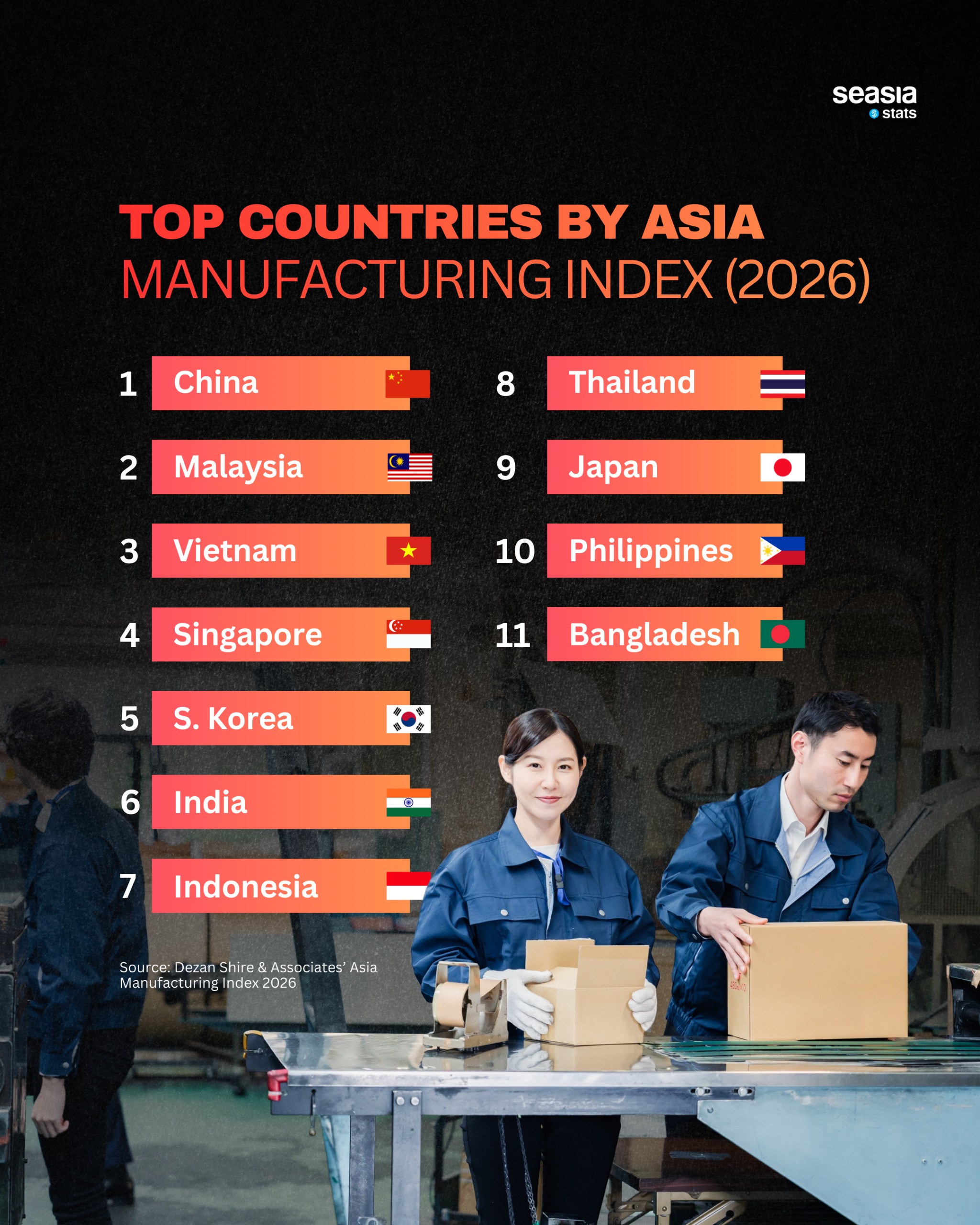
Asia’s factory floors are changing—but not in the way many expected. As companies talk about diversifying supply chains and “China-plus-one” strategies, new data from the Asia Manufacturing Index (AMI) 2026 shows that Asia’s industrial hierarchy remains resilient, competitive, and increasingly complex. While familiar giants still dominate, several Southeast Asian economies are rapidly reshaping the manufacturing map.
China Still Sets the Benchmark
For the third consecutive year, China tops the Asia Manufacturing Index. Despite geopolitical tensions and relocation efforts by multinational firms, China’s industrial depth remains unmatched. Its advantage lies not just in scale, but in fully integrated supply chains, world-class logistics, skilled labor pools, and infrastructure that allows manufacturers to operate at speed and volume few countries can rival.
For many global producers, diversification may reduce dependency—but China remains the reference point against which all others are measured.
Malaysia’s Breakout Moment
The most notable shift in the 2026 rankings is Malaysia’s rise to second place, overtaking Vietnam for the first time. This jump reflects Malaysia’s growing appeal as a balanced manufacturing destination—offering competitive labor costs, strong infrastructure, political stability, and deep integration into global trade networks.
Malaysia has also benefited from its role in electronics, semiconductors, and precision manufacturing, positioning itself as a high-quality alternative for companies seeking reliability without sacrificing efficiency.
Vietnam Holds Strong Under Pressure
Dropping to third place, Vietnam remains one of Asia’s most dynamic manufacturing hubs. Its strengths—high trade openness, export-oriented policies, and strong participation in global supply chains—continue to attract investment, particularly in electronics, garments, and consumer goods.
However, rising wages and intensifying regional competition mean Vietnam is no longer the uncontested “next China,” but rather one of several strong contenders in Southeast Asia’s manufacturing ecosystem.
Singapore and South Korea: Value Over Volume
At fourth place, Singapore continues to punch above its weight. While it lacks scale, it excels in high-value manufacturing, advanced technology, pharmaceuticals, and precision engineering. Singapore’s strengths lie in innovation, regulatory clarity, and its role as a regional headquarters and logistics hub.
South Korea, slipping to fifth, remains a global industrial leader, particularly in semiconductors, automotive manufacturing, and heavy industry. Its slight drop reflects intensifying competition rather than declining capability.
Indonesia, Thailand, and the Power of Scale
India and Indonesia hold steady in sixth and seventh place, respectively. Both benefit from massive domestic markets that provide scale and demand stability. Indonesia, in particular, is gaining momentum through downstream processing, especially in nickel and electric vehicle supply chains.
Thailand records one of the biggest improvements in the index, jumping from 10th to eighth place. Long a regional automotive hub, Thailand has strengthened its industrial competitiveness through infrastructure investment, supply-chain upgrades, and incentives aimed at advanced manufacturing.
The Rest of the Field
Japan, ranked ninth, remains a technology and quality leader but faces structural challenges such as an aging workforce. The Philippines, in tenth place, shows potential driven by electronics assembly and a young labor force, while Bangladesh, ranked eleventh, continues to rely heavily on garments while gradually diversifying.
Southeast Asia’s Manufacturing Moment
Taken together, the AMI 2026 rankings underline a key reality: manufacturing in Asia is no longer about a single winner. Southeast Asia, in particular, has emerged as a diversified production zone—where Malaysia, Vietnam, Indonesia, Thailand, and the Philippines each play distinct roles.
For investors and manufacturers, the future isn’t about replacing China—it’s about building smarter, more resilient supply chains across a rapidly evolving Asian industrial landscape.


