

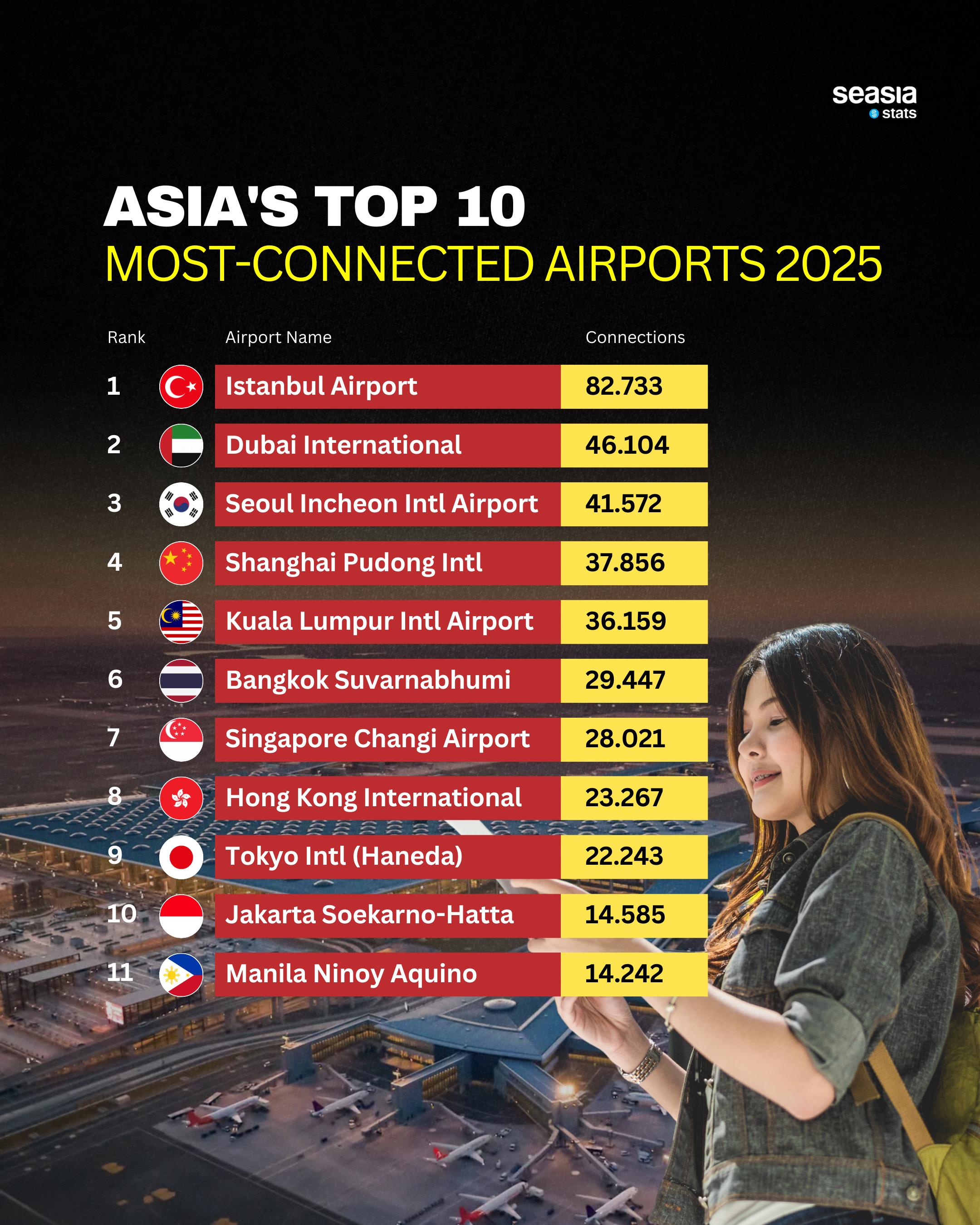
Asia’s skies are busier than ever. As global travel continues its post-pandemic rebound, air connectivity across the continent has surged—led not by legacy hubs alone, but by fast-growing airports powered by high-frequency, low-cost travel. The latest rankings for 2025–early 2026 reveal a clear shift: Southeast Asia is now at the center of Asia’s aviation recovery, reshaping how millions move across the region.
Kuala Lumpur Takes the Lead
The standout winner is Kuala Lumpur International Airport (KUL). Once considered a secondary hub behind Singapore and Tokyo, KUL has surged to become Asia’s most connected airport and the fourth most connected globally. The key driver is density—an enormous number of short-haul and medium-haul connections operated primarily by AirAsia, which uses Kuala Lumpur as its main operational base.
Rather than relying on fewer long-haul routes, KUL thrives on volume. High-frequency flights link Malaysia to nearly every corner of Southeast Asia, South Asia, East Asia, and Australia, making it one of the most efficient transfer points on the continent.
Northeast Asia’s Heavyweights Hold Strong
Not far behind is Seoul Incheon International Airport (ICN), ranked second in Asia and sixth globally. Incheon has seen one of the fastest rebounds in connectivity, cementing its role as Northeast Asia’s primary interchange hub. Its strength lies in balanced growth—strong long-haul routes paired with dense regional connections to China, Japan, and Southeast Asia.
Tokyo Haneda (HND) remains Japan’s most connected airport, while Shanghai Pudong (PVG) and Hong Kong International Airport (HKG) continue their recovery, serving as gateways to the vast Chinese travel market. These hubs reflect Asia’s traditional aviation power centers—still influential, but now facing stronger competition.
Southeast Asia’s Multi-Hub Advantage
Southeast Asia dominates the middle of the rankings. Bangkok Suvarnabhumi (BKK) remains a critical tourism gateway, feeding passengers into Thailand’s domestic and regional routes. Singapore Changi Airport (SIN), long regarded as Asia’s gold standard, maintains elite status through a mix of premium long-haul services and regional connectivity, even as it adapts to competition from low-cost carriers.
Further south, Jakarta Soekarno-Hatta (CGK) and Manila Ninoy Aquino International Airport (MNL) reflect the region’s demographic strength. Large domestic markets, combined with booming outbound tourism, have pushed both airports into the upper tier of Asia’s connectivity rankings.
Low-Cost Carriers Change the Game
The defining trend behind these rankings is the rise of low-cost carrier networks. Airlines such as AirAsia, Scoot, Cebu Pacific, and Lion Air prioritize frequency over prestige, creating dense webs of short routes that dramatically boost connectivity scores.
This model favors Southeast Asia, where travel demand is price-sensitive, distances are short, and tourism flows are constant. As a result, airports that embrace high-volume, low-cost operations are outperforming traditional long-haul hubs.
Asia’s Aviation Future Is Regional
The 2025–2026 rankings send a clear message: Asia’s aviation future is no longer dominated by a few global megahubs. Instead, it’s being shaped by regional connectivity, with Southeast Asia leading the way.
From Kuala Lumpur’s rise to Singapore’s adaptation and Jakarta’s scale, the region is proving that in modern aviation, connections matter more than ever—and Southeast Asia has mastered the art of staying connected.


