

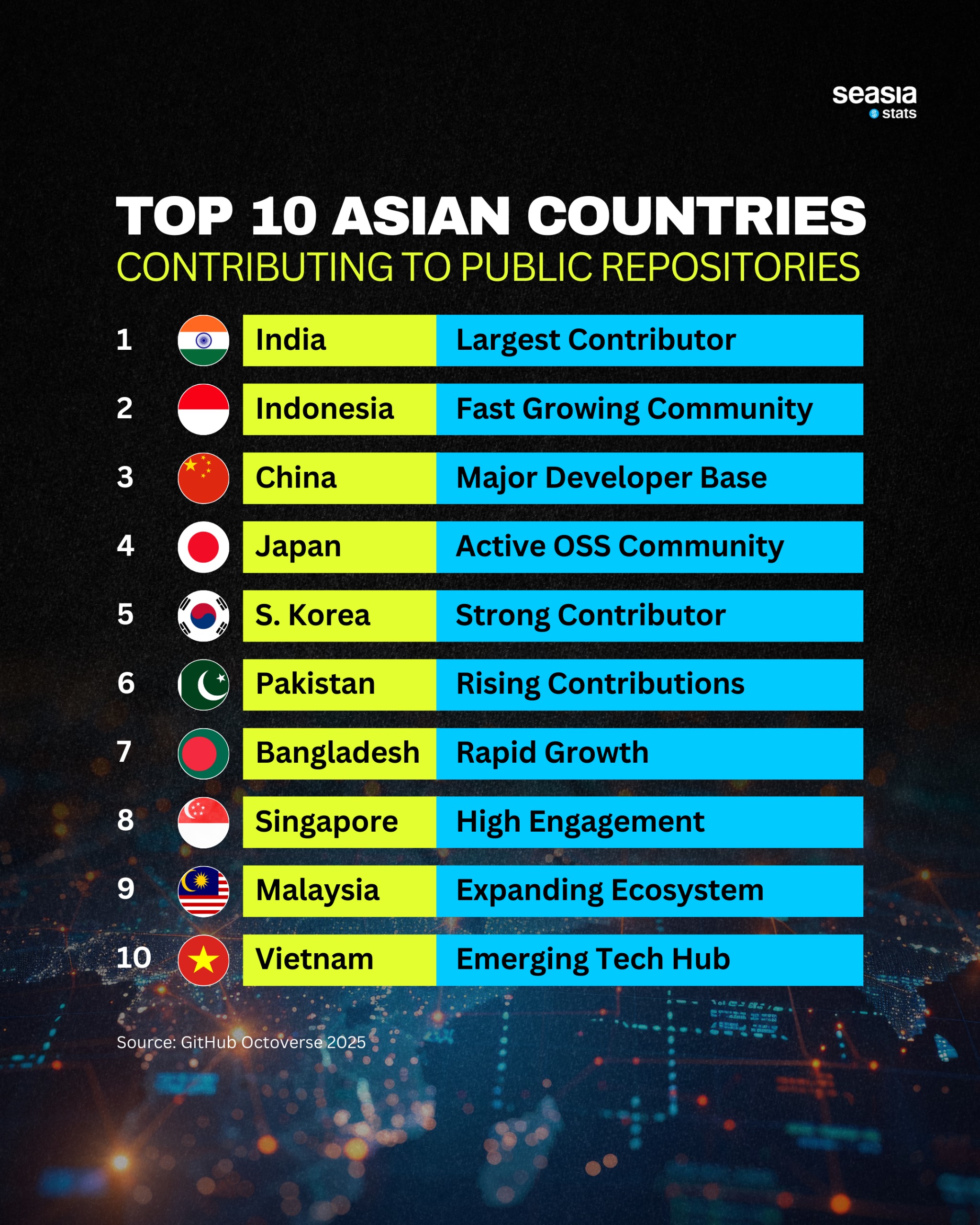
A quiet revolution is unfolding in the world of software—and it’s happening in Asia. In 2025, the continent reached a historic milestone as Asian developers became the dominant force behind public code repositories. From massive population-driven growth to fast-rising digital ecosystems, Asia is no longer just consuming technology—it is building it, line by line.
India Becomes the World’s Largest Contributor
At the heart of this shift is India, which in 2025 surpassed the United States to become the largest contributor to public repositories globally. According to GitHub’s 2024–2025 Octoverse reports, India added over 5.2 million new developers in a single year, accounting for roughly 14% of all new GitHub accounts worldwide.
This surge is fueled by India’s youthful population, widespread digital education, and a thriving startup ecosystem centered in cities like Bangalore, Hyderabad, Pune, and Delhi NCR. Open-source skills are increasingly viewed as essential career capital, accelerating participation across industries—from fintech and health tech to AI and cloud infrastructure.
Southeast Asia’s Digital Powerhouses Rise
Beyond India, Southeast Asia has emerged as one of the fastest-growing open-source regions in the world. Leading the charge is Indonesia, now ranked among the top global contributors to public repositories. Over the past five years, Indonesia’s developer base has quadrupled, supported by strong grassroots communities in Jakarta, Bandung, Yogyakarta, and Surabaya.
Indonesia’s rise reflects a broader transformation. Government-backed digitalization programs, startup investment, and affordable internet access have turned the country into a genuine digital powerhouse.
Vietnam also stands out as an emerging tech hub. Its developer community is one of the fastest-growing globally, driven by outsourcing demand, strong STEM education, and increasing participation in open-source AI, mobile, and backend projects.
Meanwhile, Singapore, despite its small size, punches far above its weight. Its developers show exceptionally high engagement per capita, specializing in fintech, cybersecurity, and enterprise software. Malaysia and the Philippines are also expanding rapidly, with the Philippines recently overtaking Australia in total developer population—driven by its young workforce and growing IT services sector.
China, Japan, and Korea: Scale Meets Specialization
China remains a major contributor, particularly in AI, cloud computing, and infrastructure software. With an estimated 1.2 million new developers added annually, contributions are often led by engineers affiliated with major firms such as Alibaba, Tencent, and Huawei—alongside a vibrant independent developer scene.
Japan maintains a strong and steady presence, with a focus on manufacturing software, robotics, and embedded systems, reflecting its industrial strengths. South Korea continues to be a solid contributor as well, excelling in gaming, semiconductors, and platform technologies.
South Asia’s Fast-Growing Frontier
Beyond India, Pakistan and Bangladesh are among the fastest-growing developer communities worldwide, according to GitHub. Their rise is powered by freelancing platforms, export-oriented software services, and increasing access to global open-source projects as pathways into the tech economy.
Open Source as Asia’s New Infrastructure
What unites these diverse countries is a shared realization: open-source is no longer optional. It is now core infrastructure for innovation, skills development, and economic competitiveness.
As Asia’s developer population continues to grow at unmatched speed, the center of gravity in global software development is shifting decisively eastward. In the open-source era, Asia isn’t catching up—it’s leading.


