

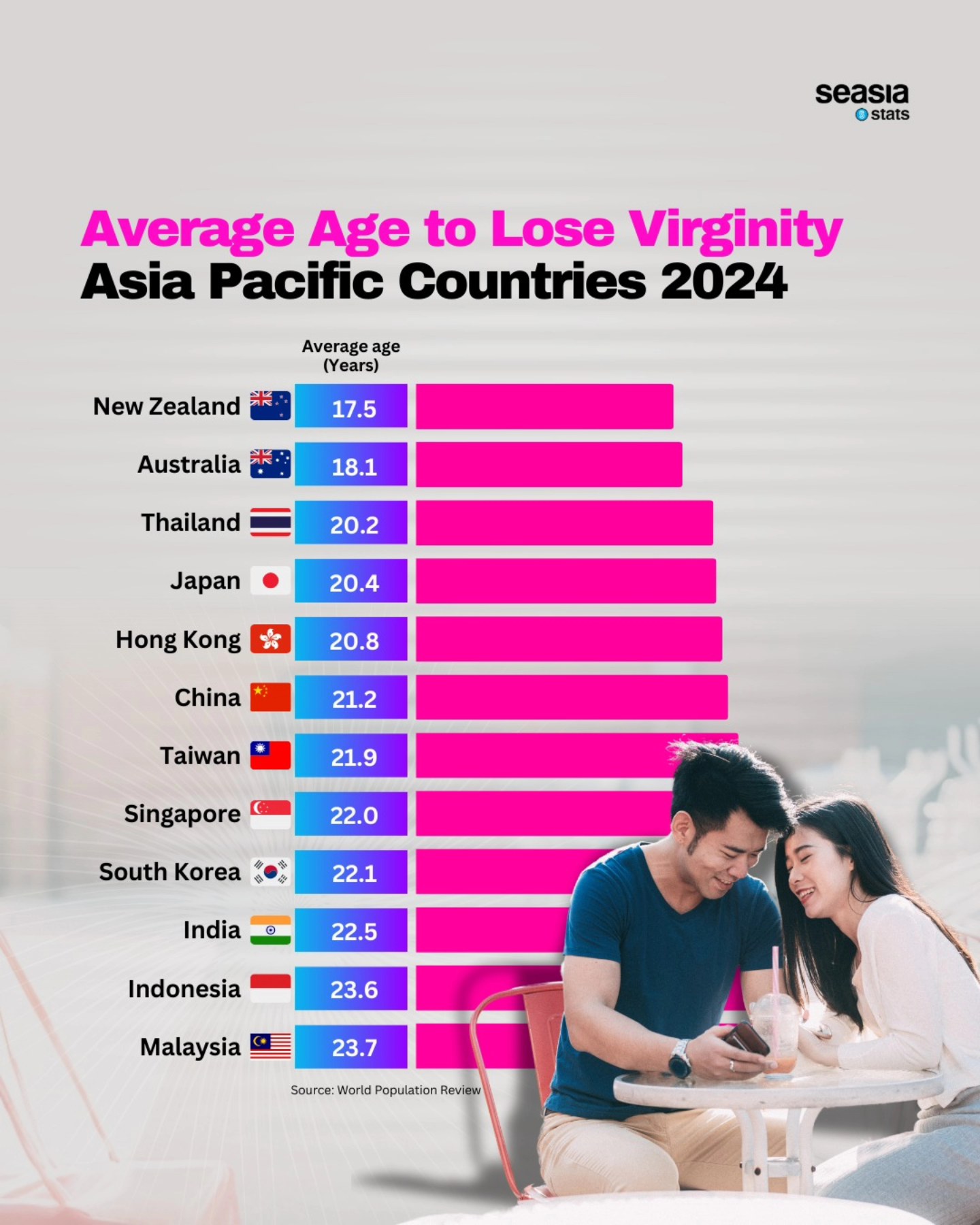
Recent statistics provide a nuanced perspective on the sexual behaviors of young adults across the Asia-Pacific region. The data reveals significant variations in the average age at which individuals lose their virginity, influenced by cultural, societal, economic, and personal factors.
Youngest Averages: New Zealand and Australia
At the younger end of the spectrum, New Zealand leads with an average age of 17.5 years. This is followed by Australia at 18.1 years and Thailand at 19.0 years. These figures reflect relatively open attitudes toward discussing and engaging in sexual relationships. For New Zealand and Australia, comprehensive sexual education and liberal societal norms likely contribute to earlier initiation. Thailand’s inclusion in this category suggests a blend of modern influences and traditional values, as the country balances its cultural heritage with evolving societal norms.
Higher Averages in Southeast Asia: Malaysia and Indonesia
In stark contrast, Southeast Asian nations such as Malaysia and Indonesia report much higher average ages, at 23.7 and 23.6 years respectively. These figures align with societal expectations shaped by religious and cultural values, where premarital sex is often viewed as taboo. Strong familial and community influences, coupled with limited sexual education in some areas, likely reinforce these patterns.
Variations Across East Asia: South Korea, Japan, and China
South Korea and China display average ages of 22.1 and 21.9 years respectively, while Taiwan and Hong Kong reflect slightly younger averages at 21.0 and 20.8 years. These figures suggest evolving attitudes toward premarital sex, as modern lifestyles and traditional values coexist. Japan, with an average of 20.4 years, highlights the region's diversity, reflecting both the influence of urbanization and lingering conservative elements.
South Asia and Regional Norms
In India, the average age stands at 21.5 years, indicating a gradual shift as urbanization and globalization influence traditional norms. The trend across South Asia and Southeast Asia underscores the complex interplay between modern influences and deep-rooted cultural expectations.
Understanding the Broader Trends
The Asia-Pacific region generally maintains higher average ages of first sexual experiences compared to global trends. This reflects a combination of societal norms, education systems, and individual values. While countries like New Zealand and Australia lead with younger averages, many parts of the region emphasize restraint influenced by cultural and religious teachings.
Understanding these trends from an academic and public health perspective is vital for developing effective sexual health education and addressing societal attitudes, ensuring that young individuals are informed and supported in their decisions.


