

Sleep has quietly become one of the biggest quality-of-life issues in Asia. Across the region, people are working longer, commuting farther, staring at screens later, and carrying more stress into bed than ever before. So while sleep may seem like a private, everyday habit, it is increasingly becoming a public health story—and a revealing one.
Asia’s Sleep Divide Is More Than Just a Number
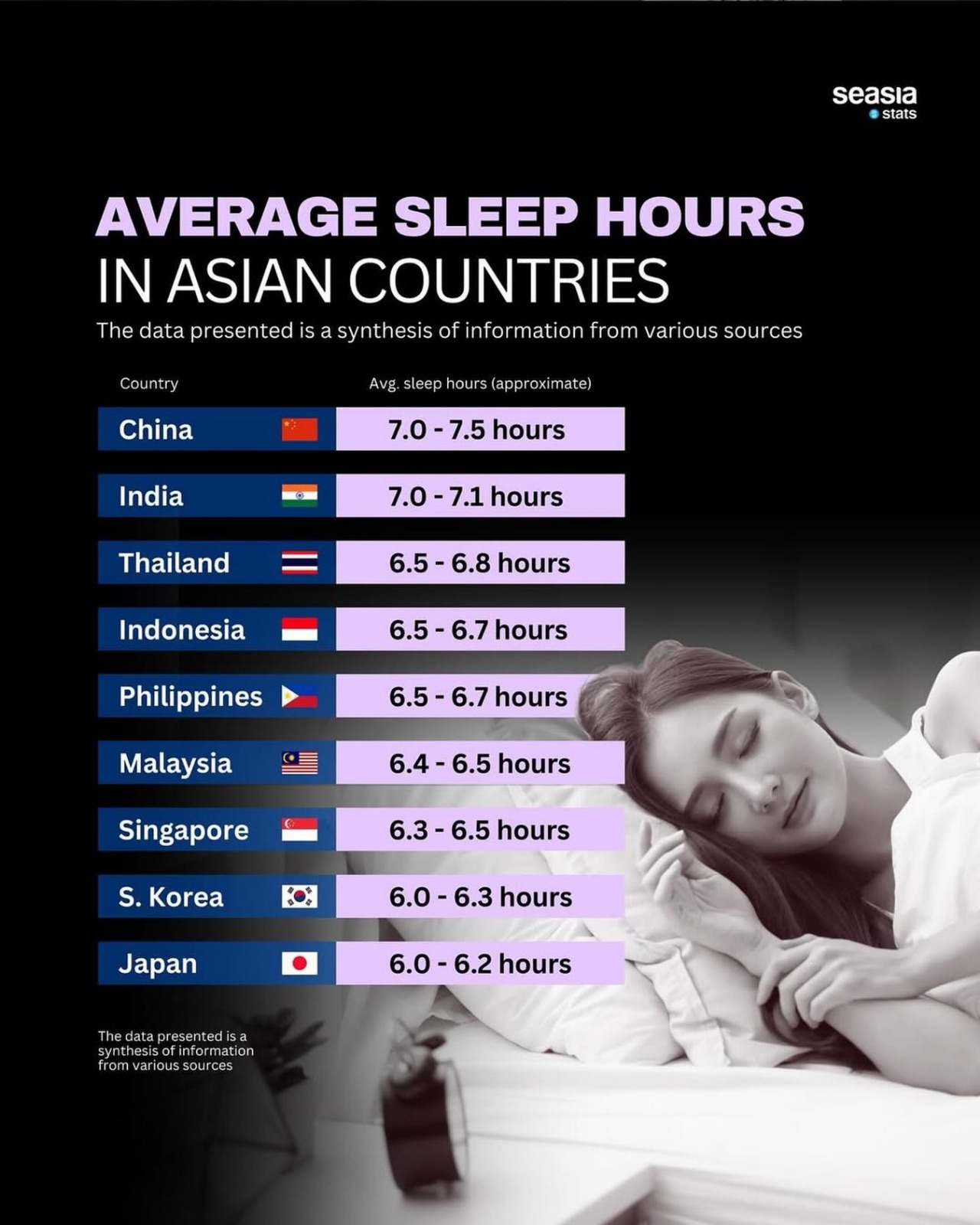
Based on the infographic compiled by Seasia Stats, China and India sit at the top of this list for average sleep duration, with China estimated at 7.0 to 7.5 hours and India at 7.0 to 7.1 hours per night. That places both countries closest to the commonly recommended adult sleep range of around seven or more hours.
The contrast becomes clearer further down the list. Much of Southeast Asia clusters in the middle: Thailand averages 6.5 to 6.8 hours, Indonesia and the Philippines both sit at 6.5 to 6.7 hours, while Malaysia is slightly lower at 6.4 to 6.5 hours. Singapore falls further behind at 6.3 to 6.5 hours, while South Korea and Japan appear at the bottom, with around 6.0 to 6.3 hours and 6.0 to 6.2 hours respectively.
These are not dramatic differences on paper. But over weeks, months, and years, even losing 30 to 60 minutes of sleep a night can shape concentration, mood, health, and productivity.
Southeast Asia’s Middle Tier Tells a Bigger Story
What stands out most in the data is how similar Southeast Asian sleep patterns are. The region is neither the most rested nor the most sleep-deprived—but it is clearly living on the edge of “not quite enough.”
In the Philippines, a 2024 report highlighted that 56% of Filipinos get less than seven hours of sleep daily, making them among the most sleep-deprived populations in Southeast Asia. That helps explain why the Philippines, despite sitting in the middle of the infographic, still appears under pressure when measured against health recommendations.
In Indonesia, sleep appears to be valued culturally, but not always achieved in practice. Reporting in The Jakarta Post cited a YouGov survey showing that 51% of Indonesians sleep less than seven hours a night. That gap between what people want and what they actually get is increasingly common across urban Asia.
In Malaysia, the picture is similarly concerning. A 2026 report citing the country’s National Health and Morbidity Survey 2023 found that 38% of Malaysian adults were not getting enough sleep, with urban residents sleeping less than rural populations.
Thailand appears slightly better positioned in this comparison, but even there, the pressures of modern urban life are shaping sleep habits. A recent wellness survey in Thailand found that sleep and recovery are now becoming top priorities for many adults, especially in city environments where exhaustion has become normalized.
Singapore, Japan, and South Korea Reflect the Cost of High Performance
If Southeast Asia reveals the strain of development, then Singapore, Japan, and South Korea reveal the cost of hyper-efficiency.
A 2025 report by Channel NewsAsia noted that many Singaporeans are not getting enough rest because of “prolonged work and study hours, and heavy screen use,” while experts also pointed to a culture that often places productivity ahead of sleep. That observation captures something broader about highly urbanized Asian societies: sleep is often the first thing sacrificed when time runs short.
In Japan, sleep loss has become so entrenched that researchers have described insufficient sleep as a “key health issue,” with OECD-linked analysis continuing to rank Japan among the shortest-sleeping developed societies.
And in South Korea, recent reporting found average sleep duration remains well below broader international norms, reinforcing the country’s long-standing reputation for sleep deprivation tied to intense work and academic culture.
Why This Matters More Than Ever
Sleep is not laziness. It is infrastructure for the brain and body. Poor sleep is linked to stress, weight gain, reduced focus, weakened immunity, cardiovascular strain, and mental health challenges. Even China—despite ranking at the top of this infographic—has recently moved to address student sleep deprivation through school policy reforms aimed at reducing overwork and screen exposure.
That may be the clearest takeaway from all of this: sleep is no longer just a personal wellness trend. It is becoming a national competitiveness issue, a public health issue, and increasingly, a social one.
Across Asia, the countries that rest better may not just feel better—they may ultimately function better too.


