

Southeast Asia is rapidly emerging as one of the most dynamic electric vehicle (EV) markets in the world. As governments push for cleaner transportation and consumers seek more affordable and efficient mobility solutions, EV adoption across the region has accelerated dramatically. Automakers from China, Europe, and regional manufacturers are racing to capture market share in this fast-growing industry.
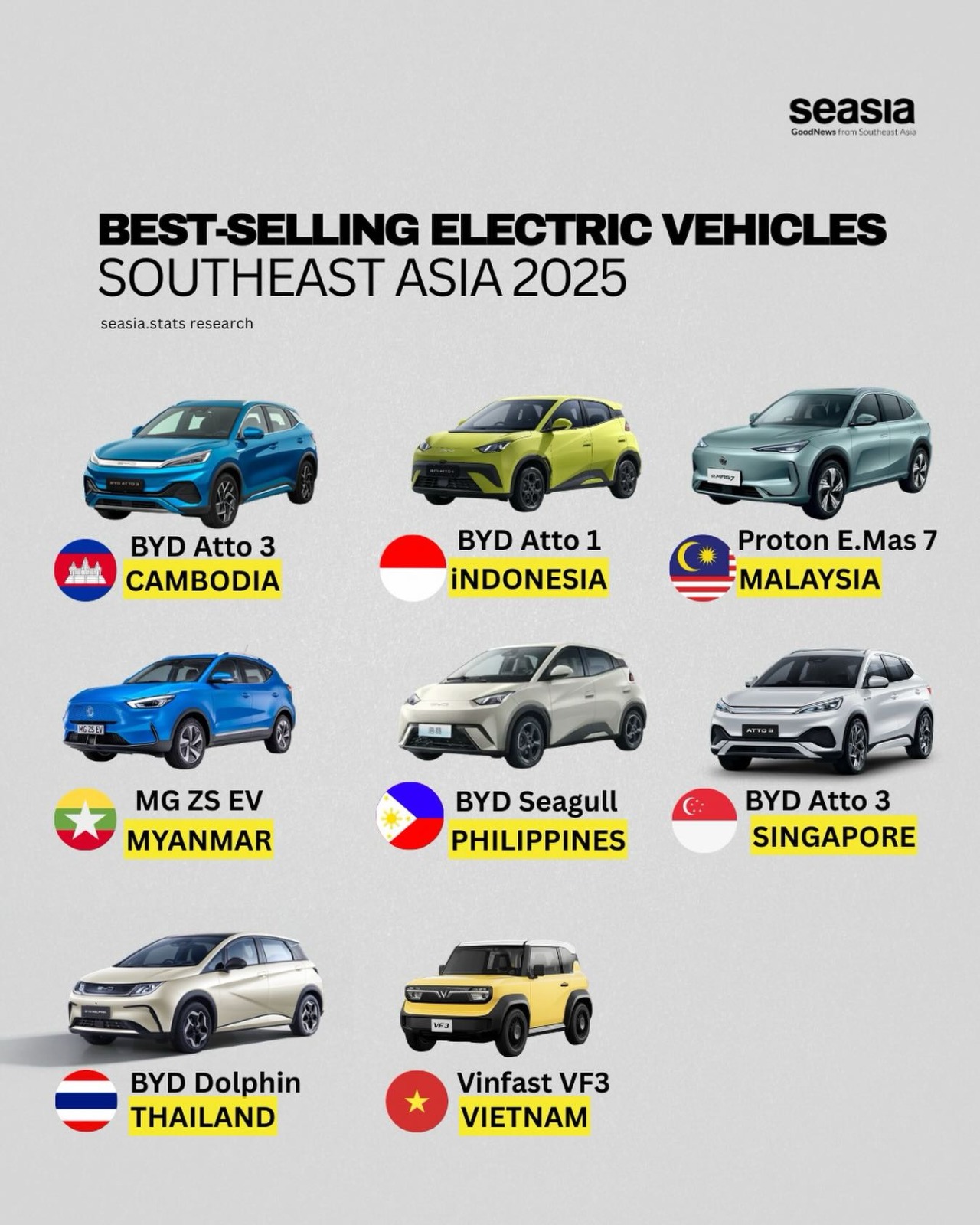
Data highlighted by Seasia Stats reveals a clear trend across the region in 2025: Chinese automaker BYD has become the dominant force in Southeast Asia’s electric vehicle market. In fact, BYD models top the sales charts in the majority of Southeast Asian countries, reflecting both aggressive regional expansion and strong demand for competitively priced EVs.
BYD Dominates the Regional Market
Chinese EV giant BYD leads the regional rankings, claiming the best-selling electric vehicle in six of the eight Southeast Asian markets featured in the infographic.
The BYD Atto 3 stands out as one of the brand’s most successful models. It holds the top sales position in both Cambodia and Singapore, demonstrating the SUV’s wide appeal across very different markets—from developing economies to highly advanced urban centers.
Meanwhile, Indonesia, the largest economy in Southeast Asia, has embraced the BYD Atto 1 (also known as the Dolphin Mini or Seagull in other markets). Its compact size and relatively affordable price make it especially attractive for Indonesia’s densely populated cities.
The brand’s dominance continues elsewhere in the region. In the Philippines, the BYD Seagull leads the EV market, while Thailand, one of Southeast Asia’s most important automotive hubs, sees the BYD Dolphin as its top-selling electric vehicle.
These results highlight how BYD has successfully tailored its product lineup to Southeast Asian consumers by offering affordable, technology-driven EVs with competitive driving ranges.
Local Champions Rise in Key Markets
Despite BYD’s regional dominance, several countries demonstrate strong support for domestic or alternative brands.
In Malaysia, the best-selling EV is the Proton e.Mas 7, reflecting the country’s efforts to strengthen its national automotive industry while participating in the global shift toward electric mobility. Proton’s entry into the EV market signals Malaysia’s ambition to remain competitive in the evolving automotive landscape.
Similarly, Vietnam shows strong domestic support with the VinFast VF3 emerging as the country’s top-selling electric vehicle. VinFast, backed by the Vietnamese conglomerate Vingroup, has rapidly expanded both domestically and internationally, positioning itself as Southeast Asia’s most ambitious homegrown EV manufacturer.
Meanwhile, Myanmar stands out with the MG ZS EV leading the national market. MG, a brand now owned by China’s SAIC Motor, represents the only non-domestic manufacturer besides BYD to top a country’s EV sales ranking in the region.
Southeast Asia’s Growing EV Ecosystem
The growing popularity of electric vehicles across Southeast Asia reflects broader regional trends. Governments throughout the region—including those in Indonesia, Thailand, Vietnam, and Malaysia—have introduced incentives, tax breaks, and investment programs aimed at accelerating EV adoption.
Indonesia, for example, is investing heavily in the global EV battery supply chain, leveraging its vast nickel reserves to become a key player in electric vehicle production. Thailand, long known as the “Detroit of Asia,” is also transforming itself into a major EV manufacturing hub.
Singapore, on the other hand, is focusing on infrastructure development, rapidly expanding its nationwide charging network and encouraging the transition toward zero-emission vehicles.
A Competitive Future for EVs in ASEAN
While Chinese brands like BYD currently dominate Southeast Asia’s EV sales charts, the region’s electric vehicle landscape is becoming increasingly diverse. Local manufacturers such as VinFast and Proton are gaining momentum, while international automakers continue to invest heavily in Southeast Asia’s fast-growing markets.
As infrastructure improves and government policies continue to support clean mobility, Southeast Asia is poised to become one of the most important battlegrounds in the global electric vehicle industry.


