

Southeast Asia’s electric vehicle revolution is no longer on the horizon—it is happening now. Across bustling megacities and emerging secondary towns, EVs are rapidly becoming a common sight on the roads. Driven by supportive government policies, competitive pricing, and a growing awareness of sustainability, 2025 has become a breakthrough year for electric mobility across the region.
A Region Electrified: The Rise of EV Demand
The surge in EV adoption across Southeast Asia is the result of a powerful convergence of factors. Governments have rolled out tax incentives, subsidies, and long-term electrification roadmaps, while charging infrastructure has expanded significantly in major urban centers. At the same time, manufacturers—particularly from China—have introduced more affordable models that are tailored to regional needs.
As a result, countries such as Thailand, Indonesia, Singapore, and Vietnam are now among the fastest-growing EV markets globally, with adoption rates that rival or even surpass some advanced economies.
Best-Selling Models Across Southeast Asia
In 2025, a clear pattern emerged across the region: a strong presence of Chinese electric vehicle brands alongside a handful of local champions.
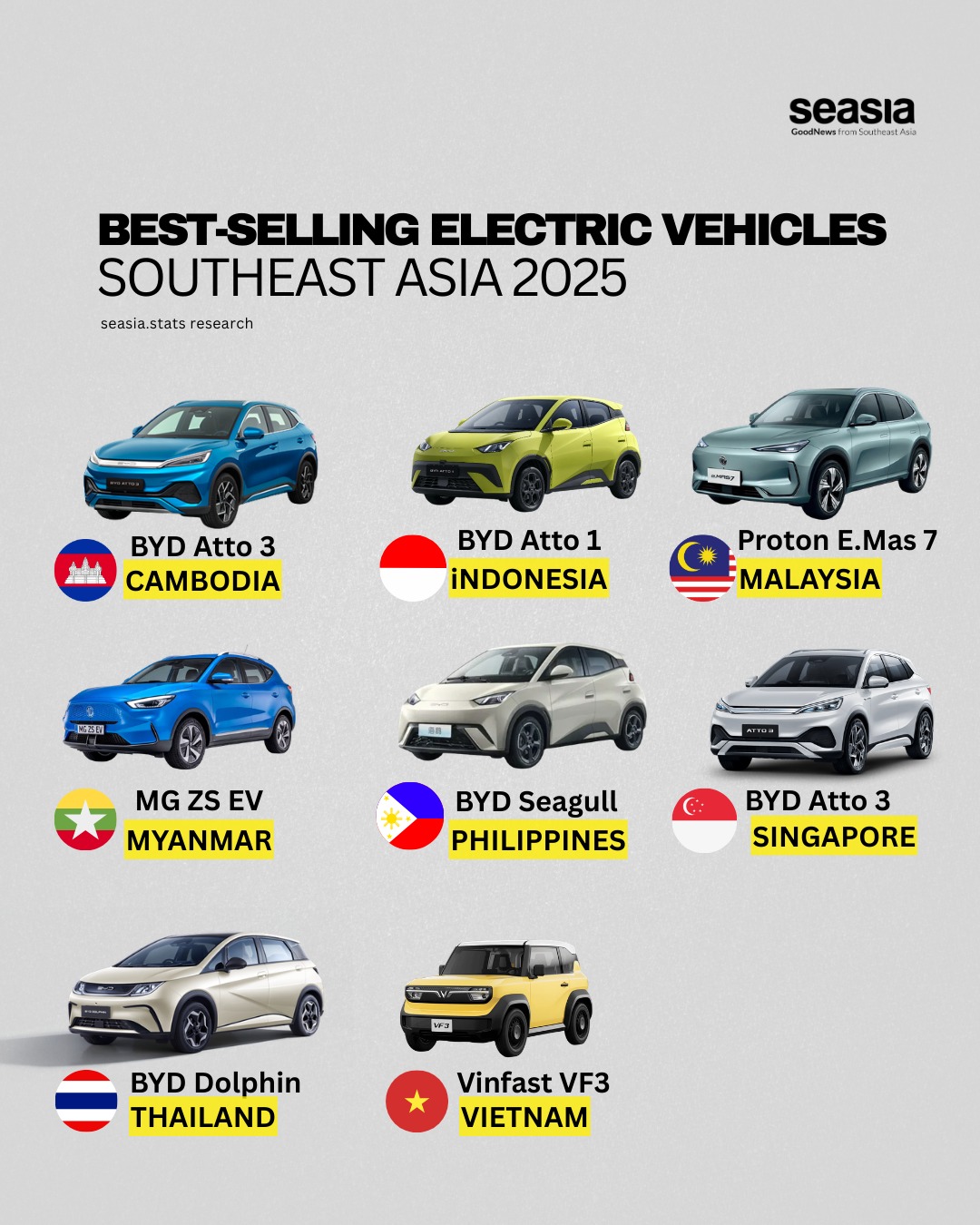
Indonesia’s EV market was led by the BYD Atto 1, known globally as the Seagull. This compact and affordable model dominated sales, at one point accounting for nearly 90% of BYD’s monthly deliveries in the country. Its success reflects Indonesia’s growing demand for budget-friendly EVs and its supportive policies, including VAT reductions and investment in domestic battery production.
In Malaysia, the Proton e.MAS 7 emerged as a national success story. As the country’s first home-grown EV, it topped sales charts for eight consecutive months, signaling strong consumer confidence in local innovation and manufacturing.
Thailand, widely considered Southeast Asia’s EV hub, saw the BYD Dolphin take the lead. The model’s balance of affordability, range, and modern design made it a favorite among Thai consumers, supported by the government’s “30@30” policy to boost EV production and adoption.
Vietnam showcased the strength of its domestic brand, VinFast. The compact VF3 became a standout model as the company delivered over 175,000 EVs in 2025, breaking national records and establishing Vietnam as a rising EV powerhouse.
Elsewhere, the BYD Atto 3 topped sales in both Cambodia and Singapore, while the MG ZS EV led in Myanmar. In the Philippines, the BYD Seagull gained strong traction as an affordable entry-level EV, helping to widen access to electric mobility.
Southeast Asia’s Strategic EV Push
Each Southeast Asian country has adopted its own strategy to accelerate EV adoption. Indonesia has focused on building a complete EV ecosystem, leveraging its vast nickel reserves to develop battery production capabilities. Thailand has positioned itself as a regional manufacturing hub, attracting major Chinese automakers to establish production facilities.
Singapore has pursued a high-tech approach, combining strict emissions regulations with advanced charging infrastructure and incentives for EV ownership. Meanwhile, Vietnam has prioritized domestic innovation through VinFast, while Malaysia continues to support local industry development.
Even smaller markets such as Cambodia, Laos, and Brunei are gradually entering the EV space, signaling that the transition is spreading across the entire region.
The Road Ahead for Southeast Asia
The rise of best-selling EV models across Southeast Asia is more than just a market trend—it reflects a broader transformation in how the region approaches energy, transportation, and sustainability. With continued investment, policy support, and technological innovation, Southeast Asia is poised to become one of the world’s most dynamic electric mobility markets.
As consumers increasingly embrace electric vehicles for their affordability and environmental benefits, the roads of Southeast Asia are set to become cleaner, quieter, and more connected than ever before.


