

From bustling Southeast Asian port cities to modern Western metropolises, the Chinese diaspora has shaped economies, cultures, and urban life far beyond China’s borders. As of 2023, new population estimates highlight a striking reality: Southeast Asia—not North America or Europe—is home to the world’s largest overseas Chinese communities, reflecting centuries of migration driven by trade, labor, and regional connectivity.
Southeast Asia: The Historic Heart of the Chinese Diaspora
Long before modern nation-states existed, Chinese merchants and workers settled across Southeast Asia, integrating into local societies while maintaining cultural ties. Today, this legacy is reflected in population figures that dwarf Chinese communities elsewhere in the world.
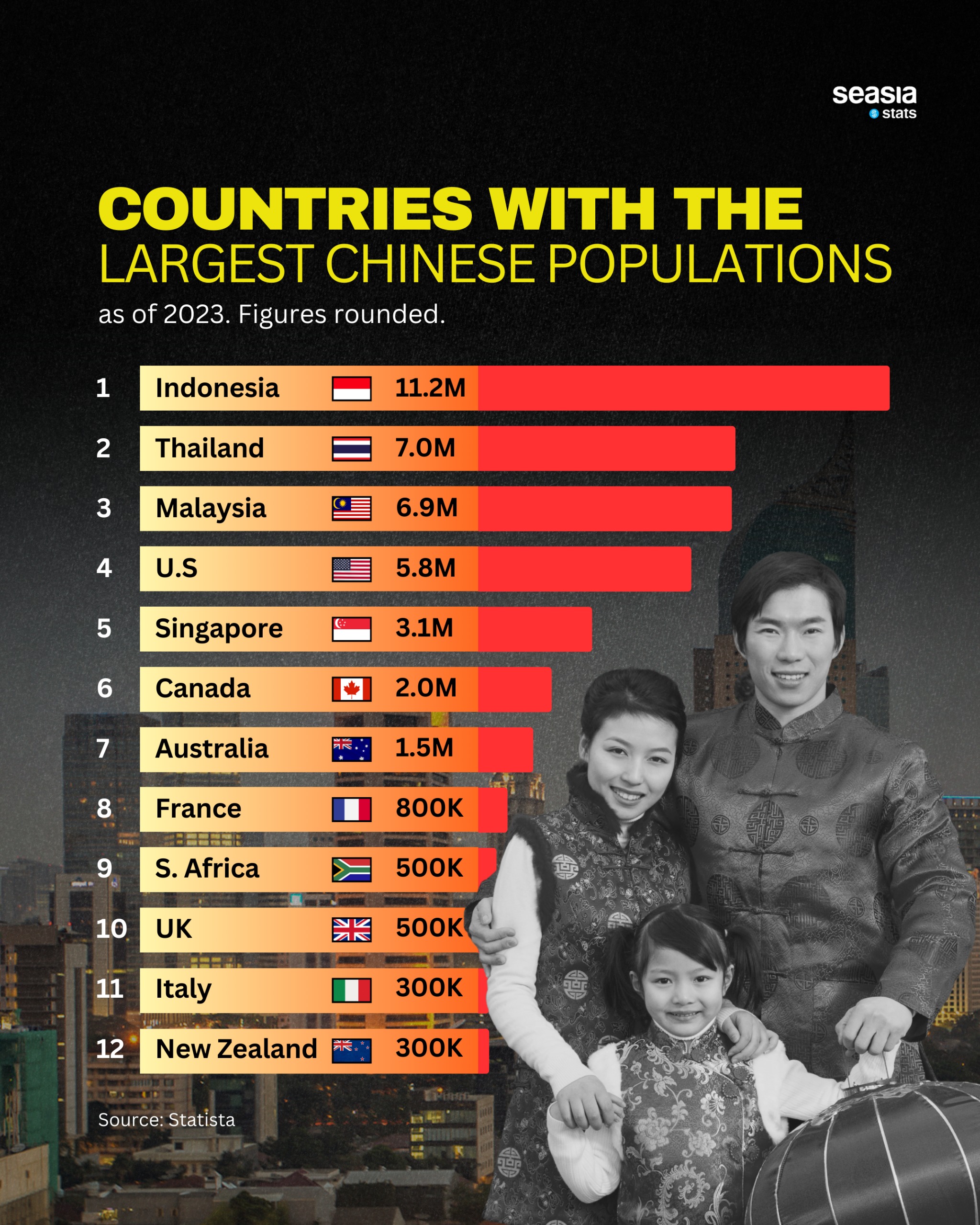
Indonesia ranks first globally, with an estimated 11.2 million people of Chinese descent, making it the largest overseas Chinese population anywhere. Despite representing a minority within Indonesia’s vast population, Chinese Indonesians have historically played an outsized role in commerce, finance, and urban development—particularly in cities like Jakarta, Surabaya, and Medan.
Thailand and Malaysia: Deep Integration, Lasting Influence
Close behind Indonesia are Thailand and Malaysia, with approximately 7.0 million and 6.9 million ethnic Chinese residents respectively.
In Thailand, Chinese descendants are deeply woven into the national identity. Many families have assimilated linguistically and culturally over generations, with broader ancestry-based estimates suggesting as many as 10 million Thais may have some Chinese heritage. This integration has produced a unique blend of Thai and Chinese traditions visible in business, cuisine, and politics.
Malaysia presents a different model. Ethnic Chinese make up roughly 22–23% of the population, forming a central pillar of the country’s multicultural framework alongside Malays and Indians. Chinese Malaysians have been instrumental in shaping the nation’s manufacturing, retail, and financial sectors, while maintaining strong linguistic and cultural institutions.
Singapore: A Majority-Chinese Nation
Singapore stands apart globally. With around 3.1 million ethnic Chinese residents, it is the only sovereign country outside China and Taiwan where ethnic Chinese form a clear majority, accounting for more than 75% of the population.
This demographic reality has profoundly influenced Singapore’s governance, language policy, and economic strategy, while the city-state maintains a carefully balanced multicultural identity that includes significant Malay and Indian minorities.
Beyond Southeast Asia: Global Migration Patterns
Outside Asia, the United States hosts the largest Chinese population, estimated at 5.8 million. Chinese Americans are concentrated in major metropolitan areas such as New York, Los Angeles, and San Francisco, reflecting both historical migration and recent professional inflows.
Other major destinations include Canada (around 2.0 million) and Australia (approximately 1.5 million), where immigration policies and educational opportunities have driven rapid growth since the late 20th century. These communities are relatively newer compared to Southeast Asia’s centuries-old settlements.
In Europe and beyond, notable Chinese populations also exist in France, the United Kingdom, Italy, South Africa, and New Zealand, though on a smaller scale.
A Diaspora Shaped by History—and the Future
What makes Southeast Asia unique is not just the size of its Chinese communities, but their longevity. Unlike migration waves driven primarily by modern globalization, Southeast Asia’s Chinese diaspora is rooted in pre-colonial trade networks, colonial-era labor flows, and post-independence nation-building.
Today, these communities continue to evolve—balancing cultural heritage with national identity. As China’s global influence grows and migration patterns shift once again, Southeast Asia’s Chinese populations remain a living reminder that globalization is not new—it has been unfolding for centuries, one port city at a time.


