

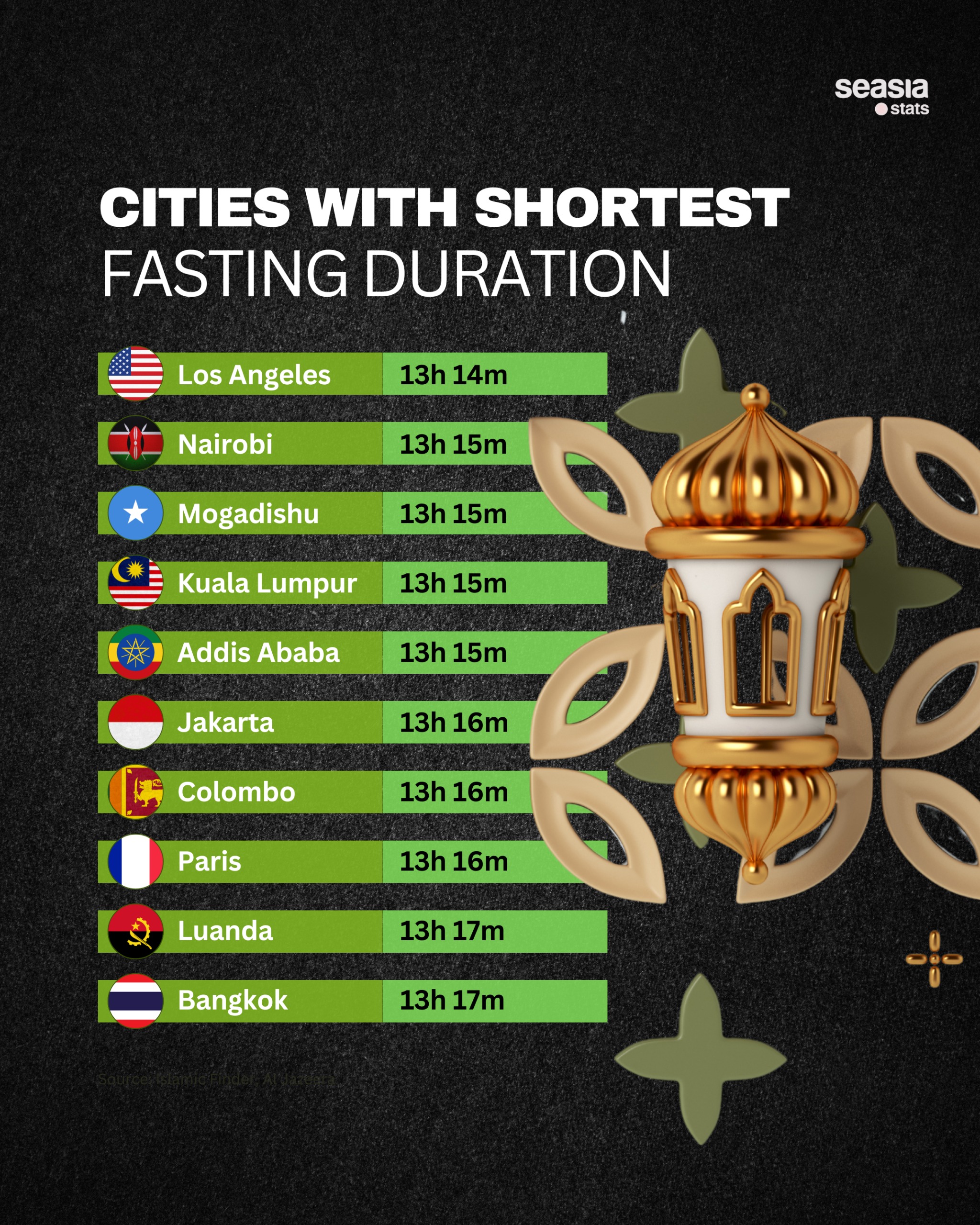
Across the Muslim world, the length of daily fasting during Ramadan varies from city to city, shaped by geography and the movement of the lunar calendar. In 2026, as Ramadan falls close to the spring equinox, fasting durations are relatively balanced worldwide—generally ranging between 12 and 15 hours. Yet even within this narrow window, a fascinating pattern emerges: cities closer to the equator enjoy some of the shortest and most consistent fasting times on Earth.
The Shortest Fasting Durations in 2026
According to Seasia Stats and Islamic Finder data, Los Angeles records the shortest fasting day among the highlighted cities in 2026 at 13 hours and 14 minutes. It is closely followed by Nairobi, Mogadishu, Kuala Lumpur, and Addis Ababa, all at approximately 13 hours and 15 minutes. Southeast Asia appears prominently in this list, with Kuala Lumpur, Jakarta, and Bangkok all ranking among the cities with the shortest fasting hours globally. Jakarta and Colombo record around 13 hours and 16 minutes, while Bangkok stands at roughly 13 hours and 17 minutes.
This cluster of Southeast Asian cities underscores a geographic advantage: their proximity to the equator ensures relatively stable daylight hours throughout the year, keeping fasting durations consistent regardless of the season. For Muslims in these regions, Ramadan observance is defined less by extreme daylight swings and more by a steady, predictable rhythm.
Why Geography Matters
Latitude is the single most important factor in determining fasting duration. Cities located near the equator—such as Jakarta, Kuala Lumpur, and Bangkok—experience nearly equal hours of daylight and darkness year-round. This means fasting durations remain close to 13 hours whether Ramadan falls in February, June, or November.
In contrast, cities further from the equator experience significant seasonal variation. In high-latitude locations like northern Europe or southern New Zealand, daylight hours can stretch dramatically in summer or shrink sharply in winter. Because Ramadan follows the lunar calendar and shifts earlier by about 10–11 days each year, fasting durations can fluctuate widely depending on the time of year in which the holy month falls.
In 2026, Ramadan begins around February 19, placing it near the transition between winter and spring in the Northern Hemisphere. This timing results in moderate fasting durations globally, avoiding the extremes seen during summer or winter Ramadan cycles.
Southeast Asia’s Consistent Ramadan Experience
Southeast Asia offers one of the most stable Ramadan experiences in the world. In Indonesia, Malaysia, Brunei, and southern Thailand, fasting times typically hover around 13 hours year after year. Even cities such as Manila and Ho Chi Minh City experience only minor variations, maintaining similar daylight patterns.
This consistency has helped shape Ramadan culture in the region. Evening iftar gatherings, night markets, and tarawih prayers follow predictable schedules, fostering strong communal traditions. From Jakarta’s bustling Ramadan bazaars to Kuala Lumpur’s vibrant mosque communities, the steady fasting duration allows social and spiritual life to flourish without the strain of extremely long daylight hours.
A Global Tapestry of Worship
Despite differences in fasting duration, Ramadan remains a shared spiritual journey for Muslims worldwide. Whether fasting 13 hours in Jakarta or up to 15 hours in higher-latitude cities, the essence of the holy month—reflection, discipline, generosity, and unity—remains constant.
The 2026 Ramadan calendar highlights how geography shapes daily routines, but also how it brings diversity to the global Muslim experience. From Southeast Asia’s equatorial balance to the shifting daylight of Europe and Africa, the rhythm of fasting reflects both the unity of faith and the richness of the world it spans.


