

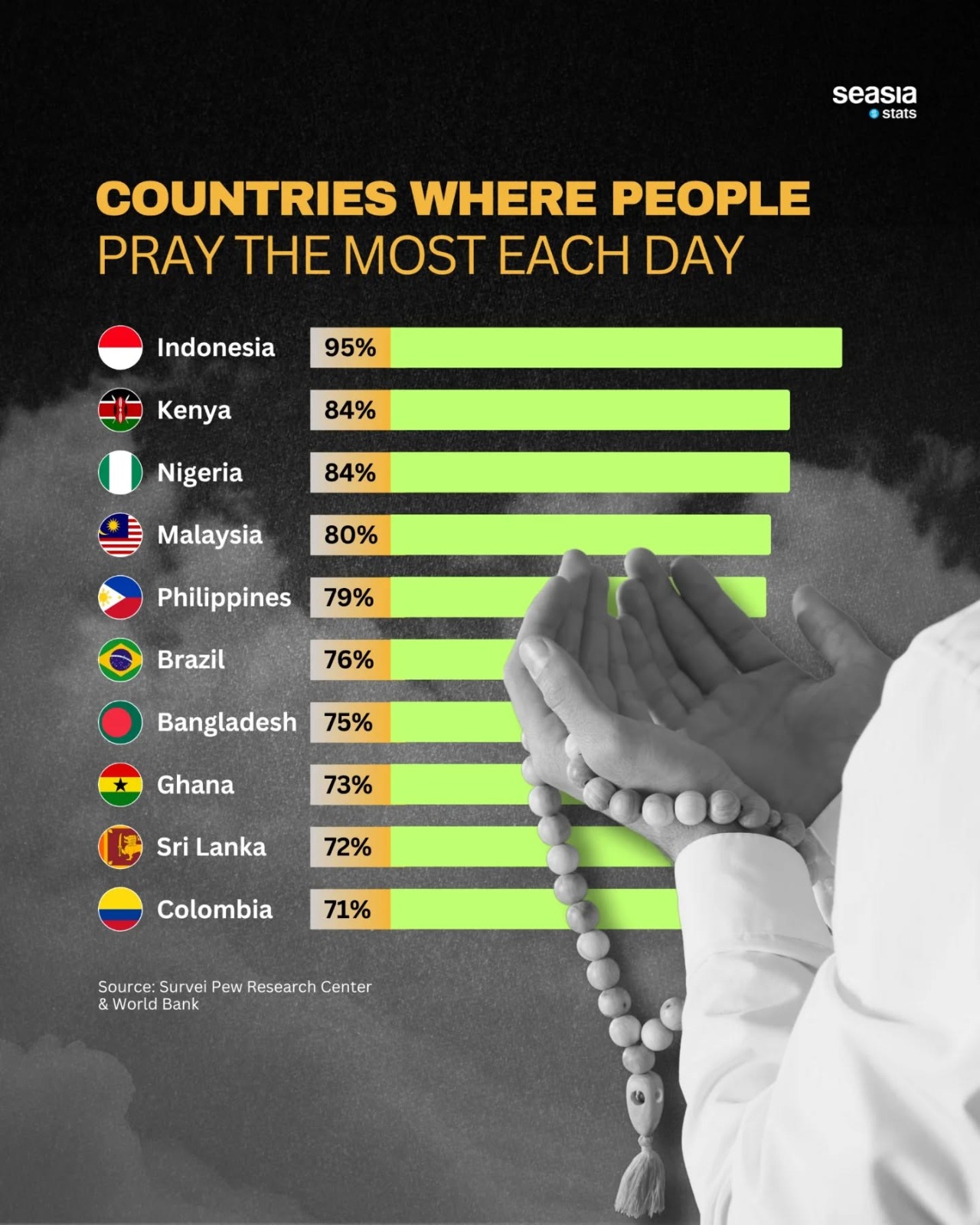
In an increasingly fast-paced and digitized world, spiritual practice remains a powerful constant for millions of people. Across continents and cultures, daily prayer continues to serve as a source of meaning, comfort, and discipline. According to recent data compiled by Pew Research Center and the World Bank and highlighted by Seasia Stats, some countries stand out for their exceptionally high rates of daily prayer—revealing how deeply faith is woven into everyday life.
Indonesia: The World’s Most Devout Daily Prayer Nation
At the very top of the global ranking is Indonesia, where an extraordinary 95% of the population reports praying every day. As the world’s largest Muslim-majority country, Indonesia’s daily rhythm is closely tied to religious practice—from the call to prayer echoing across cities and villages to communal worship during Ramadan and Friday congregations.
Yet Indonesia’s spiritual culture is not limited to Islam alone. The country’s pluralistic society—home to Christians, Hindus, Buddhists, and indigenous belief systems—also contributes to a broad culture of devotion. In Bali, daily offerings known as canang sari are placed outside homes and temples, while in eastern Indonesia, church services and household prayers remain central to community life.
Africa’s Strong Spiritual Core
Following Indonesia, Kenya and Nigeria share second place, each with 84% of their populations engaging in daily prayer. Both nations are characterized by vibrant religious landscapes where Christianity and Islam play central roles in social life.
In Nigeria, mosques and churches alike serve as vital centers of community, while in Kenya, faith-based institutions often play a key role in education and social services. Across both countries, prayer is not only a personal ritual but also a collective expression of identity and resilience.
Southeast Asia’s Deeply Rooted Faith Traditions
Southeast Asia emerges as one of the most spiritually active regions in the world. Malaysia ranks fourth globally, with 80% of its population praying daily, reflecting its strong Islamic traditions alongside vibrant Buddhist, Christian, and Hindu communities. Close behind is the Philippines at 79%, where Catholicism shapes much of daily life—from morning devotions to large-scale religious festivals.
Beyond the top five, other Southeast Asian nations also demonstrate high levels of religiosity. In Thailand, daily Buddhist rituals and temple visits remain part of routine life for many citizens. In Myanmar, almsgiving and meditation practices form the backbone of Theravada Buddhist devotion. In Vietnam and Cambodia, a blend of Buddhism, ancestor worship, and folk traditions ensures that spiritual rituals remain embedded in family life.
A Global Pattern of Devotion
The remainder of the top ten reflects a broad global spread of faith. Brazil ranks sixth at 76%, followed by Bangladesh (75%), Ghana (73%), Sri Lanka (72%), and Colombia (71%). These countries represent diverse religious traditions—from Catholicism in Latin America to Islam in South Asia and Buddhism in Sri Lanka—yet all share a common thread of daily spiritual engagement.
What unites these nations is the role of prayer as both a personal and social anchor. In many cases, religious institutions provide not only spiritual guidance but also community support, education, and social services.
Faith in a Changing World
The persistence of daily prayer across such diverse regions highlights an important truth: even in an era defined by rapid modernization, spirituality continues to offer meaning and structure to everyday life. In Southeast Asia especially, religion is not confined to private spaces—it shapes public life, cultural identity, and social cohesion.
As societies continue to evolve, these traditions of daily devotion remain a powerful reminder of the enduring role of faith in human life—bridging generations, cultures, and nations through a shared sense of purpose and belief.


