

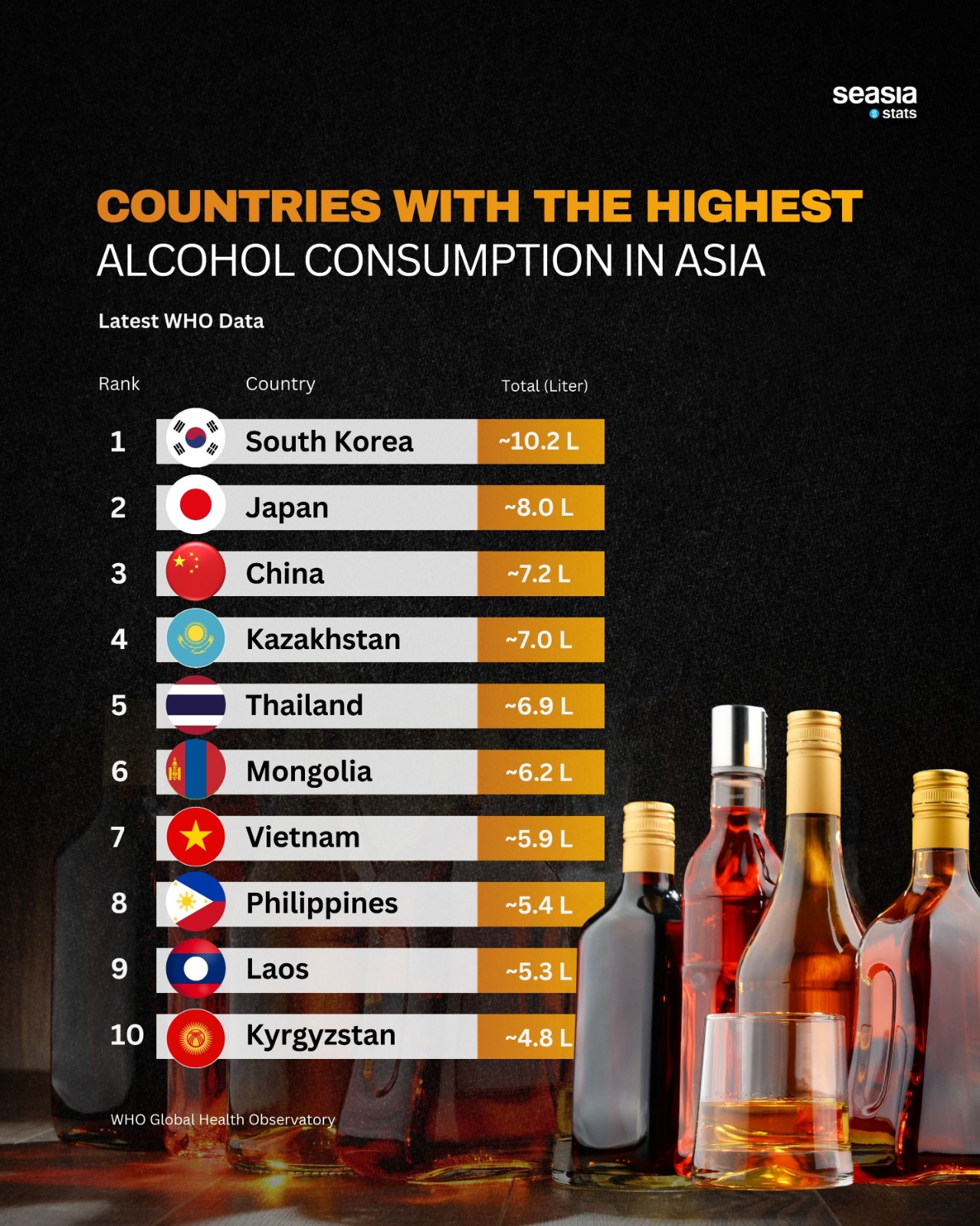
Alcohol is one of those statistics that reveals more than a drinking habit. It often tells a story about work culture, social rituals, urban life, disposable income, and public health all at once. The latest WHO data, as presented by Seasia Stats, shows that South Korea leads Asia in alcohol consumption at roughly 10.2 liters per person, followed by Japan at 8.0 liters and China at 7.2 liters. But beyond the headline numbers, the list also says something important about how drinking is woven into everyday life across different parts of the continent.
East Asia’s Long-Standing Drinking Culture
South Korea’s place at the top will not surprise many observers. Drinking there has long been tied to social bonding, office hierarchy, and after-hours culture. Soju, beer, and mixed drinks are not simply beverages in South Korea—they are part of the social script. Reuters noted in a 2024 report that while alcohol consumption in South Korea has fallen from earlier peaks, the country’s hard-drinking culture remains deeply embedded, even as younger generations begin to shift away from it.
Japan follows a similar pattern, though often with a more restrained public image. From izakaya culture to after-work nomikai gatherings, alcohol remains central to social and professional life. China’s position in third reflects both scale and diversity: a vast market where drinking customs vary enormously between regions, generations, and occasions, but where alcohol still plays a major role in hospitality, celebration, and business etiquette.
Southeast Asia’s Strong Presence on the List
What stands out most for regional readers is Southeast Asia’s heavy representation. Thailand, Vietnam, the Philippines, and Laos all appear in the top ten, showing that alcohol consumption in Southeast Asia is not a marginal issue but a major social and economic one.
Thailand ranks fifth at around 6.9 liters per person, a figure that reflects both domestic consumption and the influence of tourism and nightlife. Yet Thailand’s relationship with alcohol is also shaped by regulation. Reuters recently reported on how election-period alcohol bans in Thailand disrupted bars and restaurants, underscoring just how intertwined alcohol sales are with hospitality and urban leisure.
Vietnam, in seventh place with roughly 5.9 liters, is perhaps the most fascinating case in Southeast Asia. Beer culture is deeply rooted in daily life, especially in cities like Hanoi and Ho Chi Minh City, where drinking often feels communal rather than exclusive. Reuters described Hanoi’s beloved bia hoi scene as one where “beer is king,” with locals gathering over fresh draft beer that is cheap, social, and almost ritualistic.
That cultural centrality is now colliding with public health policy. Vietnam’s parliament approved a gradual rise in alcohol taxes through 2031 in an effort to curb consumption, showing that governments in the region are increasingly aware of the long-term health and social costs.
What the Numbers Don’t Fully Show
The raw liters-per-person data can be revealing, but they do not capture everything. They do not distinguish between casual drinking and binge drinking, between urban nightlife and rural tradition, or between social drinking and dependency. Nor do they show how gender, age, religion, and income shape who drinks and how often.
That matters especially in Southeast Asia, where drinking culture varies sharply even within the same country. In the Philippines, for instance, alcohol is often linked to celebration, family gatherings, and neighborhood social life. In Laos and parts of mainland Southeast Asia, local rice spirits and communal drinking traditions remain important in both daily life and ceremony.
A Public Health and Cultural Story
In the end, this ranking is not simply about who drinks the most. It is about the intersection of culture and consequence. Alcohol can be a marker of conviviality, but also of policy gaps, health risks, and changing lifestyles.
And for Southeast Asia, the takeaway is clear: the region is not only rising economically and culturally, but also facing the same modern questions many developed societies already confront—how to balance freedom, tradition, nightlife, and public health in a rapidly changing world.


