

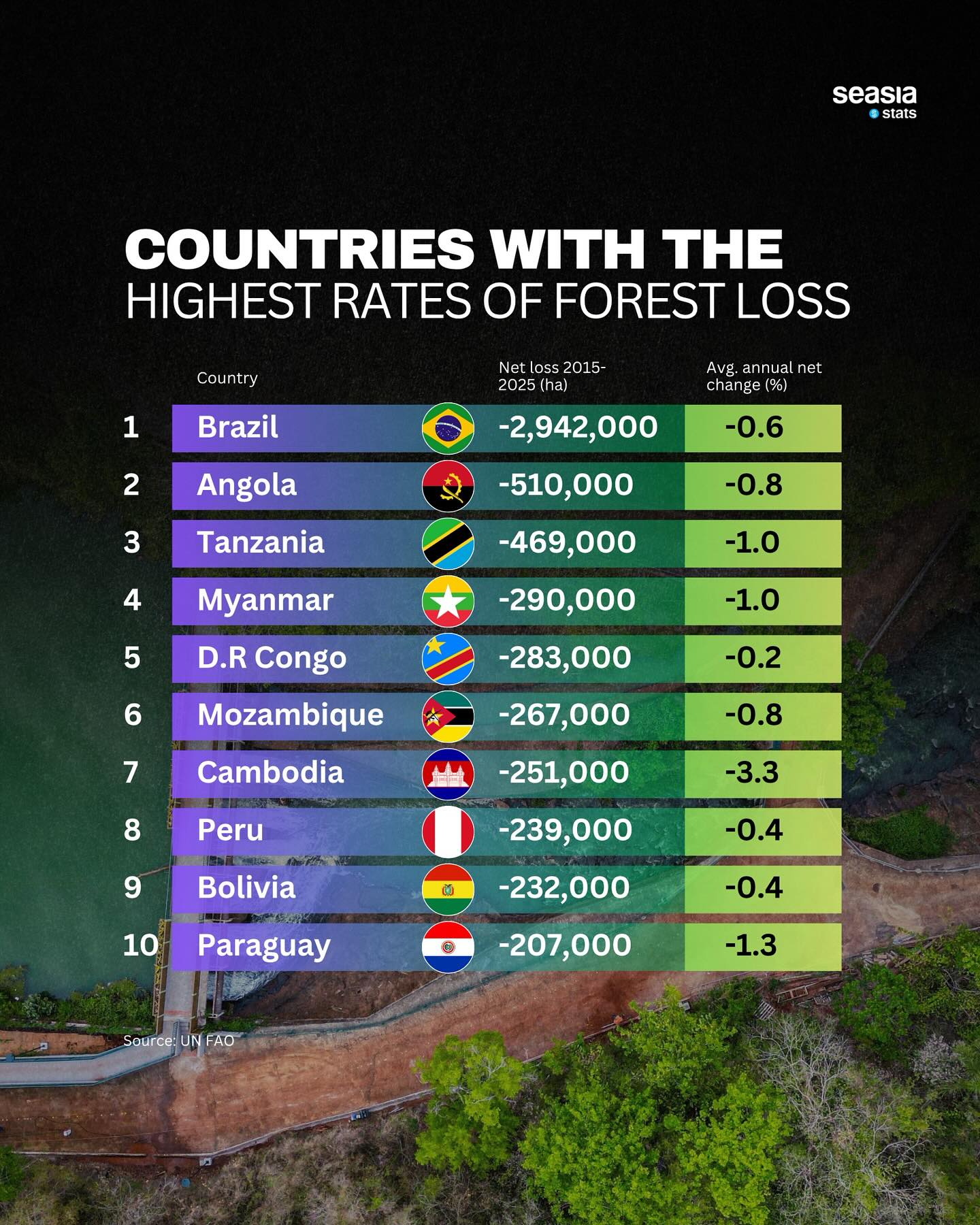
The latest data from the UN FAO reveals alarming levels of forest loss across several countries, with Brazil experiencing by far the greatest net loss between 2015 and 2025 at 2.94 million hectares. This significant decline is tied to continued deforestation in the Amazon, largely driven by agricultural expansion and illegal logging. Angola follows in second place with 510,000 hectares lost, while Tanzania, in third, has recorded a net loss of 469,000 hectares, both countries impacted by land clearing, shifting agriculture, and fuelwood demand.
Other nations across Africa, Asia, and South America also face critical levels of forest reduction. Countries like Myanmar and Mozambique report losses of around 290,000–267,000 hectares, while the Democratic Republic of Congo, despite having one of the world’s largest tropical forests, has lost 283,000 hectares. In South America, Peru, Bolivia, and Paraguay are also among the top ten, driven by mining, cattle ranching, and infrastructure expansion. Notably, Cambodia shows one of the highest annual net change rates at –3.3%, reflecting rapid and ongoing forest degradation.
This trend has serious implications for global biodiversity, climate resilience, and local communities. In Southeast Asia, countries like Myanmar and Cambodia are facing increasing pressure as deforestation threatens ecosystems connected to major cities such as Yangon and Phnom Penh. These urban centers rely on surrounding forests for climate stability, water resources, and ecological balance. As regional economies grow, balancing development with conservation remains crucial to protecting the natural environments that sustain millions of people across Asia and beyond.


