

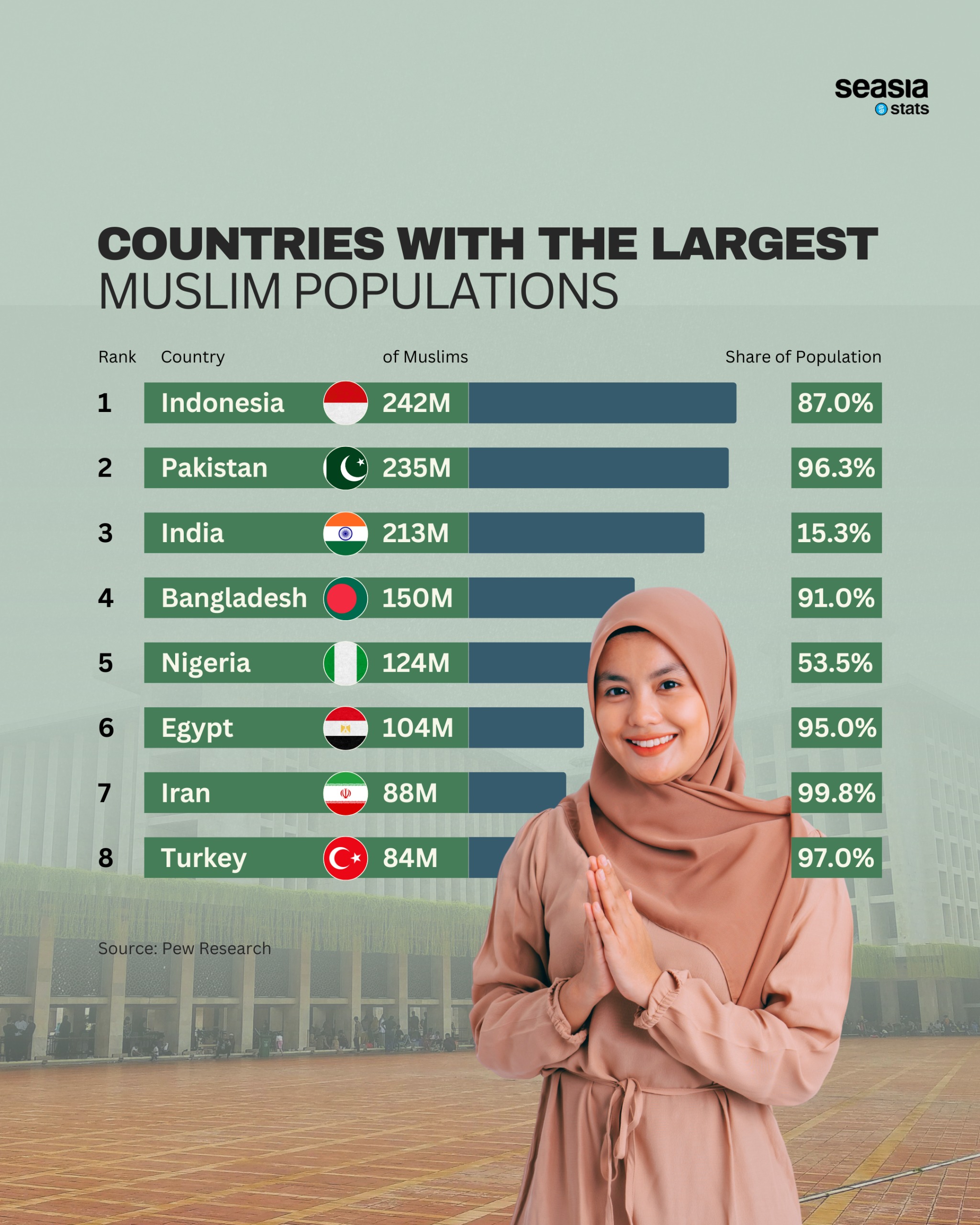
Across continents and cultures, Islam is one of the world’s most widespread religions, with nearly two billion adherents globally. Yet the demographic center of this global community is not in the Middle East, as many assume—but firmly rooted in South and Southeast Asia. Recent estimates from the Pew Research Center and updated 2025–2026 demographic studies show that the world’s largest Muslim populations are concentrated in this vast region, reflecting centuries of history, migration, and cultural exchange.
Indonesia Leads the World
Indonesia continues to hold its long-standing position as the country with the largest Muslim population in the world. With an estimated 242 million Muslims, the faith represents about 87% of the national population. From Aceh to Java and beyond, Islam is deeply woven into daily life, local traditions, and national identity.
As the world’s largest Muslim-majority democracy, Indonesia also represents a unique model of religious pluralism and civic coexistence. Its scale and diversity make it one of the most influential Muslim societies globally—both culturally and politically.
South Asia’s Giant Muslim Communities
Close behind Indonesia is Pakistan, home to roughly 235–240 million Muslims, accounting for about 96.3% of its population. Pakistan’s rapid population growth means that it could soon surpass Indonesia as the world’s largest Muslim country by total numbers.
India ranks third globally with around 213 million Muslims. Although they represent about 15.3% of India’s population, this still makes Indian Muslims one of the largest Muslim communities in any single country on Earth—larger than the total populations of many Muslim-majority nations.
Bangladesh follows in fourth place with 150 million Muslims, representing over 91% of its population, further reinforcing South Asia’s central role in shaping the global Muslim demographic landscape.
Africa and the Middle East’s Major Contributors
Outside Asia, Nigeria stands as Africa’s largest Muslim nation with approximately 124 million Muslims, making up 53.5% of its population. Meanwhile, Egypt, Iran, and Turkey complete the top tier of Muslim-majority countries.
Egypt is home to 104 million Muslims, Iran to 88 million, and Turkey to 84 million, each with overwhelming Muslim majorities exceeding 95%. These nations remain central to Islamic scholarship, politics, and cultural heritage, even as population growth shifts the global balance eastward.
Southeast Asia’s Broader Muslim Landscape
Beyond Indonesia, Southeast Asia is home to several significant Muslim populations that further highlight the region’s importance. Malaysia, for example, has a Muslim majority of around 60%, while Brunei’s population is also predominantly Muslim. In the southern Philippines, particularly in Mindanao, millions of Muslims form a vibrant and historically rooted community. Thailand and Myanmar also host long-standing Muslim minorities that contribute to the region’s cultural diversity.
Collectively, Southeast Asia plays a critical role not only in population numbers but also in shaping modern Islamic identity in a multicultural and multi-religious environment.
A Global Faith with an Asian Center of Gravity
Across continents and cultures, Islam is one of the world’s most widespread religions, with nearly two billion adherents globally.Across continents and cultures, Islam is one of the world’s most widespread religions, with nearly two billion adherents globally.


