

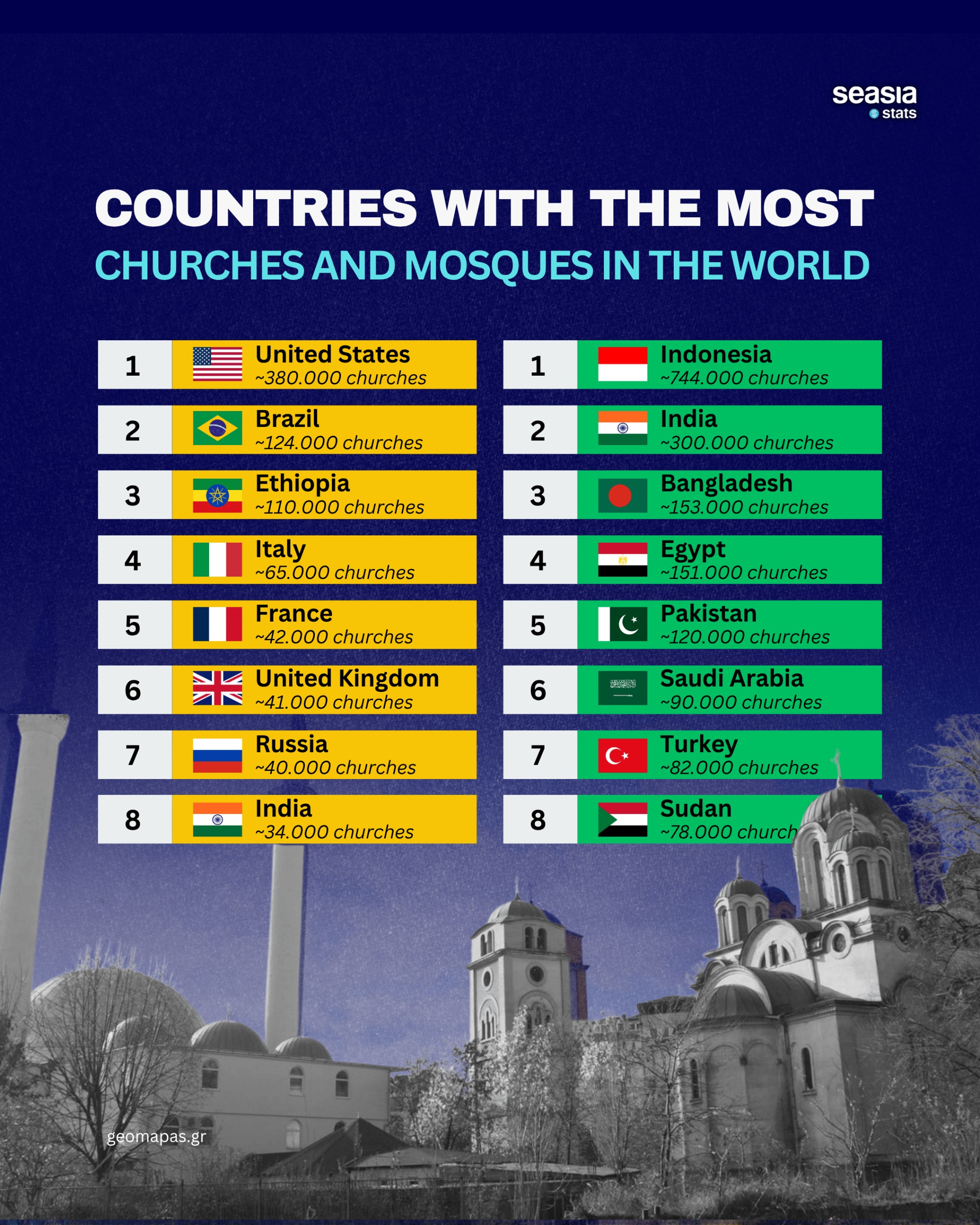
Places of worship are more than just buildings. They are memory, routine, identity, and community made visible in concrete, brick, stone, and sound. The Seasia Stats infographic, citing broad global estimates, offers a striking snapshot of where churches and mosques are most concentrated—and it reveals something deeper than architecture. It shows where faith remains deeply woven into everyday life, and nowhere is that more evident than in Southeast Asia.
Where faith takes physical form
On the church side, the United States sits at the top with an estimated 380,000 churches, followed by Brazil and Ethiopia. That ranking reflects both religious history and the scale of Christian populations in those countries. In Brazil, for example, the extraordinary rise of Pentecostal and evangelical Christianity has transformed the urban and suburban landscape over the last few decades, with churches multiplying across neighborhoods and city blocks. Pew Research has noted that Brazil’s Protestant population grew rapidly in the modern era, helping explain why so many worship spaces exist there.
But the mosque ranking tells an equally powerful story—and this is where Asia, especially Muslim Asia, becomes central. Indonesia stands far ahead with an estimated 744,000 mosques, followed by India at roughly 300,000 and Bangladesh at around 153,000. These are not just numbers. They reflect how religious life is structured around locality. In many Muslim-majority societies, the mosque is not simply a Friday destination; it is often a neighborhood institution, a place for daily prayer, Quran recitation, charity, and social gathering.
Indonesia’s extraordinary religious landscape
Indonesia’s place at the top of the mosque list feels almost inevitable. It is the world’s largest Muslim-majority country, but numbers alone do not explain the density of its religious infrastructure. What makes Indonesia distinctive is how religion is embedded into community life at the neighborhood level. In many towns and kampungs, a mosque or musholla is within walking distance of almost every household.
That aligns with broader findings about religiosity in the region. Pew Research found that religion is “very important” in the lives of overwhelming majorities in Indonesia and Malaysia, and that daily prayer among Muslims is especially common in Indonesia. That helps explain why the country’s physical religious footprint is so vast: the architecture follows the practice.
For Southeast Asia, Indonesia is not an outlier so much as a regional anchor. Malaysia, southern Thailand, Brunei, and parts of the southern Philippines also have deeply rooted Islamic public life, even if they do not appear on this particular mosque ranking. Across the archipelago and peninsula, the mosque is often as much a civic landmark as a religious one.
Southeast Asia’s quieter church story
What the chart does not fully show is Southeast Asia’s Christian geography, which is also significant. The Philippines, while absent from the church top eight in this graphic, is one of the largest Christian nations in Asia and has one of the most visible church-centered public cultures in the world. Timor-Leste, too, is intensely Catholic. In Indonesia itself, Christian communities remain highly visible in places like North Sulawesi, East Nusa Tenggara, Papua, and parts of Maluku.
That matters because Southeast Asia is not defined by one religious architecture alone. It is one of the few regions where mosques, churches, temples, shrines, and monasteries all shape public space in meaningful ways. Pew described Singapore as among the world’s most religiously diverse countries, while also finding that several Southeast Asian societies strongly connect faith with national and cultural identity.
More than numbers on a map
Of course, raw counts should always be treated carefully. Definitions vary. A “church” may mean a cathedral, a parish, or a storefront congregation. A “mosque” may range from a grand national mosque to a small neighborhood prayer hall. So the infographic is best read not as a perfect census, but as a broad portrait of where worship remains highly visible in public life.
And that may be the real takeaway. These buildings are not just religious infrastructure. They are signs of how people organize belonging. In a world that often talks about secularization, these numbers suggest something else: in many countries—especially across Southeast Asia—faith is still not retreating. It is still being built, one neighborhood at a time.


