

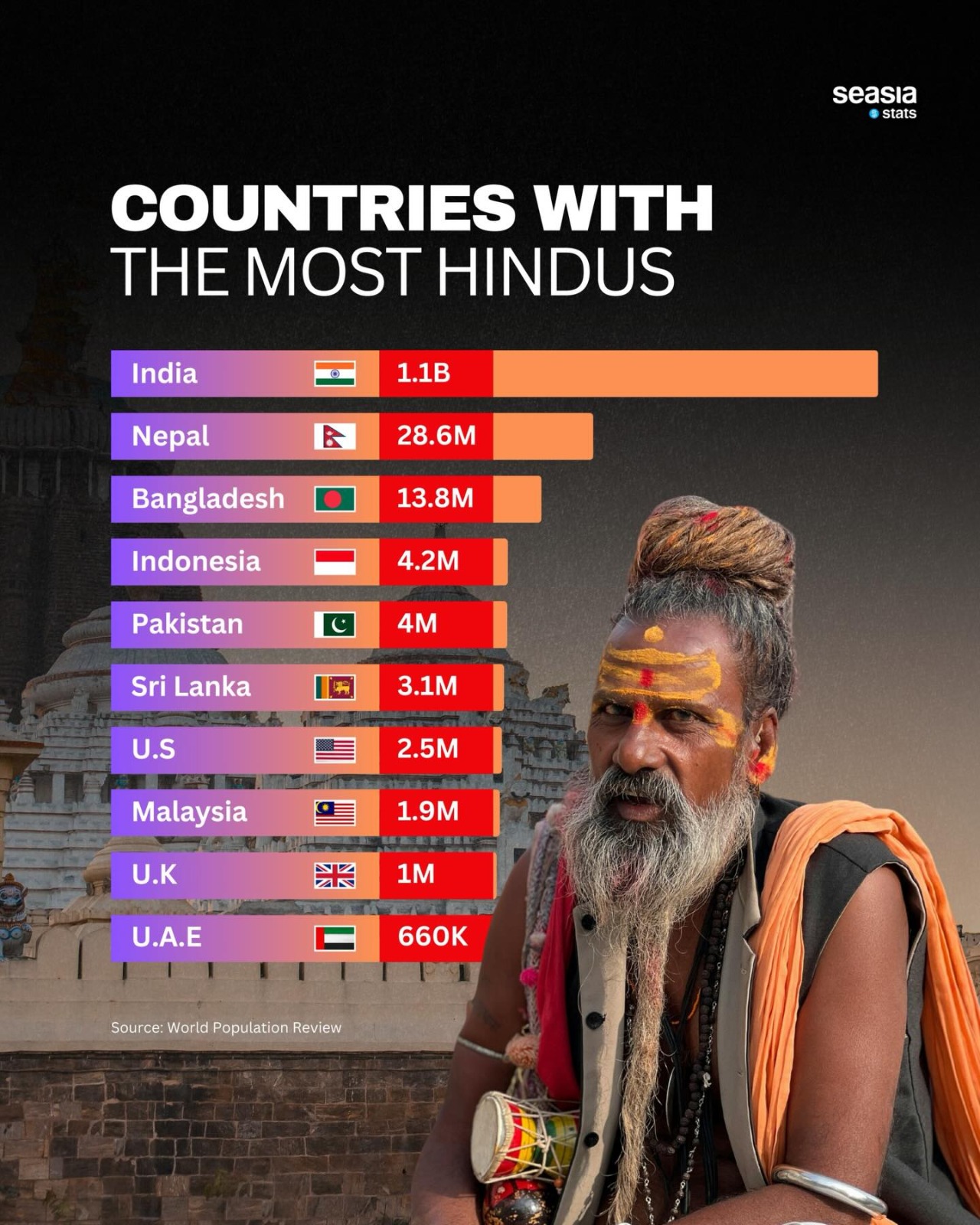
Across continents and cultures, Hinduism continues to shape communities, traditions, and identities on a remarkable global scale. With an estimated 1.2 billion followers worldwide, it stands as the world’s third-largest religion—deeply rooted in South Asia yet increasingly visible across Southeast Asia and the global diaspora. Recent figures from Seasia Stats and World Population Review highlight where Hindu communities are most concentrated and how their presence continues to evolve in the modern world.
India: The Spiritual Epicenter
At the heart of Hindu civilization lies India, home to around 1.1 billion Hindus—roughly 94% of the global total. From the sacred Ganges River to ancient temple cities like Varanasi and Madurai, India remains the primary center of Hindu philosophy, ritual, and pilgrimage. Festivals such as Diwali, Holi, and Navaratri are not only religious observances but also national celebrations that define cultural identity across the country.
India’s central role ensures that its traditions continue to influence Hindu communities worldwide. The country’s vast religious institutions, scholars, and spiritual leaders also serve as key references for global Hindu practices.
Nepal and South Asia’s Core Communities
Beyond India, Nepal stands as the only other country where Hinduism is the clear majority faith, with about 28.6 million followers representing over 80% of the population. Temples like Pashupatinath in Kathmandu symbolize the country’s enduring devotion and cultural connection to Hindu traditions.
Other South Asian nations also host significant Hindu populations. Bangladesh is home to approximately 13.8 million Hindus, while Pakistan has around 4 million, many of whom maintain ancient traditions despite being minorities. Sri Lanka’s 3.1 million Hindus—primarily Tamil communities—continue to preserve a vibrant temple culture centered in the northern and eastern regions of the island.
Southeast Asia’s Living Traditions
Southeast Asia plays a unique role in the global Hindu story, where the religion blends with local cultures and histories. Indonesia, with 4.2 million Hindus, stands out as the largest Hindu population outside South Asia. On the island of Bali, more than 80% of residents practice Balinese Hinduism, a distinctive form that integrates animist and Buddhist elements. Temples, daily offerings, and elaborate ceremonies are woven into everyday life.
Malaysia is another key hub, with around 1.9 million Hindus—largely from the Indian diaspora. Major festivals such as Thaipusam at Batu Caves attract millions of devotees and tourists annually, showcasing Southeast Asia’s dynamic Hindu presence.
Elsewhere in the region, smaller communities can be found in Singapore and Thailand, where Hindu temples serve as important cultural landmarks. These communities highlight how Southeast Asia has preserved and adapted Hindu traditions over centuries of trade, migration, and cultural exchange.
A Growing Global Diaspora
Modern migration has carried Hindu communities far beyond Asia. In the United States, approximately 2.5 million Hindus form one of the most highly educated and economically successful religious groups. The United Kingdom hosts around 1 million Hindus, many with roots in India, East Africa, and the Caribbean, reflecting the legacy of the British Empire.
The Gulf region also plays a major role in the modern Hindu diaspora. The United Arab Emirates is home to about 660,000 Hindus, largely expatriate workers and professionals contributing to the region’s economy. New temples in Dubai and Abu Dhabi reflect the growing recognition of these communities.
A Faith That Transcends Borders
From the ghats of India to the temples of Bali and the diaspora communities of London and New York, Hinduism today is both deeply traditional and globally connected. Its spread reflects centuries of migration, trade, and cultural exchange, especially across Southeast Asia where ancient links continue to shape modern identities.
As globalization accelerates, Hindu communities are becoming more visible and interconnected than ever before. Whether in South Asia’s sacred heartlands or Southeast Asia’s cultural crossroads, the faith continues to thrive—adapting to new environments while preserving its timeless spiritual heritage.


