

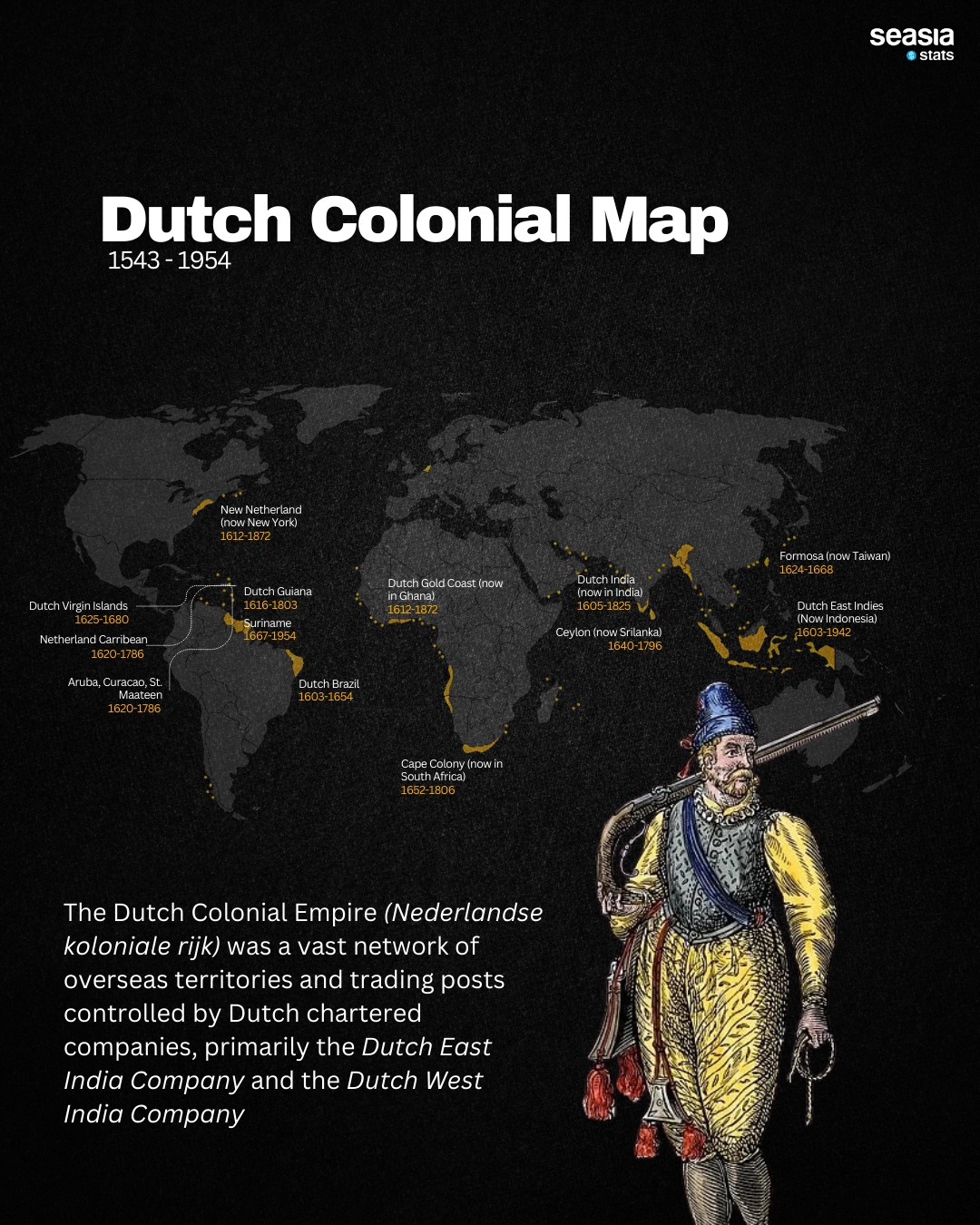
The Dutch Colonial Empire (Nederlandse koloniale rijk) spanned several centuries, shaped by Dutch chartered companies such as the Dutch East India Company and the Dutch West India Company. Initially, it operated as a trade-based system, deriving influence from merchant enterprise and control over international maritime routes. Unlike other empires that sought vast territorial conquests, the Dutch approach centered on strategically positioned coastal forts, factories, and port settlements. These outposts facilitated commerce rather than territorial dominance. The Dutch were early empire-builders, leveraging their shipping industry to monopolize key trade routes worldwide. Their overseas holdings primarily consisted of coastal enclaves, reflecting their commercial focus.
.
Among these holdings, the Dutch East Indies (now Indonesia) stood out as the crown jewel. This vast archipelago was rich in resources, including spices, coffee, tea, and precious metals. The Dutch established a robust presence, controlling major ports like Batavia (now Jakarta) and Surabaya. The lucrative spice trade, particularly nutmeg and cloves, fueled the empire’s prosperity. The Dutch East Indies became a vital hub for global commerce, connecting Europe to Asia. Plantations flourished, producing commodities like sugar, tobacco, and rubber. The colony’s significance extended beyond economics—it shaped Dutch culture, language, and even cuisine. The legacy of the Dutch East Indies remains deeply intertwined with Indonesia’s history and identity, By the 19th century, the Dutch Colonial Empire faced challenges, including nationalist movements and pressure for independence. World War II accelerated change, and in 1945, Indonesia finally gained sovereignty after a long struggle. The Dutch East Indies, with its diverse population and complex social fabric, left an indelible mark on both nations. The empire’s legacy includes architectural remnants, cultural exchanges, and shared memories. While the Dutch Colonial Empire had other holdings across the globe, none rivaled the Dutch East Indies in terms of economic impact, cultural fusion, and historical significance.


