

Asia’s roads are quietly undergoing a revolution. From the Himalayan foothills to the bustling megacities of Southeast Asia, electric vehicles (EVs) are no longer a futuristic concept—they are rapidly becoming the new normal. As governments push for cleaner air and energy independence, 2025 has emerged as a turning point for EV adoption across the region.
A Surprising Leader in the Himalayas
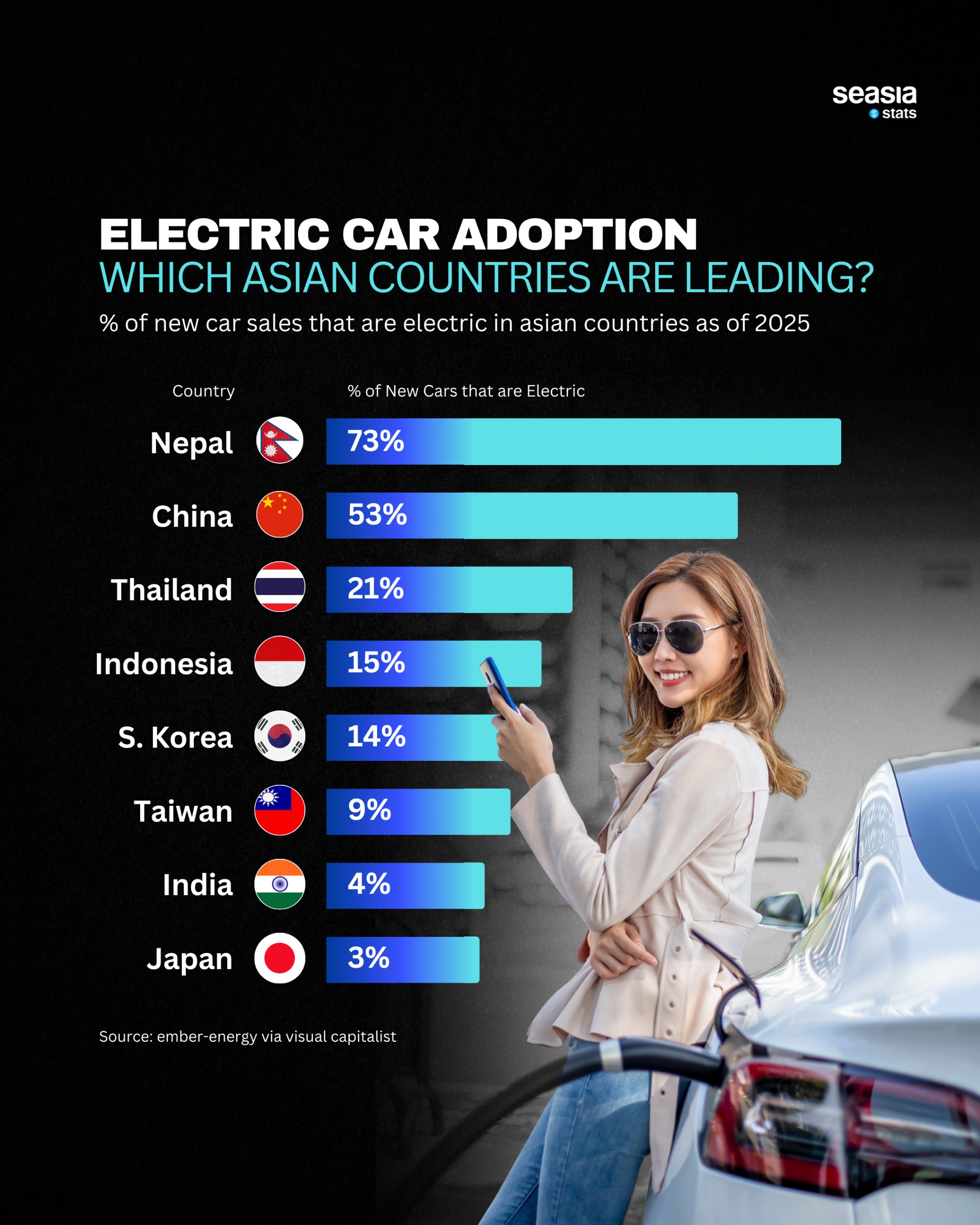
One of the most unexpected leaders in Asia’s EV race is Nepal. According to data from Ember Energy and Visual Capitalist, electric vehicles now account for an astonishing 73% of new car sales in the country. This remarkable shift is driven by Nepal’s abundant, low-cost hydroelectric power and policies that make EV imports far cheaper than fossil-fuel alternatives.
This combination has created one of the most favorable EV ecosystems in the world, proving that even smaller economies can leap ahead when policy, energy resources, and public demand align.
China’s Electrified Momentum
China, the world’s largest automotive market, remains a powerhouse in EV adoption. By 2025, electrified vehicles—including battery electric and plug-in hybrids—are expected to exceed 50% of all new passenger car sales. This milestone positions China as the first major economy where electric mobility becomes mainstream.
Beyond its domestic market, China’s influence extends across Asia through affordable EV exports and manufacturing investments. Chinese brands are increasingly visible on roads in Southeast Asia, helping to lower costs and accelerate adoption in emerging markets.
Southeast Asia’s Leapfrog Moment
Southeast Asia is emerging as one of the most dynamic regions in the EV transition. Thailand and Indonesia are leading the charge, with EVs accounting for 21% and 15% of new car sales respectively.
Thailand’s progress is anchored in its ambitious “30@30” policy, which aims for 30% of domestic vehicle production to be electric by 2030. Government subsidies, tax incentives, and investment in charging infrastructure have helped make EVs more accessible to Thai consumers.
Indonesia, meanwhile, is leveraging its vast nickel reserves to build a domestic battery industry. Tax reductions, including VAT cuts for EV purchases, have further accelerated consumer uptake. Cities like Jakarta and Surabaya are already seeing a visible increase in electric cars and motorbikes on the streets.
Elsewhere in the region, Vietnam is expanding its EV ecosystem through domestic brands like VinFast, while Malaysia is investing in charging networks and import incentives. Singapore continues to push forward with strict emissions policies and long-term electrification targets, positioning itself as a regional innovation hub.
Mixed Progress Across Asia
Outside Southeast Asia, EV adoption shows a more varied picture. South Korea has reached 14% of new car sales, supported by strong domestic manufacturers and government incentives. Taiwan follows at 9%, while India’s market remains at 4% but is growing rapidly due to urban electrification policies and incentives for two-wheel EVs.
Japan, despite its leadership in hybrid technology, lags behind in full EV adoption at just 3%. Industry experts suggest that the country’s continued focus on hybrid systems has slowed its transition to fully electric mobility.
A Regional Shift Toward a Cleaner Future
Across Asia, the rise of EVs reflects more than just technological change—it signals a broader shift in how countries approach energy, transportation, and sustainability. From Nepal’s hydro-powered revolution to Southeast Asia’s industrial transformation, the region is rapidly redefining the future of mobility.
As infrastructure improves and costs continue to fall, electric vehicles are poised to become a central part of everyday life across Asia—driving the continent toward a cleaner, more sustainable future.


