

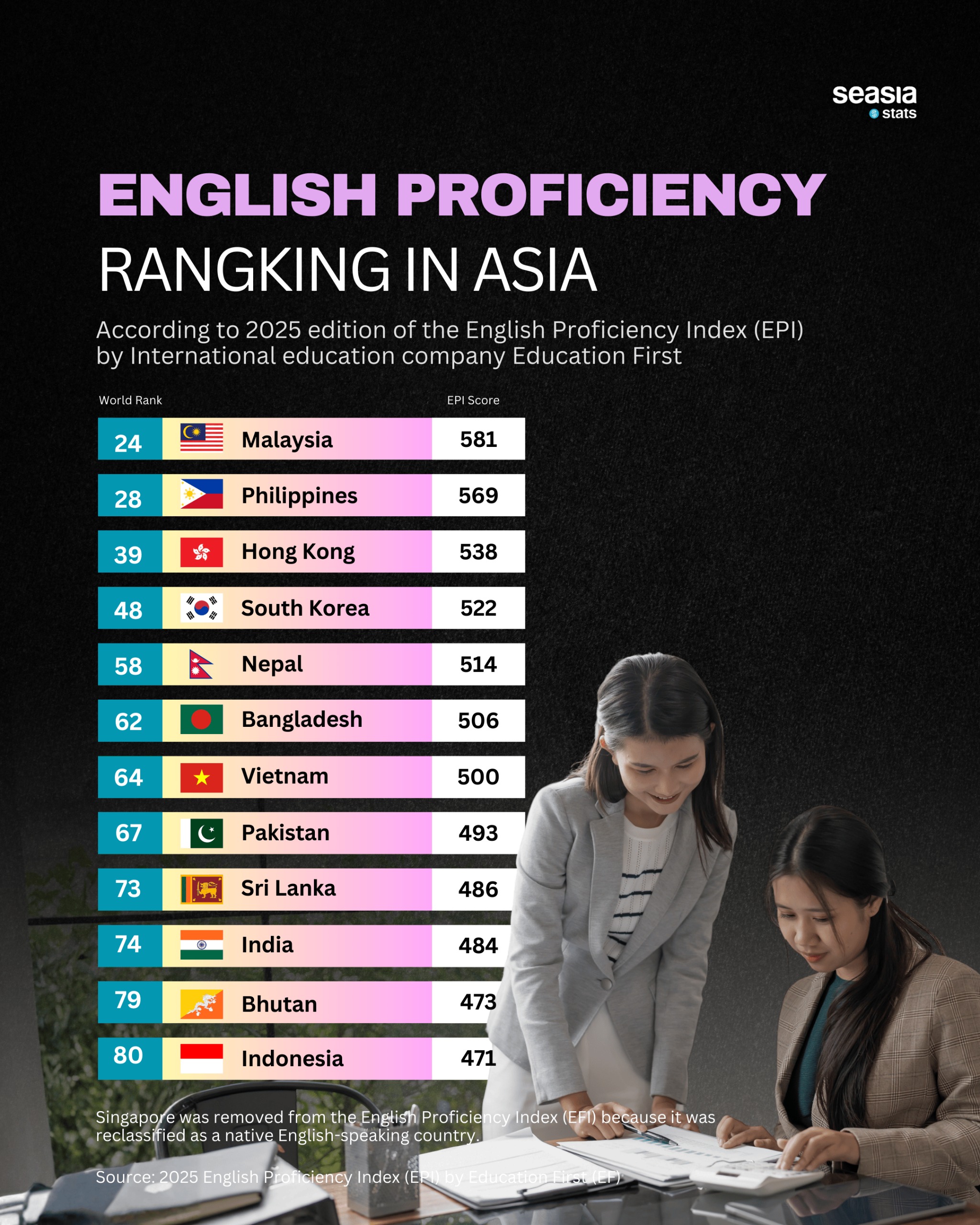
English in Asia is no longer just a classroom subject. It is a passport skill, a hiring advantage, a customer-service tool, and in many countries, a quiet marker of who gets access to global opportunities faster. The 2025 edition of the EF English Proficiency Index, highlighted by Seasia Stats, captures that reality clearly: English proficiency across Asia remains highly uneven, but Southeast Asia continues to punch above its weight.
Southeast Asia Holds Its Ground
Malaysia leads the Asian countries shown in the ranking with an EF EPI score of 581, placing 24th globally, followed by the Philippines at 569 and Hong Kong at 538. EF says its 2025 edition is based on test data from more than 2.2 million adults in 123 countries and regions, making it one of the broadest snapshots of adult English ability in the world.
That result is especially significant for Southeast Asia, where English often functions not as a replacement for national languages, but as a practical bridge across trade, tourism, education, aviation, and technology. In that sense, the region’s strongest performers are not simply “good at English.” They have built ecosystems where English has real economic value.
Malaysia’s position at the top of the Asian list reflects exactly that. Local coverage in The Star described Malaysians as leading Asia in English proficiency, noting the country’s improved score and strong performance in urban centers such as Kuala Lumpur.
Why Malaysia and the Philippines Keep Standing Out
Malaysia’s strength comes from a familiar formula: English remains deeply embedded in higher education, business, law, and corporate life, even while Bahasa Malaysia remains central to national identity. That balancing act is now being reinforced by policy. Earlier this year, Malaysia’s Human Resources Ministry said it wanted to promote English proficiency in the workforce without undermining the role of the national language—an approach that reflects how many multilingual societies in Southeast Asia now think about competitiveness.
The Philippines, meanwhile, continues to benefit from long-standing English usage in media, schooling, government, and especially the business process outsourcing sector. In the Philippine case, English is not just a prestige language; it is infrastructure. It powers call centers, remote work, international services, and migration pathways.
That matters even more in a world where communication is becoming more global and more immediate. As EF put it in launching the 2025 report, “English remains the world’s most widely shared language for international communication.” That line may sound obvious, but it still explains a lot about who is best positioned in an AI-driven and service-heavy economy.
Vietnam’s Momentum, Indonesia’s Challenge
Vietnam’s score of 500 puts it in the middle of the Asian pack shown here, but the bigger story is momentum. Vietnam has spent the last decade expanding its role in manufacturing, tech services, and international education, and English proficiency is becoming increasingly tied to those ambitions. In cities like Ho Chi Minh City and Hanoi, English is no longer confined to elite schools or tourism districts. It is becoming a practical workplace skill.
Indonesia, by contrast, lands lower on this list at 471. That should not be read too simplistically. Indonesia’s scale alone makes nationwide English advancement much harder than in smaller countries. A vast archipelago, regional inequality, uneven school quality, and differing local language environments all affect outcomes. But the challenge is clear: Southeast Asia’s largest economy cannot fully maximize its demographic and digital advantages without raising average English confidence, especially in speaking and professional communication.
The Singapore Exception
One of the most revealing details in this year’s discussion is that Singapore is absent—not because it performed poorly, but because it was reclassified by EF as a native English-speaking country in this context. That says a great deal about where Singapore now sits in Asia’s language landscape.
Its absence also changes the competitive picture for the rest of Southeast Asia. Without Singapore dominating the table, countries like Malaysia and the Philippines become more visible examples of how English can coexist with strong local linguistic identity.
More Than a Ranking
Ultimately, this is not just about who speaks the best English. It is about who is best prepared for a region where jobs, education, tourism, diplomacy, and digital life increasingly cross borders.
And in Asia today, Southeast Asia is proving that language can still be one of its most underrated competitive advantages.


