

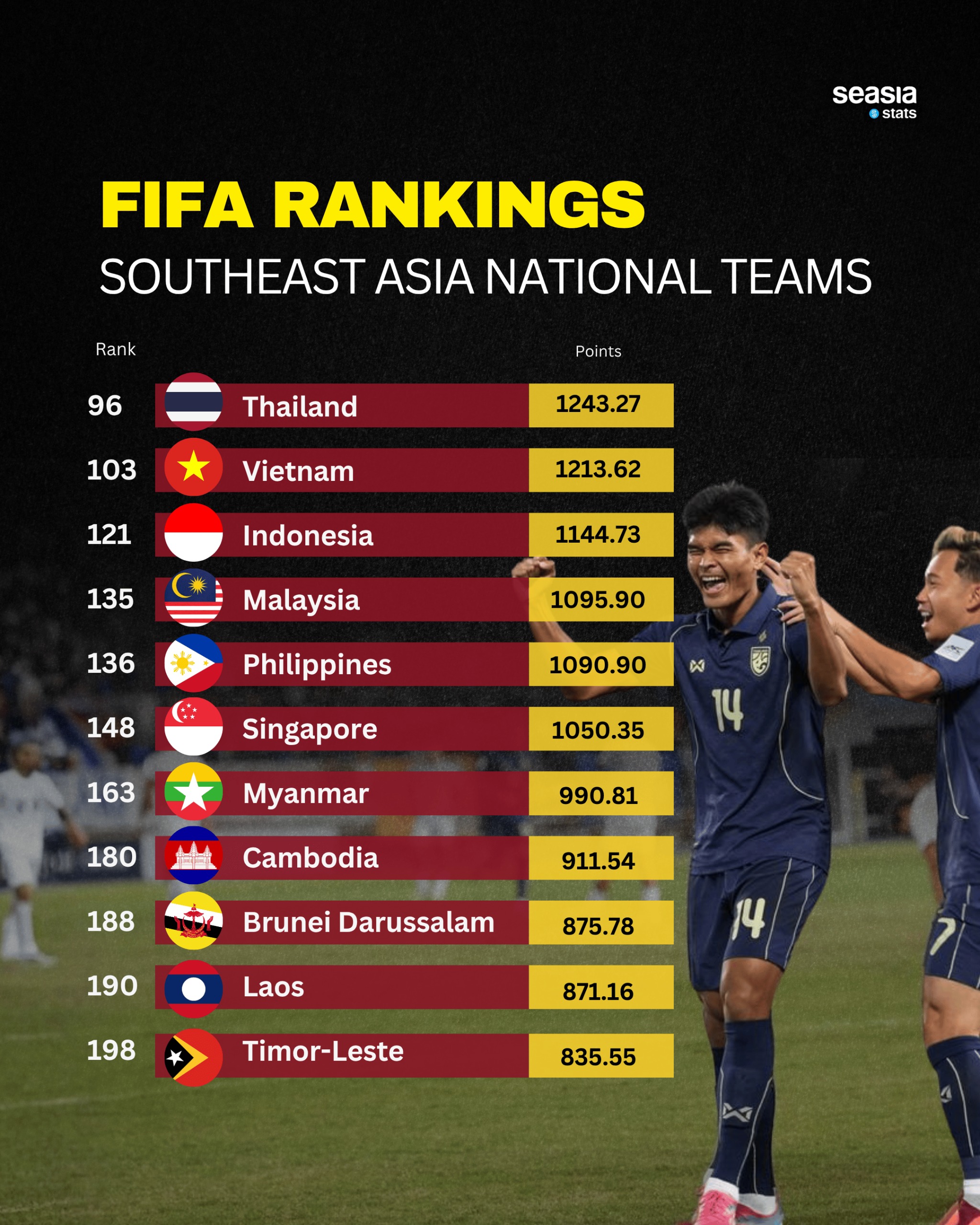
Southeast Asian football has long lived in the shadow of the continent’s heavyweights, but the latest FIFA Men’s World Rankings suggest the region is becoming harder to ignore. The numbers still show a clear gap between ASEAN and Asia’s elite, yet they also tell a more hopeful story: one of momentum, ambition, and a region increasingly serious about competing beyond its traditional limits.
Thailand still sets the pace
Thailand remains Southeast Asia’s highest-ranked men’s national team, sitting 96th in the world with 1,243.27 points. That standing confirms what many regional observers already know: when it comes to consistency, Thailand is still the benchmark. The country has built its football identity through a stronger domestic structure than many of its neighbors, a deeper player pool, and years of being the side others measure themselves against.
But Thailand’s lead no longer feels untouchable. The real story in the latest rankings is not just who sits on top, but how tightly the region’s upper tier is beginning to bunch together. Vietnam, now ranked 103rd with 1,213.62 points, has continued to look like one of the most disciplined and tactically coherent teams in Southeast Asia. Indonesia, in 121st with 1,144.73 points, remains one of the most watched football projects in the region, driven by massive public interest and growing institutional support.
Together, Thailand, Vietnam, and Indonesia now form a compelling regional trio—not yet Asian giants, but no longer easy to dismiss either.
Vietnam and Indonesia are changing the conversation
Vietnam’s rise over the past several years has not been accidental. It has come through youth development, tactical organization, and a national team culture that increasingly believes it belongs in bigger conversations. Indonesia, meanwhile, has become perhaps the most emotionally charged football story in Southeast Asia. The country’s fan culture is immense, its stadium atmosphere is among the most intense in Asia, and its football authorities have been trying to convert that passion into structure.
That ambition is now being matched by broader recognition. FIFA itself said Indonesian football has enjoyed “significant growth” and has even established a regional FIFA hub in Jakarta, underscoring how strategically important the country has become to the sport’s future in Asia.
For Southeast Asia, that matters. Indonesia’s rise is not just an Indonesian story. It signals that the region’s football ceiling may be higher than previously assumed.
The middle tier tells its own story
Below the leading three, the regional picture becomes more fragmented. Malaysia, ranked 135th, remains one of Southeast Asia’s most football-passionate nations, but its latest drop is a reminder that progress in international football is rarely linear. The Philippines, just behind in 136th, continues to hover in a position that reflects both potential and inconsistency. Singapore, at 148th, remains in a rebuilding phase, still searching for a formula that can reconnect its football ambitions with meaningful international progress.
These middle-tier nations are particularly important because they often determine the overall strength of a region. A football region becomes truly competitive not when it has one or two strong teams, but when six or seven countries can hurt each other on any given night. Southeast Asia is not fully there yet—but it is closer than before.
Malaysia’s football ecosystem still has clear upside, especially when looking at the club level. Johor Darul Ta’zim’s recent run to the AFC Champions League Elite quarter-finals offered a reminder that the country’s football infrastructure is not lacking in ambition.
The lower ranks reveal the real challenge
Further down the rankings, Myanmar, Cambodia, Brunei Darussalam, Laos, and Timor-Leste reflect the more difficult reality of football development in Southeast Asia. Rankings at this level are shaped not only by talent, but by funding, coaching pathways, youth competition, federation stability, and access to high-level matches.
That is why these numbers should not be read simply as a hierarchy of “good” and “bad” teams. They are also a map of uneven football development across the region.
And yet, even here, there is reason for optimism. Football in Southeast Asia has never been more commercially visible, more politically supported, or more emotionally central to public identity. FIFA’s recent media-rights push across Asian markets ahead of the 2026 World Cup also reflects the region’s growing importance as an audience and football economy.
More than rankings
Ultimately, the FIFA rankings are not the destination. They are the pulse check. What they show today is a region in transition—still climbing, still imperfect, but increasingly restless.
Southeast Asia may not yet have a men’s national team that can consistently trouble Asia’s elite. But the gap no longer feels permanent. And in football, belief is often where every real rise begins.


