

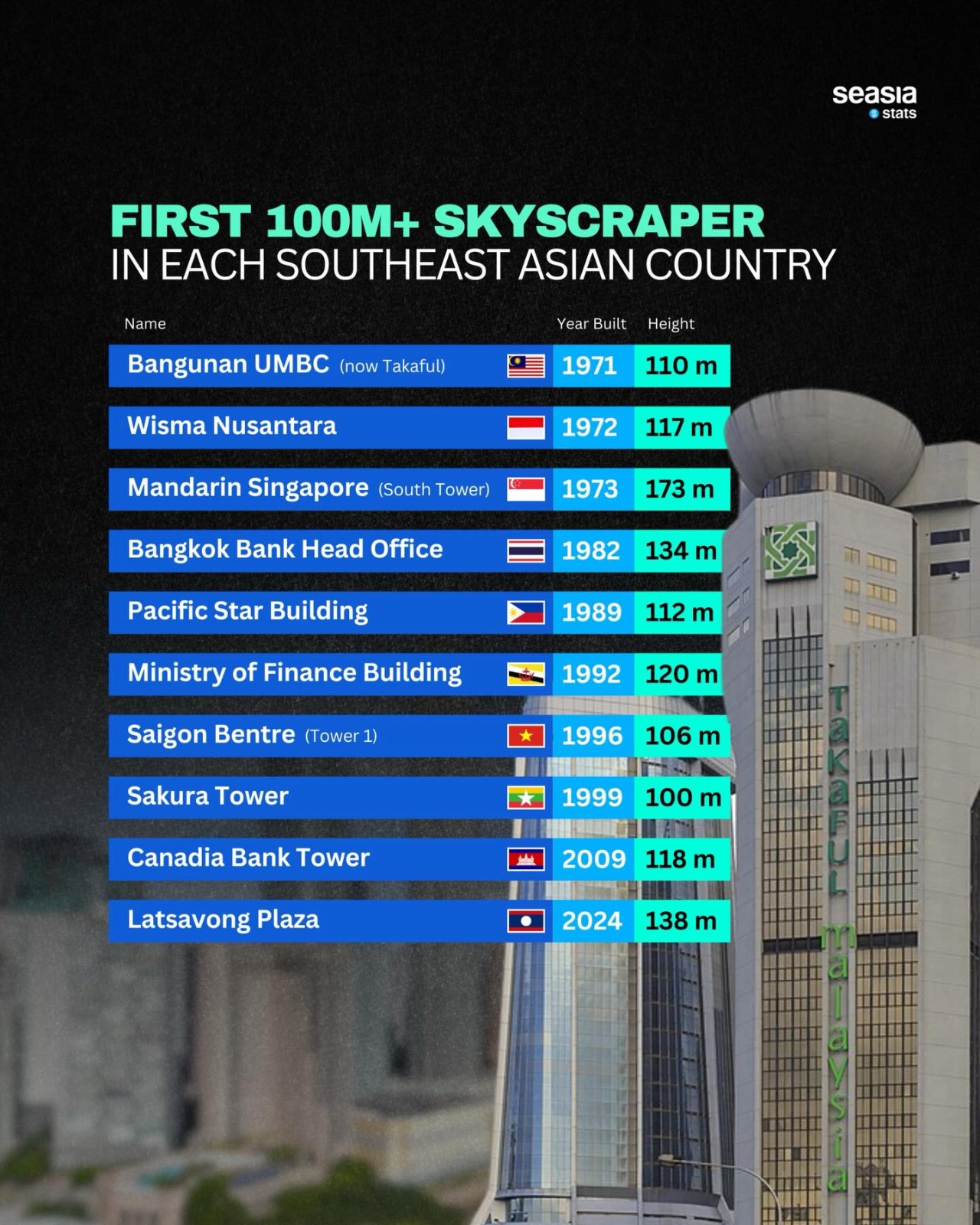
Across Southeast Asia, the skyline tells a story of ambition, modernization, and economic transformation. Today, the region is home to some of the world’s most striking skylines—but this journey began only a few decades ago. According to Seasia Stats, the race to build the first skyscrapers exceeding 100 meters in height began in the early 1970s, marking a turning point in the region’s architectural identity.
The Early Pioneers of the 1970s
Malaysia led the way in 1971 with the completion of Bangunan UMBC (now known as Takaful) in Kuala Lumpur, standing at 110 meters. This milestone symbolized the country’s early push toward financial and urban modernization. Just one year later, Indonesia followed with Wisma Nusantara in Jakarta, reaching 117 meters and quickly becoming a landmark of the capital’s growing business district.
Singapore soon raised the stakes. In 1973, the Mandarin Singapore (South Tower) rose to 173 meters—significantly taller than its regional counterparts. The building reflected Singapore’s rapid transformation into a global trade and financial hub, setting the tone for its future as one of Asia’s most vertical cities.
Expansion Across the Region in the 1980s and 1990s
The skyscraper boom gradually spread across Southeast Asia in the following decades. Thailand joined the list in 1982 with the Bangkok Bank Head Office, reaching 134 meters and signaling Bangkok’s emergence as a regional financial center. The Philippines followed in 1989 with the Pacific Star Building in Makati, a symbol of Metro Manila’s expanding corporate sector.
In 1992, Brunei entered the skyline era with its Ministry of Finance Building, standing at 120 meters and reflecting the nation’s oil-driven prosperity. By the mid-1990s, Vietnam joined the movement with Saigon Centre Tower 1 in Ho Chi Minh City (106 meters), marking a new chapter in its post-reform economic growth. Myanmar followed shortly after in 1999 with Sakura Tower in Yangon, reaching the 100-meter threshold and representing early modernization efforts in its urban core.
The 21st Century Wave of Growth
The new millennium brought skyscraper development to the remaining Southeast Asian nations. Cambodia reached the milestone in 2009 with the Canadia Bank Tower in Phnom Penh, standing at 118 meters and symbolizing the country’s rapid urban revival. Most recently, Laos joined the 100-meter skyline club in 2024 with Latsavong Plaza in Vientiane, reaching 138 meters—an indication of the country’s growing investment and urban expansion.
These milestones reflect broader regional trends. Countries like Vietnam, Indonesia, and the Philippines have since seen rapid vertical growth, with cities like Ho Chi Minh City, Jakarta, and Manila now filled with hundreds of high-rise buildings. Meanwhile, Singapore and Kuala Lumpur have become global icons of skyscraper architecture, hosting some of the tallest and most innovative buildings in Asia.
Skyscrapers as Symbols of Progress
Beyond steel and glass, these early skyscrapers represent turning points in Southeast Asia’s economic story. Each building marked a moment when a nation signaled its readiness to compete on a global stage—whether through finance, tourism, trade, or manufacturing.
Today, the region’s skylines continue to evolve, with new megaprojects rising in cities from Bangkok to Jakarta and Ho Chi Minh City. Yet the first 100-meter towers remain important symbols of where it all began—milestones that transformed Southeast Asia from a region of low-rise capitals into one of the world’s fastest-growing urban skylines.


