

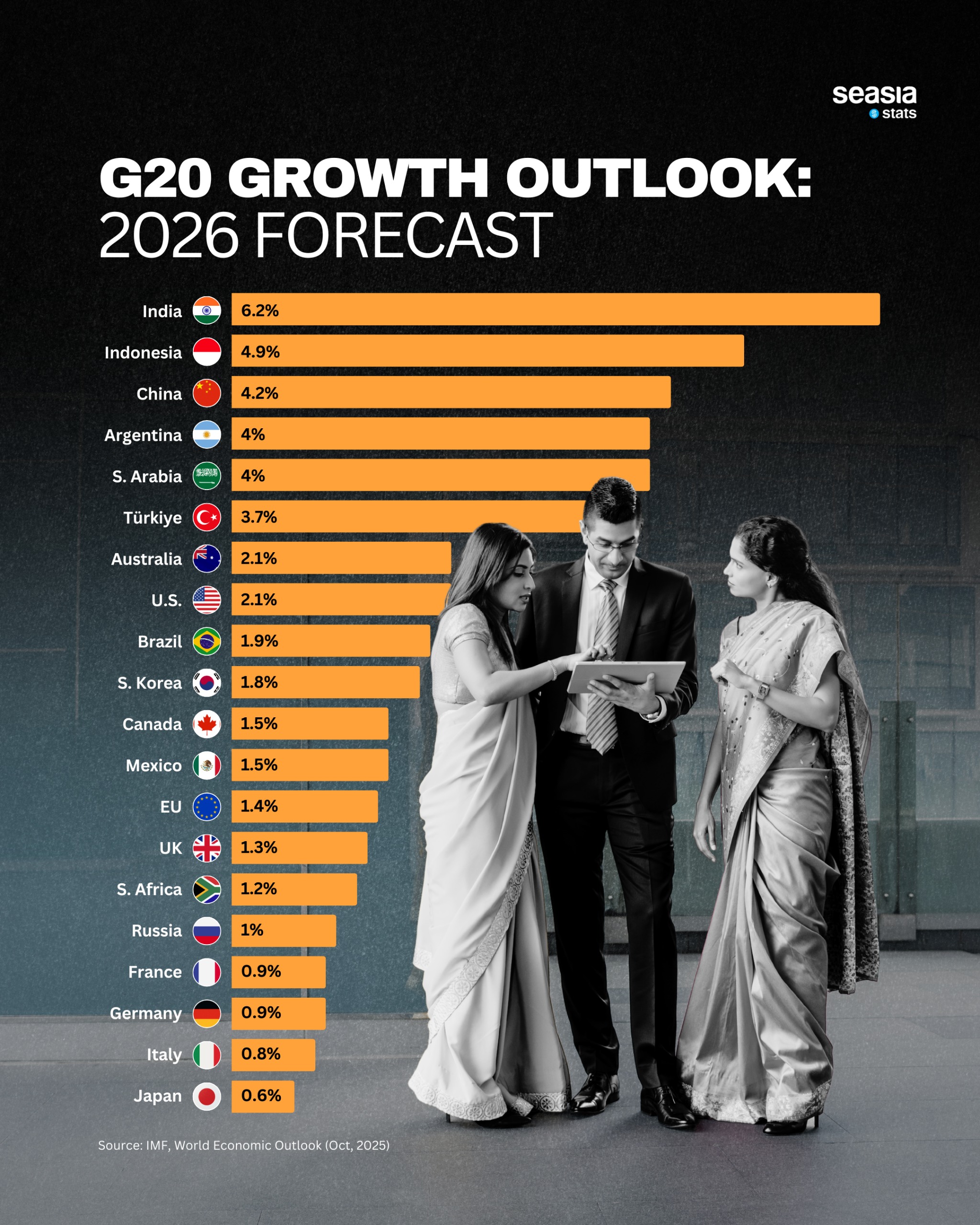
As the global economy adjusts to higher interest rates, geopolitical uncertainty, and shifting supply chains, growth is becoming increasingly uneven. The latest G20 growth forecasts for 2026 reveal a widening divide between fast-expanding emerging markets and slowing advanced economies. While overall global growth is expected to hover around 3.1%, the engines powering that growth are changing—and Asia is once again at the center of the story.
A World Growing, But at Different Speeds
According to international forecasts, G20 economies will grow at sharply different rates in 2026. Emerging markets are expected to significantly outperform their advanced counterparts, reflecting stronger domestic demand, younger populations, and continued infrastructure and industrial investment. In contrast, much of Europe and Japan face structural slowdowns, aging demographics, and weaker productivity growth.
India: The Undisputed Growth Leader
At the top of the chart sits India, forecast to grow by 6.2%, making it the fastest-growing major economy in the world. This momentum is being driven by rising household consumption, large-scale public infrastructure spending, digital transformation, and manufacturing expansion under policies aimed at attracting global supply chains.
India’s role as a global growth engine has become increasingly central, especially as multinational firms diversify production away from China and seek long-term consumer market potential.
Southeast Asia’s Quiet Strength, Led by Indonesia
Close behind India is Indonesia, projected to grow by 4.9% in 2026—well above the global average. Southeast Asia’s largest economy continues to benefit from strong domestic demand, commodity exports, and industrial downstreaming, particularly in nickel, electric vehicle supply chains, and manufacturing.
Indonesia’s performance reflects a broader regional trend. Vietnam, while not a G20 member, continues to post robust growth driven by export manufacturing. The Philippines maintains consumption-led expansion, while Thailand is gradually recovering as tourism and services rebound. Together, Southeast Asian economies are reinforcing Asia’s role as the world’s primary growth corridor.
China and Other Emerging Markets Hold Firm
China, the world’s second-largest economy, is forecast to grow by 4.2%—slower than in past decades but still strong by global standards. Structural adjustments, demographic shifts, and property sector challenges are tempering growth, even as advanced manufacturing and green technology investment remain areas of strength.
Other emerging G20 members also stand out. Saudi Arabia and Argentina are both projected to grow at 4.0%, supported by energy investment, exports, and fiscal reforms. These economies continue to outperform advanced peers despite higher volatility.
Advanced Economies Face a Slower Reality
At the opposite end of the spectrum are advanced economies. Germany and France are both projected to grow by just 0.9%, while Italy trails at 0.8%. Japan, grappling with demographic decline and weak domestic demand, is expected to grow by only 0.6%.
The United States and Australia fare slightly better at around 2.1%, but still lag far behind emerging Asia. High debt levels, tight monetary policy, and trade frictions continue to weigh on advanced economies.
A Shifting Center of Global Growth
Taken together, the 2026 G20 outlook underscores a powerful shift. Global growth is no longer driven primarily by the West, but by emerging economies—particularly in Asia. From India’s rapid expansion to Indonesia’s steady climb, the future of global economic momentum is increasingly shaped by the developing world.
In 2026, growth is not disappearing—it’s simply moving.


