

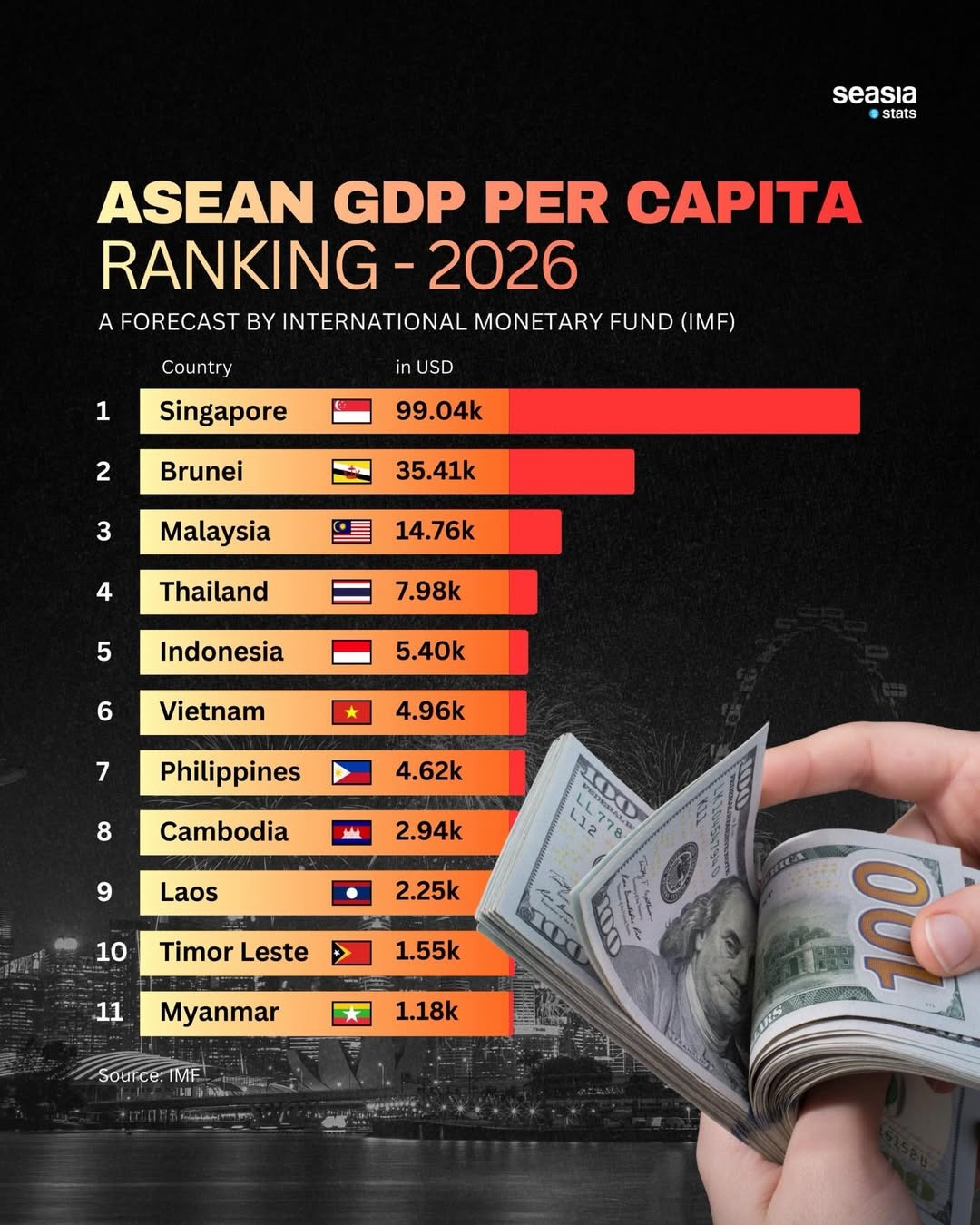
Across Southeast Asia, the story of economic growth is one of striking contrasts. From ultra-wealthy global hubs to emerging frontier economies, ASEAN’s GDP per capita rankings for 2026 reveal a region moving forward at different speeds—but often toward the same destination: sustained development and rising living standards.
Singapore’s Commanding Lead
At the top of the ASEAN income ladder sits Singapore, with a projected GDP per capita of around $99,040 USD in 2026. Its position reflects decades of investment in finance, technology, trade logistics, and human capital. As one of the world’s leading financial centers, Singapore continues to act as a gateway for capital flows into Southeast Asia, reinforcing its role as both an economic powerhouse and regional hub.
Second place goes to Brunei, with a forecast of $35,410 USD per person. The country’s small population and vast oil and gas reserves allow it to maintain a high income level, though recent years have also seen Brunei exploring diversification into tourism and Islamic finance.
Malaysia completes the region’s top tier at $14,760 USD, reflecting its mature manufacturing sector, strong electronics exports, and growing services economy. As a middle-income nation steadily advancing toward high-income status, Malaysia often serves as a benchmark for its neighbors.
The Rising Middle Tier
Below the top three lies a dynamic middle tier of economies steadily climbing the income ladder. Thailand, at approximately $7,980 USD, continues to benefit from a diversified economy that includes tourism, automotive manufacturing, and food exports.
Indonesia, the region’s largest economy, follows with a projected $5,400 USD per capita. With its vast domestic market, expanding infrastructure, and ongoing reforms, Indonesia remains one of Southeast Asia’s most promising long-term growth stories.
Vietnam and the Philippines, with projected figures of $4,960 USD and $4,620 USD respectively, represent some of the fastest-growing economies in the region. Vietnam’s rise is powered by export-oriented manufacturing and electronics production, while the Philippines continues to expand through services, remittances, and a rapidly growing digital economy.
Emerging and Developing Economies
Further down the rankings are ASEAN’s emerging economies, each with unique growth challenges and opportunities. Cambodia, at $2,940 USD, has seen strong gains in garments, construction, and tourism, while Laos, at $2,250 USD, continues to rely on hydropower exports and regional connectivity projects.
Timor-Leste, with $1,550 USD per capita, remains heavily dependent on petroleum revenues but is working toward diversification through agriculture and tourism. Myanmar, at $1,180 USD, rounds out the list, facing significant structural and political challenges that have slowed its economic progress in recent years.
A Region of Shared Momentum
Despite the wide income gap, Southeast Asia shares a broader narrative of upward mobility. Countries such as Vietnam, Indonesia, and the Philippines are experiencing rapid urbanization and industrialization, while Malaysia and Thailand continue upgrading their industries toward higher-value production.
Regional cooperation through ASEAN also plays a critical role. Cross-border trade, infrastructure connectivity, and digital integration are helping to reduce disparities over time and create a more cohesive economic community.
Looking Ahead
The 2026 IMF projections highlight both inequality and opportunity across ASEAN. While Singapore and Brunei stand far ahead in income levels, the region’s emerging economies are steadily closing the gap through industrial growth, digital transformation, and rising consumer markets.
Ultimately, Southeast Asia’s diversity is its strength. From advanced financial centers to fast-growing manufacturing hubs, ASEAN’s varied economic landscape ensures that the region will remain one of the most dynamic and promising parts of the global economy in the years ahead.


