

Naval power has long been a defining measure of global military strength. In an era where maritime trade routes carry the majority of global commerce and geopolitical tensions increasingly play out at sea, countries continue to expand and modernize their naval fleets. From aircraft carriers and destroyers to submarines and patrol vessels, the composition of a navy determines not only defensive capability but also a nation’s ability to project influence far beyond its borders.
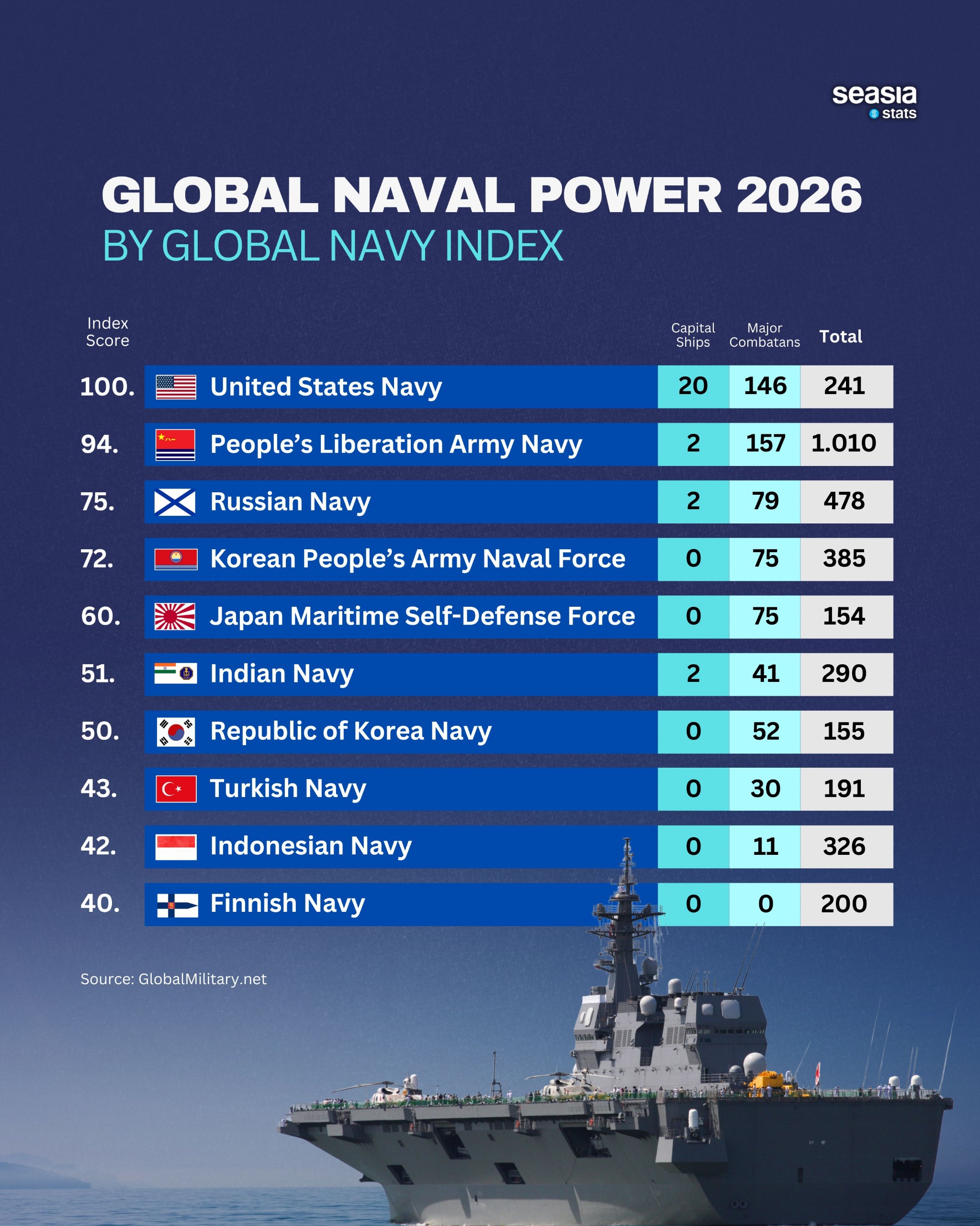
According to data highlighted by Seasia Stats and compiled by GlobalMilitary.net, the Global Navy Index 2026 ranks the world’s most powerful naval forces based on a combination of fleet size, major combat vessels, and capital ships. The ranking reveals both traditional naval superpowers and emerging maritime forces, including one from Southeast Asia.
The United States Remains the World’s Dominant Naval Power
Topping the global rankings is the United States Navy, which holds a perfect index score of 100. Despite having a total fleet of 241 vessels, smaller than some competitors, the U.S. Navy’s strength lies in its unmatched force projection capabilities.
The United States operates 20 capital ships, primarily aircraft carriers and amphibious assault ships, along with 146 major combatants such as destroyers and cruisers. These vessels allow the U.S. to maintain a powerful global presence across multiple oceans simultaneously.
Aircraft carrier strike groups, advanced submarines, and global logistics networks give the U.S. Navy the ability to respond quickly to crises anywhere in the world.
China’s Rapid Naval Expansion
In second place is China’s People’s Liberation Army Navy (PLAN) with an index score of 94. China now possesses the largest navy in the world by number of vessels, with an impressive 1,010 ships in total.
The PLAN operates 157 major combatants, including destroyers and frigates, and has rapidly expanded its shipbuilding capabilities over the past decade. While China currently has fewer capital ships compared to the United States, it has been steadily increasing its aircraft carrier fleet as part of its long-term naval modernization strategy.
China’s naval growth reflects its ambition to protect maritime trade routes, assert territorial claims, and expand its global presence.
Northern Asia’s Strong Naval Presence
Much of the middle tier of the rankings is dominated by countries in Northern and East Asia, regions where maritime security plays a critical role in national defense.
The Russian Navy ranks third with an index score of 75 and a fleet of 478 vessels. Although Russia’s navy has faced modernization challenges, it remains a significant force, particularly in submarine warfare.
In fourth place is the Korean People’s Army Naval Force (North Korea) with a score of 72 and 385 vessels. While many of its ships are smaller coastal vessels, the sheer number contributes to its ranking.
The Japan Maritime Self-Defense Force ranks fifth with an index score of 60. Despite having no traditional aircraft carriers, Japan operates highly advanced destroyers and helicopter carriers, giving it one of the most technologically sophisticated navies in the world.
Emerging Regional Naval Powers
Several other nations also appear in the top ten, reflecting the growing importance of maritime security across multiple regions.
The Indian Navy ranks sixth with an index score of 51, supported by two capital ships and a fleet of 290 vessels. India continues to expand its naval capabilities to protect its vast coastline and growing economic interests in the Indian Ocean.
South Korea’s Republic of Korea Navy ranks seventh with a score of 50, while the Turkish Navy holds the eighth position with 43.
Indonesia Leads Southeast Asia
The only Southeast Asian nation on the list is Indonesia, which ranks ninth globally with an index score of 42. The Indonesian Navy operates 326 vessels, making it one of the largest fleets in the region.
Indonesia’s naval strength is closely tied to its geography. As the world’s largest archipelagic nation, it must protect thousands of islands and major maritime trade routes that pass through its waters.
Beyond Indonesia, several other Southeast Asian countries are also investing in naval modernization. Nations such as Singapore, Vietnam, Malaysia, and Thailand have been expanding their fleets with advanced frigates, submarines, and patrol vessels to safeguard their maritime interests.
The Growing Importance of Maritime Power
The Global Navy Index highlights a clear trend: naval expansion is accelerating worldwide. As global trade, energy security, and territorial disputes increasingly center on the world’s oceans, countries are investing heavily in modern fleets.
For Southeast Asia, where some of the world’s busiest shipping lanes pass through regional waters, naval capability is becoming more important than ever. With continued modernization and strategic investment, the region’s maritime forces are likely to play an even larger role in global naval dynamics in the years ahead.


