

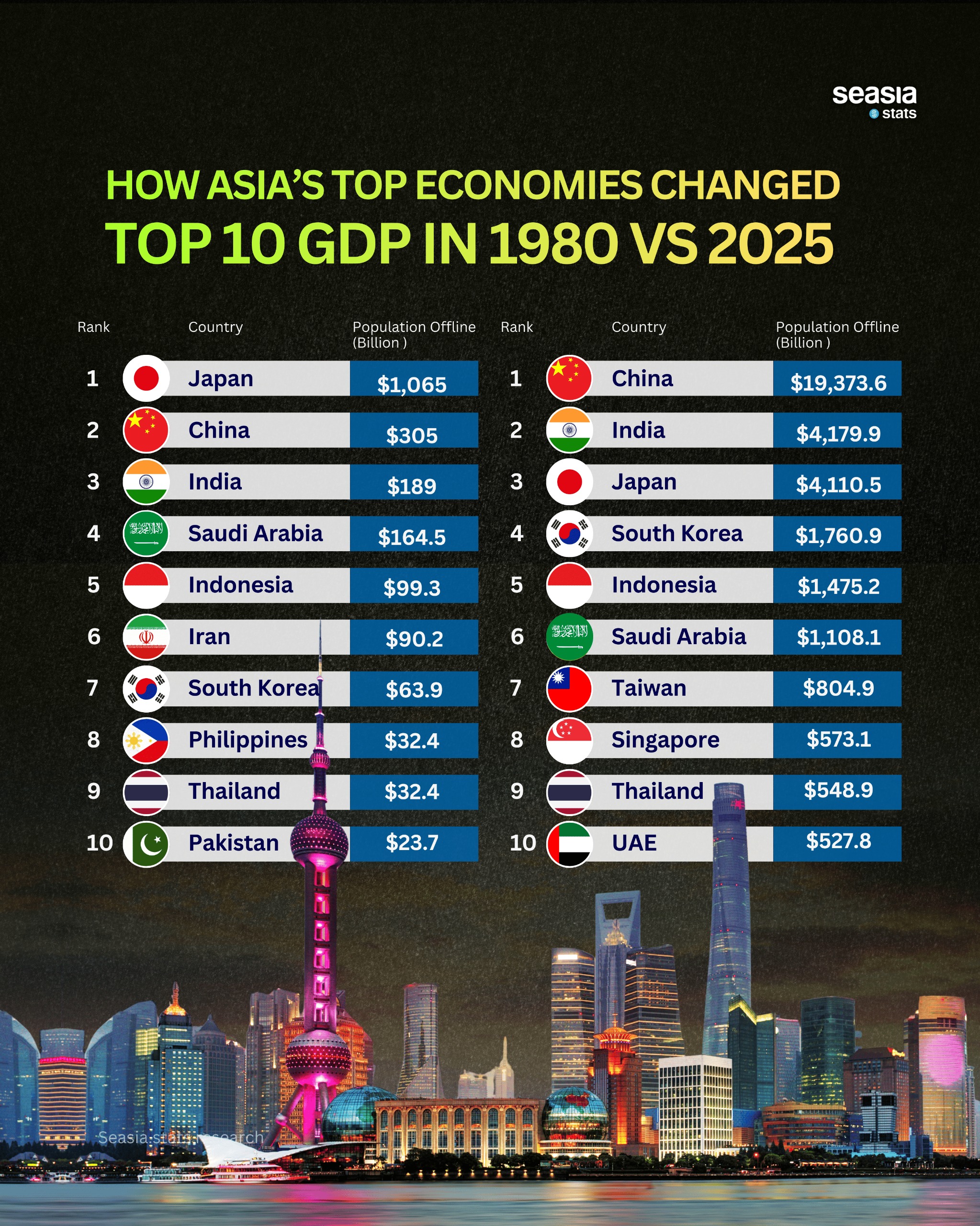
Asia’s economic story over the last four and a half decades is not just a tale of growth. It is a tale of reversal, reinvention, and rising ambition. The Seasia Stats comparison between 1980 and 2025 shows how dramatically the center of gravity in Asia has shifted—from a region once dominated by Japan and oil wealth to one now led by industrial giants, technology hubs, and fast-rising Southeast Asian economies.
From Japan’s Era to China’s Century
In 1980, Japan stood far above the rest of Asia. With a GDP of US$1,065 billion, it was the continent’s undisputed economic superpower, representing the height of its postwar miracle. At the time, Japan’s manufacturing strength, export dominance, and technological sophistication made it the symbol of Asia’s future.
But by 2025, the picture had completely changed. China now sits at the top with a staggering US$19.37 trillion, reflecting one of the most dramatic economic transformations in modern history. From factory floors to financial influence, China’s rise has redefined not only Asia but the global economy itself.
India, too, has made a remarkable leap—from third place in 1980 to second in 2025 with US$4.18 trillion, narrowly edging past Japan. The shift says a lot about where Asia’s momentum now lies: in large, youthful, rapidly urbanizing economies that combine scale with expanding domestic demand.
The New Asian Middle Powers
Perhaps the most revealing part of the ranking is not just who leads, but who climbed.
South Korea, once ranked seventh in 1980, has surged to fourth place by 2025 with US$1.76 trillion. Its rise mirrors the success of export-led industrialization, state-backed innovation, and global brands that turned the country into a technological heavyweight.
Then there is Indonesia, whose position may be one of the most significant from a Southeast Asian perspective. In 1980, it ranked fifth with US$99.3 billion. By 2025, it remains in the top five—but at a vastly larger scale, reaching US$1.48 trillion. That makes Indonesia not just Southeast Asia’s largest economy, but one of Asia’s defining economic stories.
This is where the regional significance becomes clear: Asia’s economic transformation is no longer just an East Asian story. It is increasingly a Southeast Asian story too.
Southeast Asia’s Quiet Rise
For Southeast Asia, the infographic captures both continuity and acceleration.
Indonesia, Singapore, and Thailand all appear in the 2025 top ten, while the Philippines, which was in the top ten in 1980, has since dropped out despite posting significant growth over the decades. That alone says something important: growth in Asia has been so rapid that even countries that expanded substantially could still lose relative ranking.
Singapore’s rise into the top ten is especially notable. It is the smallest country on the list by land size and population, yet it entered the 2025 rankings with US$573.1 billion, underscoring how finance, logistics, advanced services, and strategic governance can turn a city-state into a continental economic force.
Thailand, meanwhile, remains one of the region’s most durable performers. Its presence in both eras suggests a long-term capacity to remain relevant even amid changing regional competition.
And then there is the broader Southeast Asian picture beyond the chart. Countries like Vietnam and Malaysia, while not in this specific top ten, have become increasingly influential in manufacturing, electronics, digital trade, and supply-chain diversification. In many ways, Southeast Asia today is benefiting from a world that is actively looking for alternatives, complements, and new production bases beyond China.
Who Fell, Who Entered, and Why It Matters
One of the more striking elements of the comparison is who disappeared from the list.
In 1980, countries like Iran, the Philippines, and Pakistan were in Asia’s top ten. By 2025, they had been replaced by Taiwan, Singapore, and the United Arab Emirates. This is not just about economics; it reflects how political stability, industrial policy, demographics, investment climate, and geopolitical positioning can alter a nation’s long-term trajectory.
It also shows that Asia is no longer economically defined by just natural resources or postwar industrialization. Today’s winners tend to be countries that have positioned themselves around technology, services, trade networks, manufacturing specialization, and state capacity.
Asia’s Future May Be More Southern Than Ever
If 1980 belonged to Japan and 2025 belongs to China and India, the next chapter may increasingly belong to the broader Asian south—especially Southeast Asia.
The region’s population, urbanization, consumer expansion, and strategic location between the Indian and Pacific Oceans give it an increasingly central role in the Asian century. Indonesia’s rise is already proof of that. Singapore and Thailand reinforce it. Vietnam and Malaysia are strengthening it.
What this ranking really shows is not just who got richer. It shows how power in Asia is being redistributed—and how Southeast Asia is no longer standing at the edge of that story, but moving closer to its center.


