

As Ramadan 2026 unfolds across the globe, Muslims observe the daily fast from dawn (fajr) to sunset (maghrib). While the spiritual meaning of fasting remains universal, the number of hours spent abstaining from food and drink varies depending on geography, daylight patterns, and seasonal shifts.
A Month of Balance Near the Equinox
Because Ramadan in 2026 falls between February and March—close to the spring equinox—fasting hours are relatively balanced worldwide. In most countries, Muslims fast between 12 and 15 hours a day. This makes 2026 one of the more moderate years in the Islamic lunar cycle, compared with periods when Ramadan falls in peak summer or winter, when daylight extremes can significantly lengthen or shorten fasting hours.
Global Snapshot: How Long Do Muslims Fast?
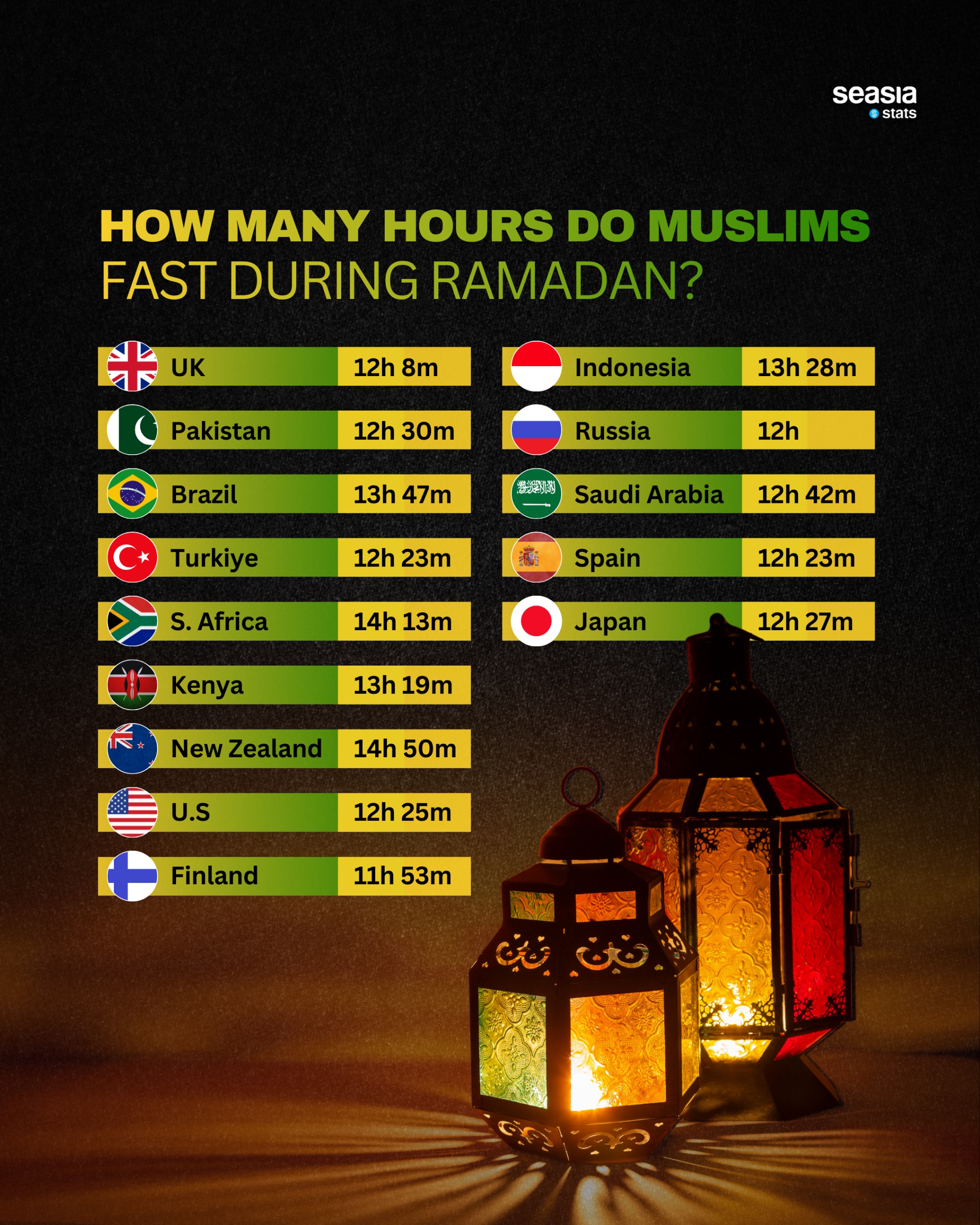
According to Seasia Stats and regional time calculations, fasting durations vary by region. In the Southern Hemisphere, countries such as New Zealand record some of the longest initial fasts at around 14 hours 50 minutes, followed by South Africa at 14 hours 13 minutes and Brazil at 13 hours 47 minutes. These longer daylight hours gradually shorten as the month progresses toward March.
Equatorial and tropical regions, however, experience remarkable consistency. In Indonesia, Muslims fast for about 13 hours 28 minutes, while Kenya records 13 hours 19 minutes. Because these countries lie near the equator, daylight length remains relatively stable throughout the year.
In the Northern Hemisphere, fasting hours begin shorter but increase slightly each day. For example, the United Kingdom starts with about 12 hours 8 minutes, Pakistan with 12 hours 30 minutes, Saudi Arabia with 12 hours 42 minutes, and the United States with 12 hours 25 minutes. Finland currently records one of the shortest fasts at approximately 11 hours 53 minutes.
Southeast Asia’s Steady Rhythm
Southeast Asia offers one of the most stable Ramadan experiences globally. Indonesia’s 13-hour fast is mirrored closely by Malaysia and Brunei, while Singapore’s fasting day also stays around the same range due to its equatorial position.
In Thailand and the southern Philippines, Muslim communities observe similar fasting hours, typically just over 13 hours daily. In Vietnam and Cambodia—where Muslim populations are smaller—fasting durations remain consistent as well, reinforcing the region’s reputation for predictable daylight cycles.
This consistency allows for well-established Ramadan traditions across Southeast Asia, from bustling night markets in Jakarta and Kuala Lumpur to communal iftar gatherings in Mindanao and Pattani.
Extreme Latitudes and Scholarly Flexibility
At the far ends of the Earth, fasting can become far more demanding. In northern regions such as parts of Greenland, Iceland, and Scandinavia, daylight hours during Ramadan can exceed 17 to 20 hours depending on the year.
To ease this challenge, Islamic scholars provide flexible rulings. Muslims in these regions may follow the fasting schedule of a nearby moderate city or adopt the timetable of Mecca. This ensures that the spiritual purpose of fasting is preserved without causing undue hardship.
A Shared Spiritual Journey
Although fasting hours differ across continents, the essence of Ramadan remains unchanged. It is a time for reflection, compassion, discipline, and community. Across Southeast Asia and beyond, Muslims rise before dawn for suhoor, gather at sunset for iftar, and spend their nights in prayer and charity.
As the days pass, fasting durations shift by a few minutes daily, gradually converging toward a global average of about 13.7 hours by mid-March.
In the end, whether fasting for 12 hours or nearly 15, the shared purpose binds millions together in one of the most profound collective spiritual experiences in the world.
Ramadan Kareem—a blessed Ramadan to all who observe.


