

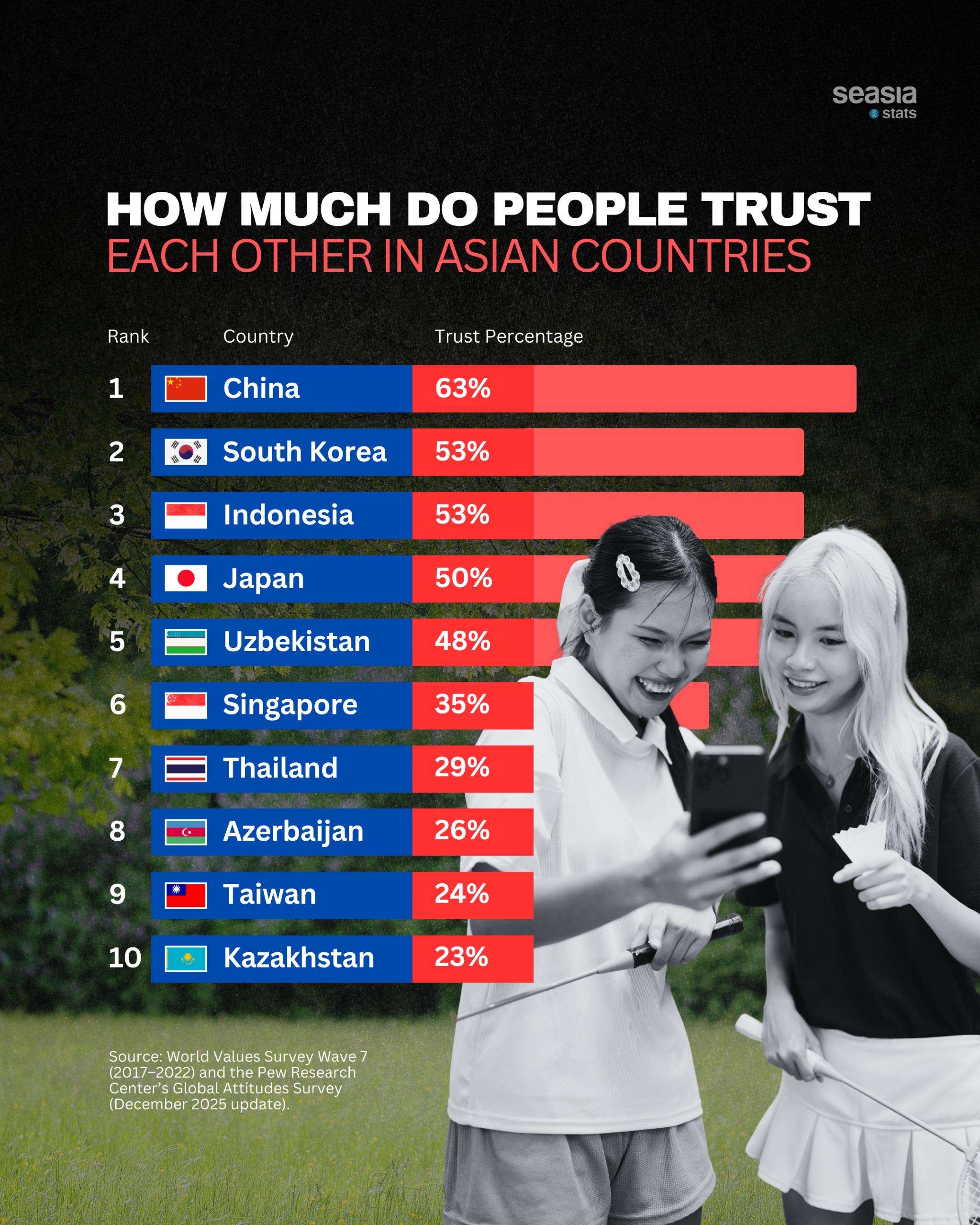
In every society, trust is the invisible thread that binds communities together. It shapes how people do business, form friendships, and cooperate with strangers. Across Asia, however, levels of interpersonal trust vary widely—reflecting deep cultural, economic, and social differences. Recent data compiled by Seasia Stats from the World Values Survey and Pew Research Center offers a revealing snapshot of how much people trust one another across the region.
China Leads the Region in Social Trust
At the top of the rankings is China, where 63% of respondents say they trust others—a clear majority that stands out in Asia. This high level of interpersonal trust reflects strong social cohesion in many communities and the importance of collective values embedded in everyday life.
Following China are South Korea and Indonesia, tied in second place with 53% trust levels. Indonesia’s position is particularly notable, as it is the highest-ranked Southeast Asian country on the list. With its strong communal traditions such as gotong royong (mutual cooperation), Indonesia demonstrates how cultural practices can reinforce social trust even in a large and diverse nation.
East and Central Asia in the Middle Tier
The middle of the ranking is dominated by East and Central Asian countries. Japan ranks fourth with 50%, followed closely by Uzbekistan at 48%. These figures suggest relatively strong social confidence, though slightly lower than the top tier.
In contrast, Singapore, despite its high economic development and global reputation for stability, records a significantly lower trust level at 35%, placing it sixth overall. This suggests that rapid urbanization, individualism, and a highly competitive environment may influence how people perceive trust in everyday interactions.
Southeast Asia’s Mixed Picture
Beyond Indonesia and Singapore, Southeast Asia presents a mixed trust landscape. Thailand ranks seventh with 29%, reflecting moderate but declining levels of social trust in a rapidly modernizing society.
While not all ASEAN countries are included in the top 10, broader regional studies often show varying trust levels in nations such as Malaysia, Vietnam, and the Philippines, where trust tends to be influenced by local governance, community ties, and economic inequality. Rural communities across Southeast Asia often display stronger interpersonal trust compared to urban centers, where anonymity and mobility can weaken social bonds.
Lower Trust Levels in Central Asia
At the lower end of the ranking are Azerbaijan (26%), Taiwan (24%), and Kazakhstan (23%). These figures highlight a significant drop in trust compared to the top-ranked countries. Lower levels of institutional confidence, economic disparities, and political factors are often cited as key influences in these societies.
Why Social Trust Matters
Interpersonal trust is more than just a cultural trait—it is a critical component of economic growth and social stability. High-trust societies tend to experience smoother business transactions, stronger civic participation, and lower crime rates. In contrast, low-trust environments can lead to higher transaction costs, reduced cooperation, and greater reliance on formal regulations.
For Southeast Asia, where regional integration and cross-border collaboration are increasing, trust is becoming an essential ingredient for future growth. From digital economies to tourism and labor mobility, stronger social trust can enhance both economic resilience and regional unity.
Building Trust in a Changing Region
As Asia continues to urbanize and digitize, maintaining and strengthening social trust will be an ongoing challenge. Governments, communities, and institutions all play a role—from promoting transparency and fairness to fostering inclusive social policies.
Ultimately, trust is built slowly, through everyday interactions and shared experiences. And in a region as diverse as Asia, the path to stronger trust may differ from one country to another—but its importance remains universal.


