

In some parts of the world, rain is not just a season—it is a way of life. From misty Andean slopes to equatorial coastlines and monsoon-soaked cities, certain places experience rainfall so frequently that umbrellas become everyday essentials. According to Seasia Stats and Climate Data, a handful of cities across Latin America, Africa, and Southeast Asia stand out for recording the highest number of rainy days each year, revealing how geography and climate shape daily life in these water-rich regions.
Latin America’s Rain Capitals
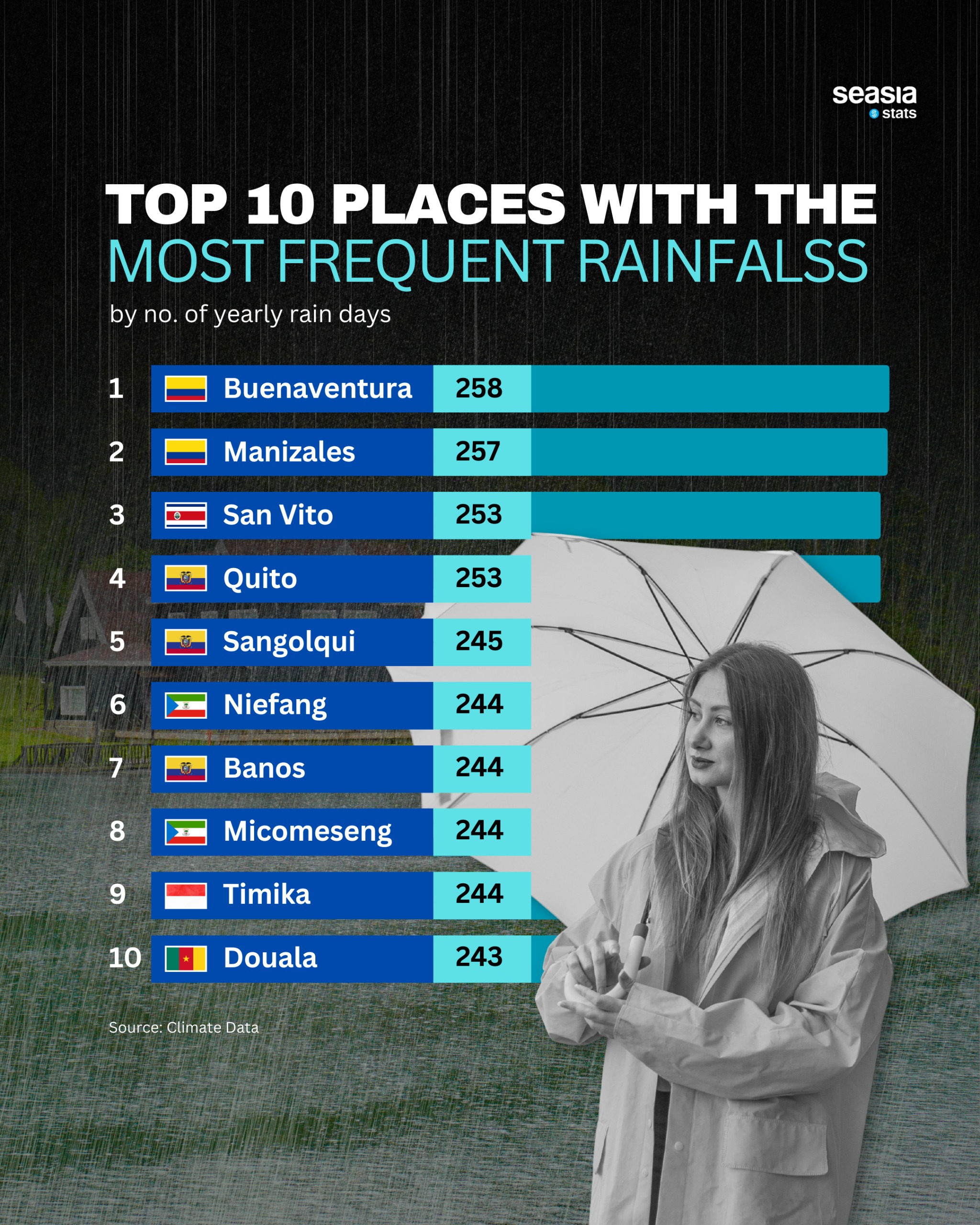
Topping the global ranking is Buenaventura, Colombia, which experiences an astonishing 258 rainy days annually—the highest in the world. Located along the Pacific coast, Buenaventura’s proximity to warm ocean currents and dense rainforest ensures near-constant moisture in the air.
Just behind it is Manizales, Colombia, with 257 rainy days per year, nestled in the Andes where moist air from the Pacific is lifted by mountainous terrain, triggering frequent rainfall. The region’s geography acts like a natural trap for clouds, creating persistent drizzle and heavy showers.
The Andean influence continues across Quito, Ecuador, and Sangolquí, as well as Costa Rica’s San Vito, all recording between 245 and 253 rainy days annually. These cities demonstrate how altitude, tropical heat, and oceanic winds combine to create near-daily rainfall across parts of Latin America.
Africa’s Equatorial Rain Belts
The list also highlights cities in equatorial Africa, where humidity and tropical climates dominate. Niefang and Micomeseng in Equatorial Guinea, as well as Banos in Ecuador’s Amazon region, each record around 244 rainy days per year, while Douala, Cameroon, experiences 243 rainy days annually.
In these regions, the Intertropical Convergence Zone (ITCZ)—a band of converging winds near the equator—drives frequent cloud formation and thunderstorms. As a result, rainfall is evenly distributed across the year, shaping agriculture, infrastructure, and daily routines.
Southeast Asia’s Rainfall Reality
While Latin America dominates the top ranks, Southeast Asia is no stranger to heavy rain. The Indonesian city of Timika, Papua, stands as the region’s representative in the global top 10, with 244 rainy days per year. Located near dense rainforests and mountainous terrain, Timika experiences consistent rainfall driven by both equatorial weather patterns and regional monsoon systems.
Across Southeast Asia, similar conditions are found in cities such as Jakarta, Manila, Kuala Lumpur, and Bangkok, where monsoon seasons bring months of intense rainfall each year. Although these cities may not reach the same number of rainy days as Buenaventura, they often experience heavier rainfall intensity and seasonal flooding, especially during peak monsoon months.
In countries like Malaysia and Brunei, rainfall is spread throughout the year due to their equatorial location, while Vietnam and Thailand experience distinct wet seasons that can last several months. Meanwhile, the Philippinesregularly faces typhoon-driven rainfall, adding to its already high annual precipitation levels.
Living in the World’s Wettest Places
Frequent rainfall shapes everything from urban design to cultural habits. In these cities, covered walkways, drainage systems, and rain-ready infrastructure are essential. Locals adapt with rain gear as daily attire, while lush vegetation thrives thanks to constant moisture.
As climate change intensifies weather patterns, understanding rainfall distribution is more important than ever. From Colombia’s Pacific coast to Indonesia’s rainforest regions, these cities remind us that water is both a life-giving resource and a powerful force shaping how communities live, build, and adapt.


