

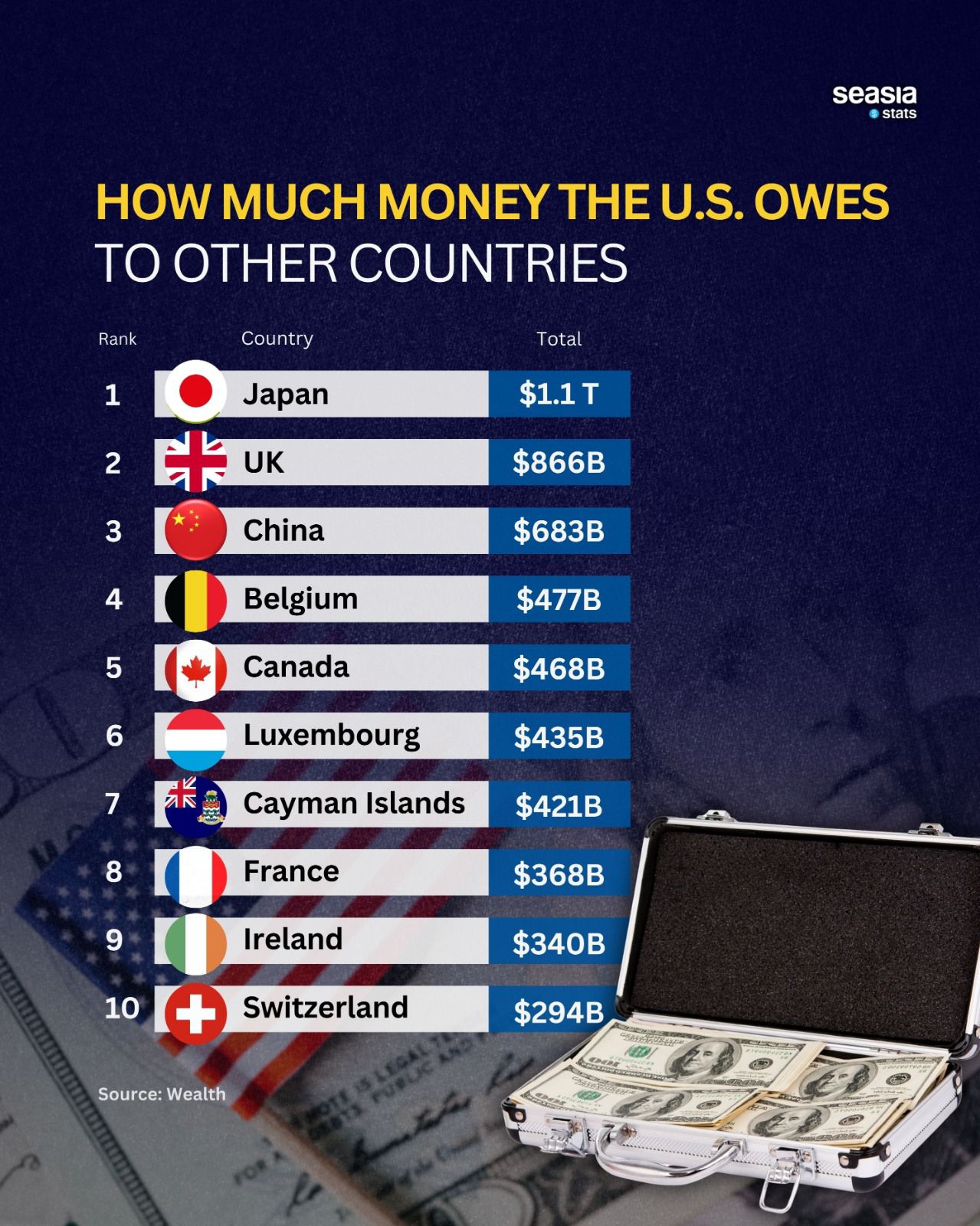
When people say the United States “owes” other countries, it can sound like a geopolitical debt collector is waiting at the door. In reality, what this infographic shows is foreign ownership of U.S. Treasury securities—the government bonds that help finance Washington’s spending. And the latest picture is striking: America’s biggest foreign creditors are not rivals alone, but some of its closest allies and largest financial partners.
Who Holds Washington’s IOUs?
According to the U.S. Treasury’s Treasury International Capital (TIC) data and Reuters reporting, Japan remains the largest foreign holder of U.S. Treasuries, with about US$1.225 trillion in January 2026. The United Kingdom followed with US$895.3 billion, while China held US$694.4 billion, placing it third. Foreign holdings overall rose to US$9.305 trillion, showing that despite periodic political noise about “de-dollarization,” global appetite for U.S. debt remains very strong.
That matters because U.S. Treasuries are still treated as one of the world’s core safe assets. Governments, pension funds, insurers, banks, and reserve managers buy them not out of charity toward Washington, but because they are liquid, tradable, and central to the global financial system.
Reuters summed up the latest shift neatly: rising U.S. yields and changing expectations for the Federal Reserve helped draw more foreign money back into Treasuries earlier this year. In other words, America’s debt is also an investment product—and a very attractive one when returns rise.
Why Japan, the UK, and China Sit at the Top
Japan’s leading position is no surprise. For decades, Japanese institutions—especially insurers, pension funds, and banks—have used U.S. Treasuries as a cornerstone of overseas investment. Reuters noted in March that Japan’s holdings had climbed to their highest level since mid-2022, reflecting the appeal of U.S. returns relative to low-yield conditions at home.
The UK’s large position often reflects not just British state policy, but also London’s role as a global financial hub, where many hedge funds, asset managers, and custodians hold U.S. securities on behalf of international clients. That is why Britain’s Treasury holdings can sometimes jump sharply without necessarily reflecting a dramatic change in British government strategy.
China, meanwhile, remains the most politically scrutinized creditor. Its Treasury holdings are still enormous, but they are far below their historical peak. Reuters reported that China’s position has been gradually declining as Beijing continues to diversify reserves and reduce dependence on U.S. assets.
The Quiet Southeast Asian Angle
Southeast Asia does not appear in the infographic’s top ten, but the region still matters to the U.S. debt story. Financial hubs like Singapore play an outsized role in global capital flows, while reserve-managing economies such as Thailand, Malaysia, Indonesia, and Vietnam are increasingly important in the wider Asian bond and currency ecosystem.
In January 2026, Reuters reported that foreign investors were still actively buying bonds across Asian markets including Thailand, Malaysia, and Indonesia, a sign that Asia remains deeply tied to dollar-based finance even while governments talk more about local-currency trade and diversification.
That is the key context often missed in popular discussions: Southeast Asia may not be among the very largest holders of U.S. Treasuries, but it is firmly embedded in the same system that keeps demand for dollar assets strong. Regional central banks, sovereign funds, and commercial institutions all operate within a financial order where U.S. debt still functions as a global benchmark.
Debt, Power, and Dependence
So does foreign ownership of U.S. debt mean America is financially vulnerable? Yes and no.
Yes, because heavy borrowing means Washington depends on continued investor confidence. But also no—because that same debt reflects the extraordinary reality that the world still trusts the U.S. Treasury market more than almost any other financial instrument.
That is the real takeaway from this ranking. It is not simply a list of who America “owes.” It is a map of who is still betting that, for all its deficits and dysfunction, the United States remains the safest place to park serious money.


