

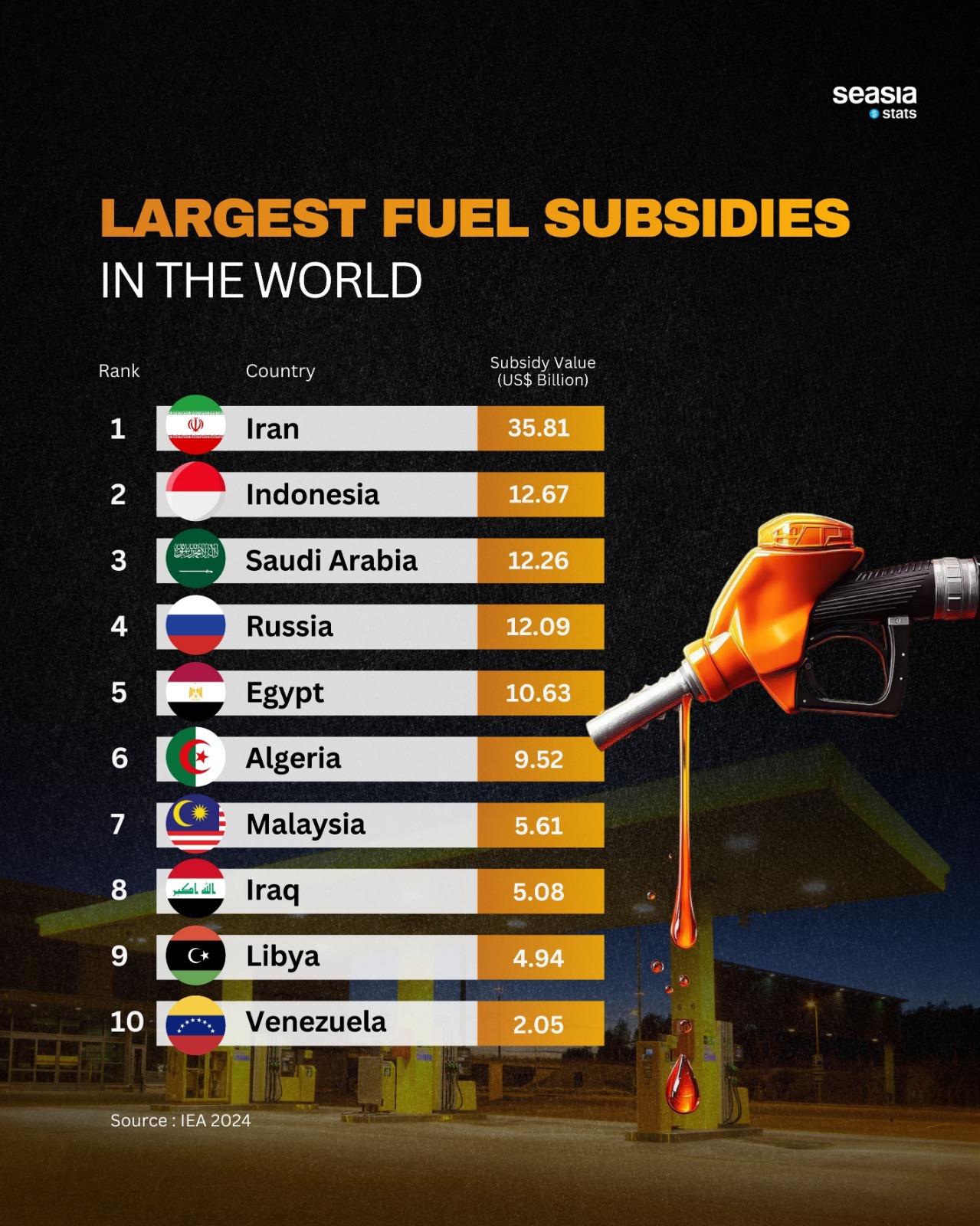
Fuel prices are never just about the pump. They are about politics, public welfare, and economic stability—and few policies reflect that balance more clearly than fuel subsidies. The latest figures highlighted by Seasia Stats, based on International Energy Agency (IEA) data, show just how massive this global intervention has become, with countries spending billions to shield citizens from volatile energy markets.
A World Propped Up by Subsidies
At the top of the list sits Iran, providing an enormous US$35.81 billion in fuel subsidies, far ahead of any other country. Indonesia follows in second place with US$12.67 billion, closely trailed by Saudi Arabia at US$12.26 billion. These figures underline a simple reality: energy-rich nations—and large developing economies—often rely on subsidies as a tool to maintain social stability.
Globally, the scale of these policies is staggering. The IEA notes that fossil fuel consumption subsidies surged dramatically during recent energy crises, even exceeding $1 trillion worldwide in 2022 before easing slightly as prices stabilized. This reflects how governments step in when global markets become too volatile for households to absorb.
As Reuters observed in a broader analysis, subsidies are frequently used to “shield consumers from high energy costs,” but they also create long-term fiscal pressure and complicate efforts to transition to cleaner energy.
Southeast Asia’s Strategic Balancing Act
What stands out in this ranking is the strong presence of Southeast Asia—particularly Indonesia and Malaysia. Indonesia’s position as the world’s second-largest fuel subsidizer highlights the scale of its domestic challenge. With a population exceeding 270 million spread across thousands of islands, energy affordability is not just an economic issue—it is a political necessity.
Fuel subsidies in Indonesia have long been tied to inflation control, transportation costs, and social equity. Keeping fuel prices stable helps prevent cascading price increases in food and logistics, which can disproportionately affect lower-income households. But the trade-off is significant: billions of dollars in state spending that could otherwise be allocated to infrastructure, education, or healthcare.
Malaysia, ranked seventh with US$5.61 billion in subsidies, reflects a slightly different model. The country has gradually shifted toward more targeted subsidies in recent years, attempting to reduce blanket fuel support while still protecting vulnerable groups. This “targeted subsidy” approach is increasingly seen across Southeast Asia as governments try to balance fiscal discipline with political realities.
The Oil Producers’ Dilemma
Beyond Southeast Asia, the list is dominated by oil-producing nations such as Russia, Algeria, Iraq, and Libya. For these countries, subsidies often serve as a way to redistribute resource wealth directly to citizens. Cheap fuel becomes a form of social contract—an implicit promise that national resources benefit the population.
However, this model comes with risks. Heavy reliance on subsidies can strain government budgets, especially when oil prices fall or when demand fluctuates. The OECD notes that while global support for fossil fuels has declined slightly in recent years, it “remains elevated relative to historical averages,” highlighting the persistent fiscal burden.
Between Affordability and Sustainability
The bigger question facing all these countries is not whether subsidies are useful—they clearly are—but whether they are sustainable. The IEA has repeatedly emphasized that inefficient subsidies distort markets, discourage energy efficiency, and slow the transition to renewable energy.
For Southeast Asia, this dilemma is especially acute. Rapid economic growth, urbanization, and rising energy demand mean governments cannot simply remove subsidies overnight. Yet at the same time, the region is increasingly investing in renewable energy, electric vehicles, and cleaner infrastructure.
Indonesia, for example, is pushing forward with its energy transition plans while still maintaining large subsidies—a reflection of the tightrope many developing economies must walk.
The Future of Fuel Support
What this ranking ultimately reveals is not just who spends the most, but how different countries manage the same fundamental challenge: keeping energy affordable without undermining long-term economic and environmental goals.
In Southeast Asia, the story is still being written. Subsidies remain a powerful tool—but also a costly one. And as global energy systems shift, the region’s ability to adapt these policies may define not just its fiscal health, but its future in the global energy transition.


