

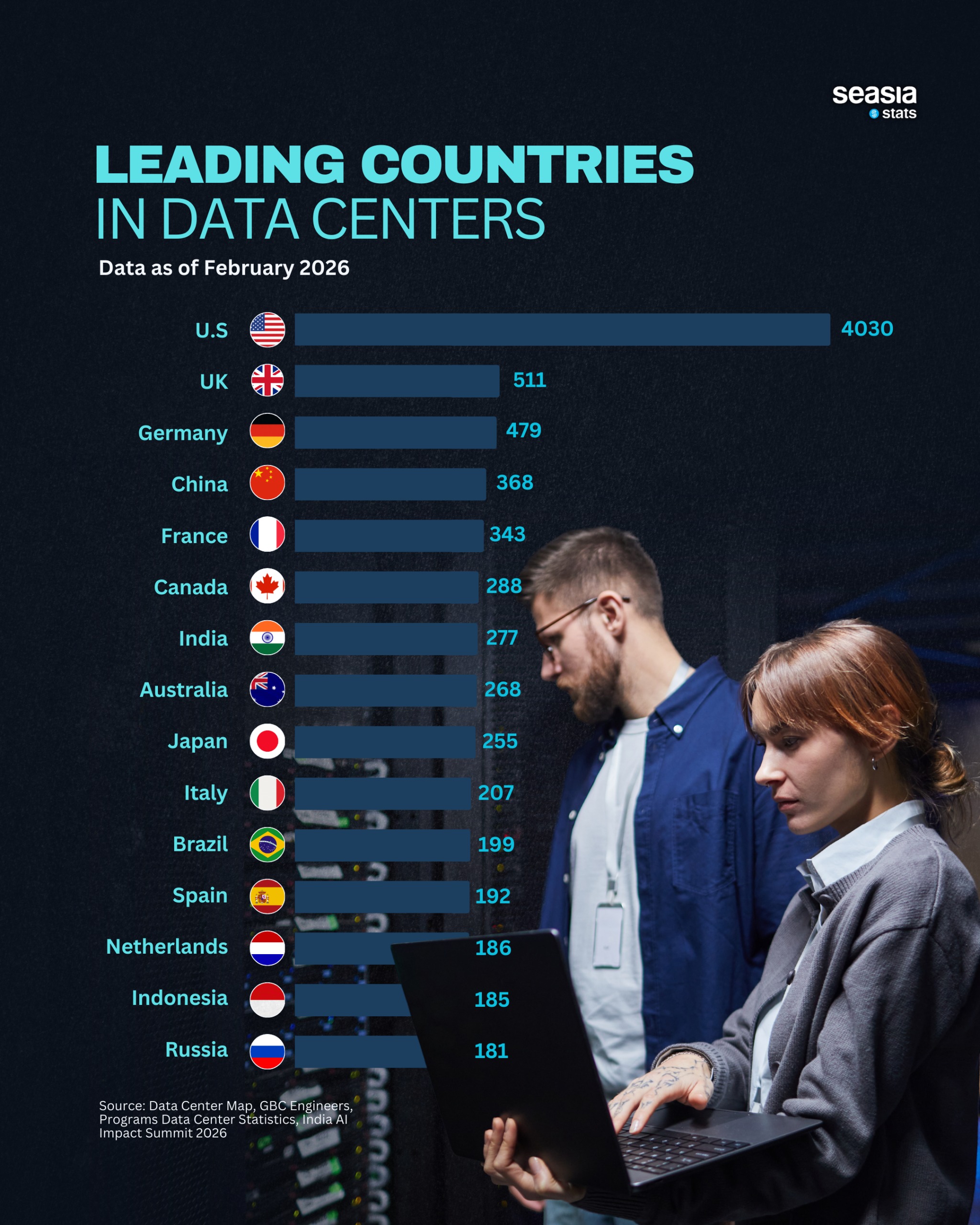
The modern world runs on data—and behind every search, stream, and transaction lies a vast network of data centers quietly powering the global digital economy. As of early 2026, the global map of these facilities reveals not just technological capacity, but also economic strength, strategic positioning, and future digital ambitions.
The United States: The Global Data Powerhouse
At the top of the global rankings stands the United States, home to an extraordinary 4,030 data centers. This figure dwarfs every other country—nearly eight times more than its closest competitor. The U.S. dominance is no accident; it is driven by the presence of major cloud providers, global tech giants, and some of the world’s most advanced artificial intelligence infrastructure.
From Silicon Valley to Northern Virginia—often referred to as the “Data Center Alley”—the country serves as the backbone of global internet traffic. Its massive scale ensures the smooth operation of everything from social media platforms to financial systems and global cloud services.
Europe’s Strategic Digital Hubs
Across the Atlantic, Western Europe has emerged as a key region for data sovereignty and cross-border connectivity. The United Kingdom leads the continent with 511 data centers, followed closely by Germany with 479. France (343), Italy (207), Spain (192), and the Netherlands (186) round out a strong European presence.
Europe’s digital infrastructure is not only about scale but also about regulation and trust. Strict data protection laws like GDPR have made these countries attractive for companies that prioritize secure and compliant data storage within regional borders.
Asia-Pacific: A Region on the Rise
The Asia-Pacific region is rapidly catching up, driven by expanding digital economies and a booming middle class. China leads the region with 368 facilities, followed by India with 277, Australia with 268, and Japan with 255.
Among Southeast Asian nations, Indonesia stands out with 185 data centers, placing it firmly among the world’s top 15. This growth reflects Indonesia’s fast-expanding internet economy, supported by its large population and rapidly digitizing industries.
Other Southeast Asian countries are also gaining momentum. Singapore remains a major regional data hub despite its small land area, thanks to its advanced connectivity and stable regulatory environment. Malaysia is emerging as a strong alternative, particularly in Johor, where large hyperscale data center projects are underway. Thailand and Vietnam are also accelerating investments in digital infrastructure to support e-commerce, fintech, and smart-city initiatives. Meanwhile, the Philippines is expanding its data capacity to support its growing digital services and outsourcing industries.
The Americas and Beyond
Beyond North America, Canada hosts 288 data centers, leveraging its proximity to the U.S. and its cooler climate, which helps reduce energy costs. In Latin America, Brazil leads with 199 facilities, acting as the region’s digital anchor. Russia, with 181 data centers, rounds out the top global list, reflecting its large domestic digital market.
Building the World’s Digital Backbone
Together, these leading nations form the backbone of the global internet, supporting the explosive growth of cloud computing, streaming services, artificial intelligence, and digital commerce. As demand for data continues to surge, countries are racing not just to increase capacity, but also to improve sustainability through renewable energy and energy-efficient cooling systems.
For Southeast Asia, the rise of data centers signals more than just technological progress—it represents a shift toward becoming a key player in the global digital economy. With continued investment and regional collaboration, the region is poised to become one of the world’s most important digital gateways in the years ahead.


