

Southeast Asia’s demographic story in 2026 is one of striking contrasts. From fast-growing youthful societies to rapidly aging economies, the region’s birth rates reveal a complex tapestry shaped by culture, economics, and policy. The latest data from Seasia Stats and the United Nations World Population Prospects highlights just how wide the gap has become—offering a glimpse into the future of Southeast Asia’s workforce, cities, and social systems.
A Region of Two Demographic Paths
Across Southeast Asia, birth rates vary dramatically, reflecting two diverging demographic paths. On one end are nations still experiencing high population growth, driven by youthful populations and relatively higher fertility rates. On the other are countries grappling with record-low birth rates, aging societies, and shrinking future workforces.
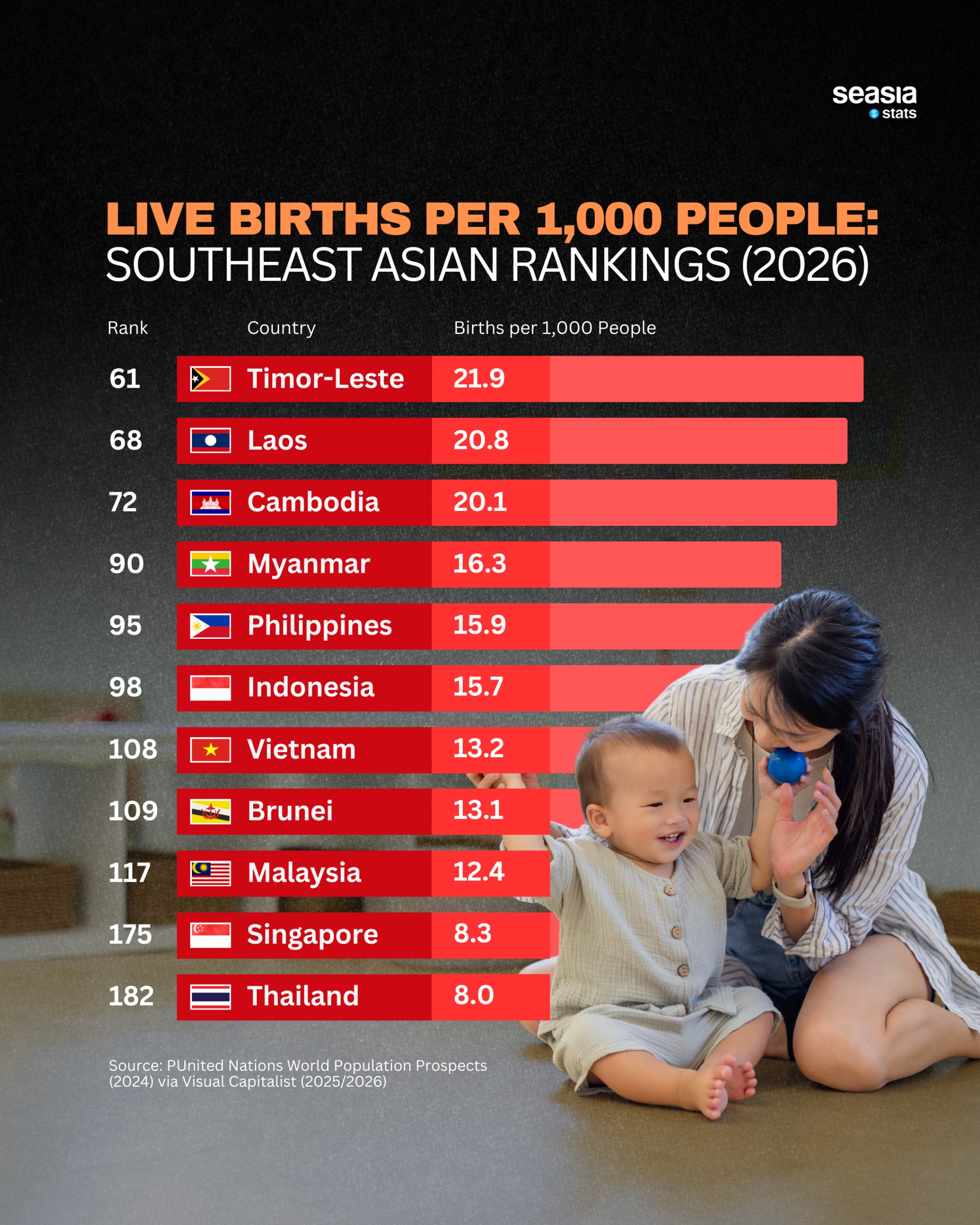
At the top of the regional rankings stands Timor-Leste, recording 21.9 live births per 1,000 people. It is the only country in Southeast Asia to surpass the 20-birth threshold, signaling strong population growth momentum. Laos and Cambodia follow closely, with rates of 20.8 and 20.1 respectively, placing them among the region’s fastest-growing populations.
These countries are characterized by younger age structures and higher fertility norms, as well as improving—but still developing—healthcare and education systems that shape family size and reproductive trends.
Mid-Range Stability Across Emerging Economies
A large group of Southeast Asian countries sits in the middle range, showing more moderate and stable demographic patterns. Myanmar records 16.3 births per 1,000 people, while the Philippines (15.9) and Indonesia (15.7) remain key contributors to the region’s overall population growth.
Indonesia, in particular, plays a critical role due to its massive population base. Even with a moderate fertility rate, the country generates one of the highest total numbers of births in the region each year, shaping labor markets and long-term economic potential.
Vietnam and Brunei fall slightly lower, with birth rates of 13.2 and 13.1 respectively, while Malaysia records 12.4. These figures suggest that many Southeast Asian economies are entering a transitional demographic phase—balancing population growth with increasing urbanization, rising education levels, and changing family preferences.
Southeast Asia’s Record Lows
At the opposite end of the spectrum are Singapore and Thailand, both facing serious demographic challenges. Singapore records a birth rate of just 8.3 per 1,000 people, while Thailand sits slightly lower at 8.0—the lowest in Southeast Asia and one of the lowest globally.
These figures are far below the “replacement level” fertility rate needed to sustain long-term population stability. Rising living costs, delayed marriage, and shifting lifestyle priorities have led to fewer children per household. As a result, both countries are now dealing with aging populations, labor shortages, and increasing pressure on healthcare and pension systems.
Implications for the Future
The wide disparity in birth rates across Southeast Asia carries major implications for the region’s future. Countries with higher fertility rates, such as Timor-Leste, Laos, and Cambodia, are likely to experience continued population growth and a youthful workforce—offering opportunities for economic expansion if supported by education and job creation.
Meanwhile, lower-fertility countries like Singapore and Thailand must adapt to aging societies by investing in productivity, automation, and immigration policies to sustain economic growth.
Across the region, demographic change is reshaping Southeast Asia’s future. Whether through rapid population growth or declining birth rates, each country faces unique challenges—and opportunities—in navigating the next chapter of its demographic journey.


