

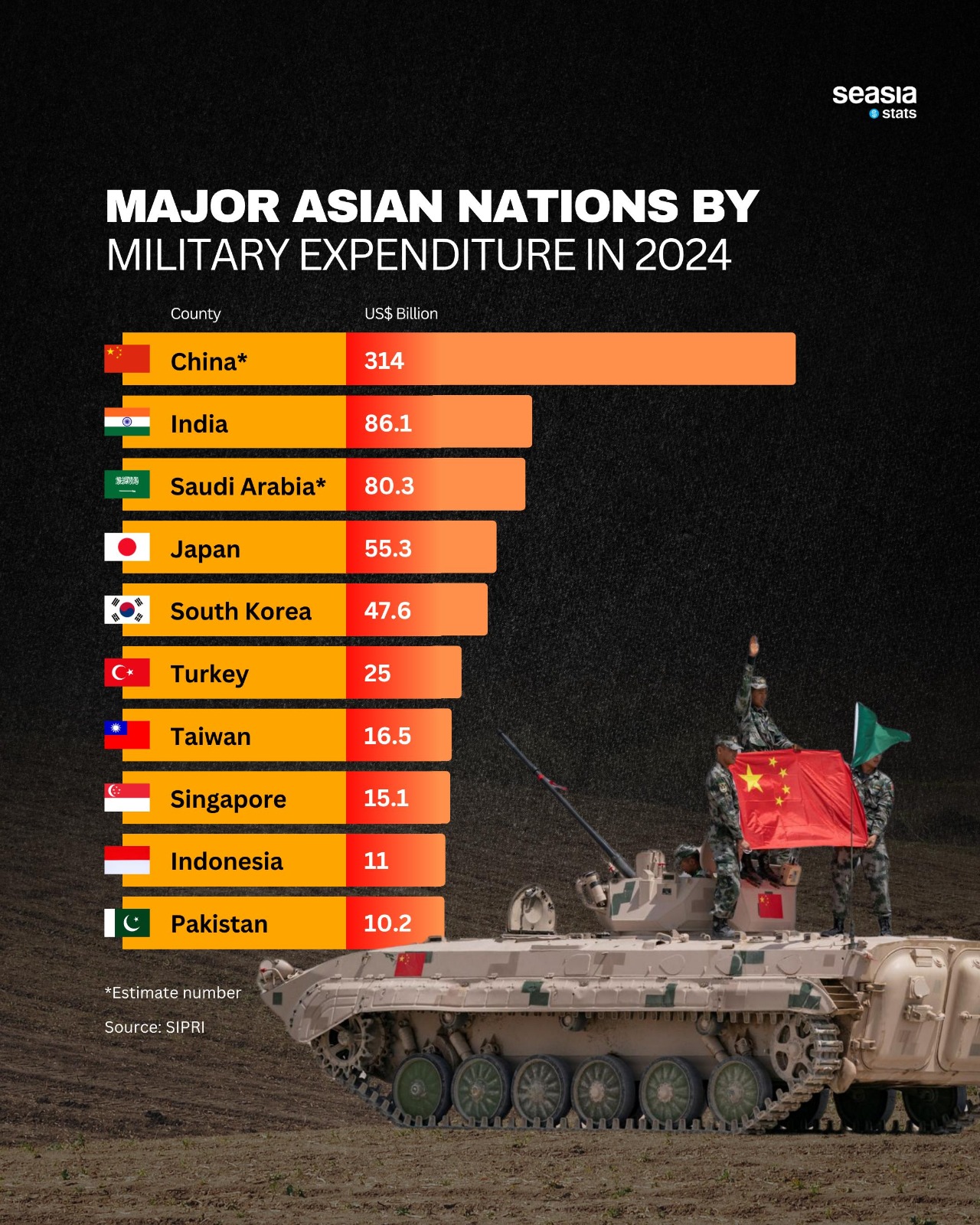
Asia’s military budgets are on the rise — and China is spending more than anyone else by a staggering margin. According to 2024 estimates from the Stockholm International Peace Research Institute (SIPRI), China’s military expenditure reached US$314 billion, more than triple the amount spent by any other country in the region.
This scale of investment not only reflects China’s global ambitions but also intensifies strategic recalculations among its neighbors.
India and Saudi Arabia: Distant But Powerful Seconds
India, the region’s second-largest spender, allocated US$86.1 billion to defense in 2024 — a figure that, while substantial, is still just over a quarter of China’s total. The country continues to modernize its military infrastructure, boost indigenous defense production, and address tensions along its borders.
Meanwhile, Saudi Arabia ranks third with US$80.3 billion, demonstrating its ongoing commitment to advanced weapons procurement and regional security operations, especially given its strategic positioning in the Gulf and proximity to ongoing conflicts.
East Asia’s Heavyweights: Japan and South Korea
Japan and South Korea come in at fourth and fifth, with US$55.3 billion and US$47.6 billion respectively. Both countries are enhancing military readiness in response to North Korean provocations and increased Chinese naval activity in the East China Sea.
Japan, in particular, is undergoing a defense transformation, with growing public and political support for a more assertive security posture. South Korea continues to develop cutting-edge systems, including missile defense and cyber capabilities, while maintaining one of the world’s largest standing armies.
Strategic Middle Tier: Türkiye, Taiwan, and Singapore
Türkiye spent US$25 billion, reflecting its strategic ambitions both in the Middle East and Central Asia. Its growing domestic defense industry and role in NATO give it a unique footprint in the Asian defense ecosystem.
Taiwan, at US$16.5 billion, focuses heavily on defensive capabilities, missile deterrence, and asymmetric warfare, given its strained relationship with China. The spending reflects rising cross-strait tensions and global attention to the island’s status.
Singapore, with US$15.1 billion, continues to prioritize quality over quantity, maintaining one of Southeast Asia’s most technologically advanced militaries. Its expenditure supports not just defense, but also regional stability and humanitarian readiness.
Southeast Asia’s Lower Tier: Indonesia and Pakistan
Indonesia allocated US$11 billion, driven by the need to patrol vast maritime territories and combat regional insurgencies. As the largest archipelagic state in the world, Indonesia faces unique defense challenges across its thousands of islands.
Pakistan, spending US$10.2 billion, maintains a strong conventional military force and continues to invest in nuclear capabilities and border defense with India.
The Power Gap: What It Means for the Region
The massive spending gap between China and the rest of Asia underscores Beijing’s position as the region’s dominant military power — both in size and technological advancement. This imbalance is prompting neighbors to boost alliances, modernize forces, and re-evaluate security strategies, especially within the Indo-Pacific framework.
As territorial disputes, cyber threats, and military modernization accelerate across Asia, 2024's numbers serve as a clear signal: Asia’s arms race is far from over — and China is setting the pace.


