

Global energy flows move across oceans in vast, invisible streams—and at the heart of this system are a handful of narrow maritime corridors that quietly power the world. Known as chokepoints, these strategic passages determine how quickly oil and gas reach global markets. Among them, Southeast Asia’s Strait of Malacca stands out as the busiest and most vital energy artery on the planet.
The Strait of Malacca: Asia’s Energy Lifeline
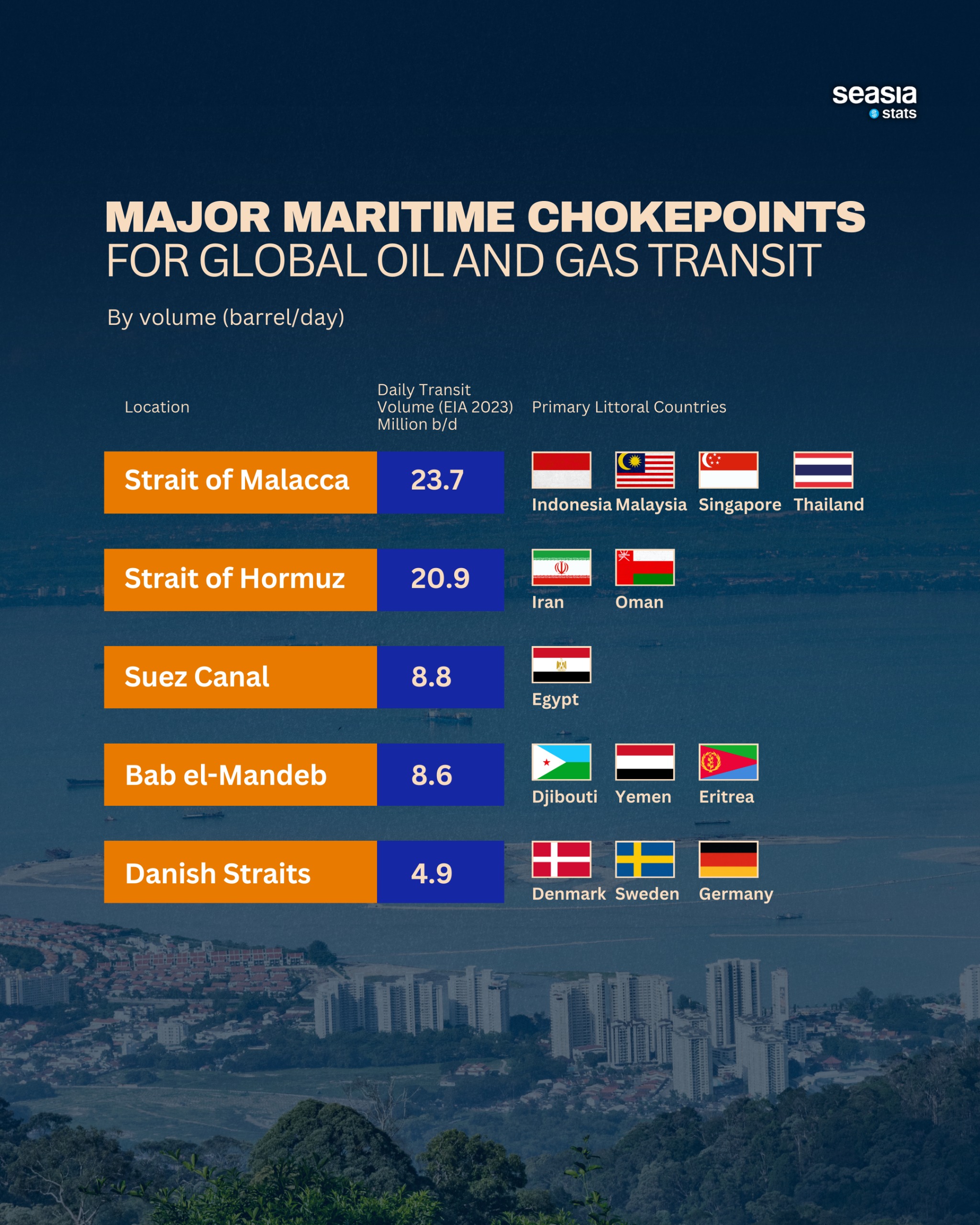
At the center of global maritime trade lies the Strait of Malacca, the world’s most heavily trafficked oil and gas chokepoint. According to 2023 data from the U.S. Energy Information Administration (EIA), an astonishing 23.7 million barrels per day pass through this narrow passage. Bordered by Indonesia, Malaysia, Singapore, and Thailand, it serves as the primary gateway connecting the Indian Ocean with the Pacific.
For Asia’s largest economies—including China, Japan, and South Korea—the Malacca Strait is indispensable. Much of their imported energy from the Middle East flows directly through these waters. This makes Southeast Asia not just a regional hub, but a central pillar of global energy security. The port infrastructure of Singapore, one of the world’s busiest maritime centers, further reinforces the strait’s critical role in fueling regional growth.
The Strait of Hormuz: A Strategic Counterpart
While Malacca leads in volume, the Strait of Hormuz remains one of the most geopolitically sensitive chokepoints in the world. Handling 20.9 million barrels per day, it acts as the main export route for oil from the Persian Gulf. Positioned between Iran and Oman, this narrow passage is essential to global supply chains, with any disruption quickly reverberating through international energy markets.
Together, the Malacca Strait and the Strait of Hormuz account for nearly three-quarters of all oil transported through the world’s top maritime chokepoints, underscoring their unmatched strategic importance.
Connecting East and West: Suez and Bab el-Mandeb
Beyond Asia and the Gulf, two additional chokepoints bridge global trade between East and West. The Suez Canal in Egypt carries 8.8 million barrels per day, linking the Mediterranean to the Red Sea and dramatically shortening shipping routes between Europe and Asia.
Just south of it lies the Bab el-Mandeb Strait, bordered by Djibouti, Yemen, and Eritrea, with a flow of 8.6 million barrels per day. This passage serves as a crucial gateway between the Indian Ocean and the Mediterranean via the Red Sea, forming a continuous energy corridor with the Suez Canal.
Europe’s Gateway: The Danish Straits
In northern Europe, the Danish Straits—linking the North Sea to the Baltic—handle around 4.9 million barrels per day. Though smaller in scale, they remain vital for energy supplies into northern and eastern Europe, particularly for countries like Sweden, Denmark, and Germany.
Southeast Asia’s Expanding Strategic Role
While Malacca dominates global attention, Southeast Asia hosts other emerging maritime routes and energy corridors. Indonesia’s Sunda and Lombok Straits, for instance, offer alternative shipping lanes that can accommodate larger vessels unable to pass through Malacca’s narrow waters. Meanwhile, major ports in Malaysia, Thailand, and Vietnam continue expanding capacity to support rising regional trade.
As Southeast Asia’s economies grow and energy demand surges, the region’s maritime geography is becoming even more critical. Nations across ASEAN are investing heavily in port infrastructure, maritime security, and regional cooperation to safeguard these lifelines.
The Fragile Arteries of Global Trade
Maritime chokepoints are both powerful and vulnerable. A single disruption—from geopolitical tensions to natural disasters—can ripple across global supply chains and energy prices. This makes cooperation among coastal nations essential, particularly in regions like Southeast Asia where trade density is highest.
In a world driven by energy, these narrow straits are far more than shipping lanes—they are the arteries of the global economy. And among them all, the Strait of Malacca stands as Southeast Asia’s defining gateway to the world.


