

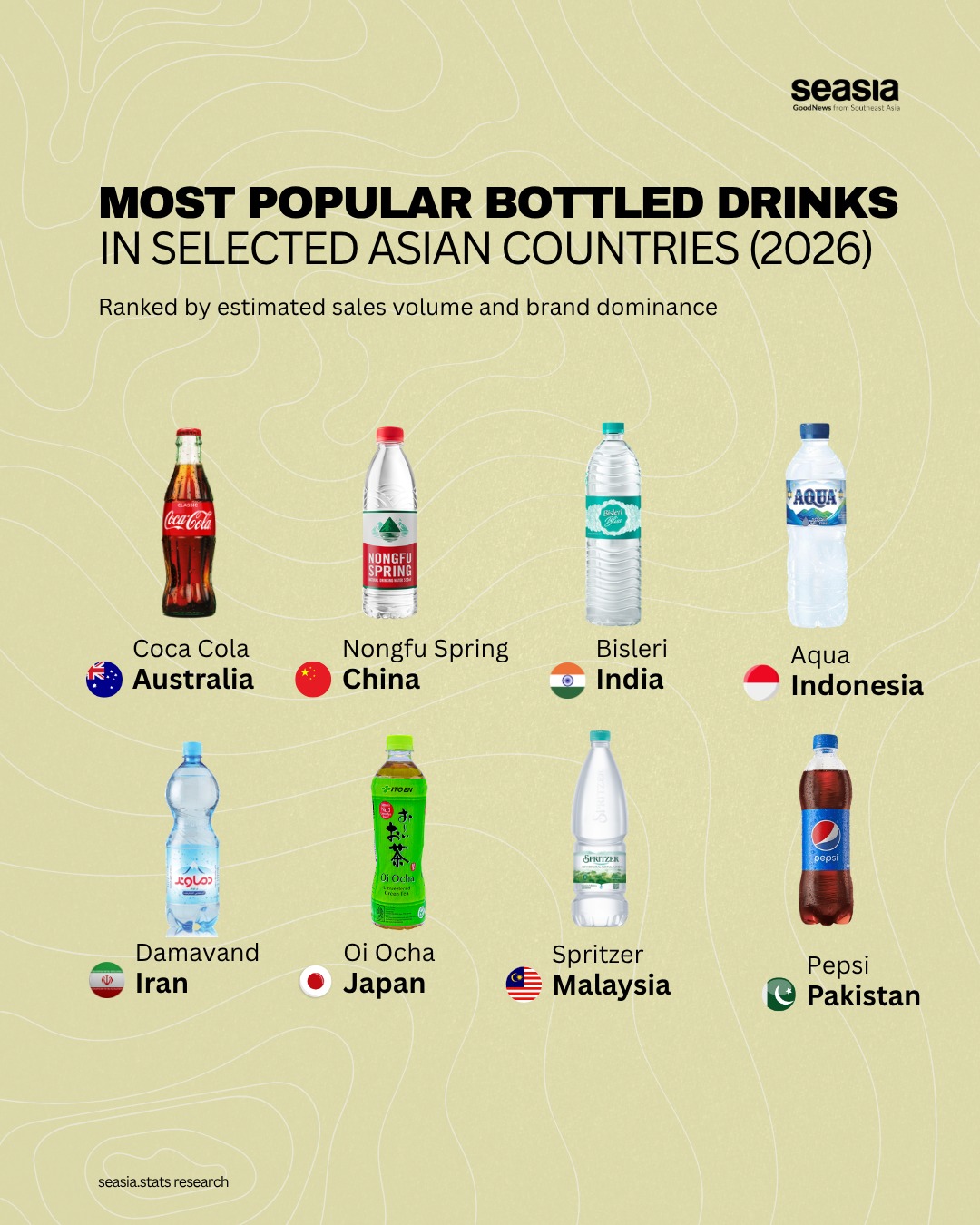
Across Asia, the most popular bottled drink is often not the flashiest product on the shelf. It is the one that fits daily life: the bottle picked up before a commute, tucked into a school bag, carried into an office, or bought from a roadside minimart on a humid afternoon. That is what makes this Seasia Stats snapshot so revealing. Behind every label is a story about climate, health habits, urban living, trust in local brands, and the simple economics of thirst.
Water Still Rules the Region
The clearest pattern in the infographic is that bottled water dominates. From Wilkins in the Philippines to Aqua in Indonesia, Spritzer in Malaysia, La Vie in Vietnam, Singha in Thailand, Bisleri in India, Nongfu Spring in China, and Damavand in Iran, consumers across the region are overwhelmingly reaching for water first.
That makes perfect sense in much of Asia, where hot climates, long commuting hours, and uneven trust in tap water have helped make bottled water an everyday essential rather than a luxury. In many cities, buying a bottle of water is less about lifestyle branding than simple routine. Hydration is practical, portable, and universal.
But this is not just a story about necessity. It is also about brand familiarity. In many countries, bottled water companies have spent years embedding themselves into daily life through convenience stores, food stalls, schools, offices, and travel hubs. Once a brand becomes associated with “safe,” “clean,” or simply “the usual,” it earns a powerful advantage.
Southeast Asia’s Drinking Habits Are Surprisingly Distinct
Southeast Asia may share weather patterns and convenience-store culture, but its bottled drink preferences still reveal strong national identities.
In the Philippines, Wilkins topping the list suggests the enduring strength of mass-market bottled water in a country where on-the-go consumption is deeply tied to commuting, school, and outdoor mobility. In Thailand, Singha—better known internationally for beer—also carries strong recognition in bottled water, showing how established beverage houses can extend trust across categories.
Indonesia’s Aqua may be one of the most culturally embedded beverage brands in the region. In fact, in everyday Indonesian speech, “Aqua” is often used almost interchangeably with bottled water itself, much like how some brands become shorthand for the whole category. That level of dominance says something powerful: consumers are not just buying a product, they are buying habit.
Meanwhile, Malaysia’s Spritzer and Vietnam’s La Vie reflect two slightly different but equally important market dynamics: national familiarity and strong distribution. These are the kinds of brands that thrive not by being trendy, but by being everywhere.
Singapore, however, is an interesting outlier. While much of Southeast Asia leans heavily on regional water champions, the city-state’s top bottled drink is Dasani, a global label. That fits Singapore’s highly international consumer environment, where multinational brands often compete on equal footing with local preferences.
Not Every Country Wants Plain Water
Still, bottled water does not win everywhere.
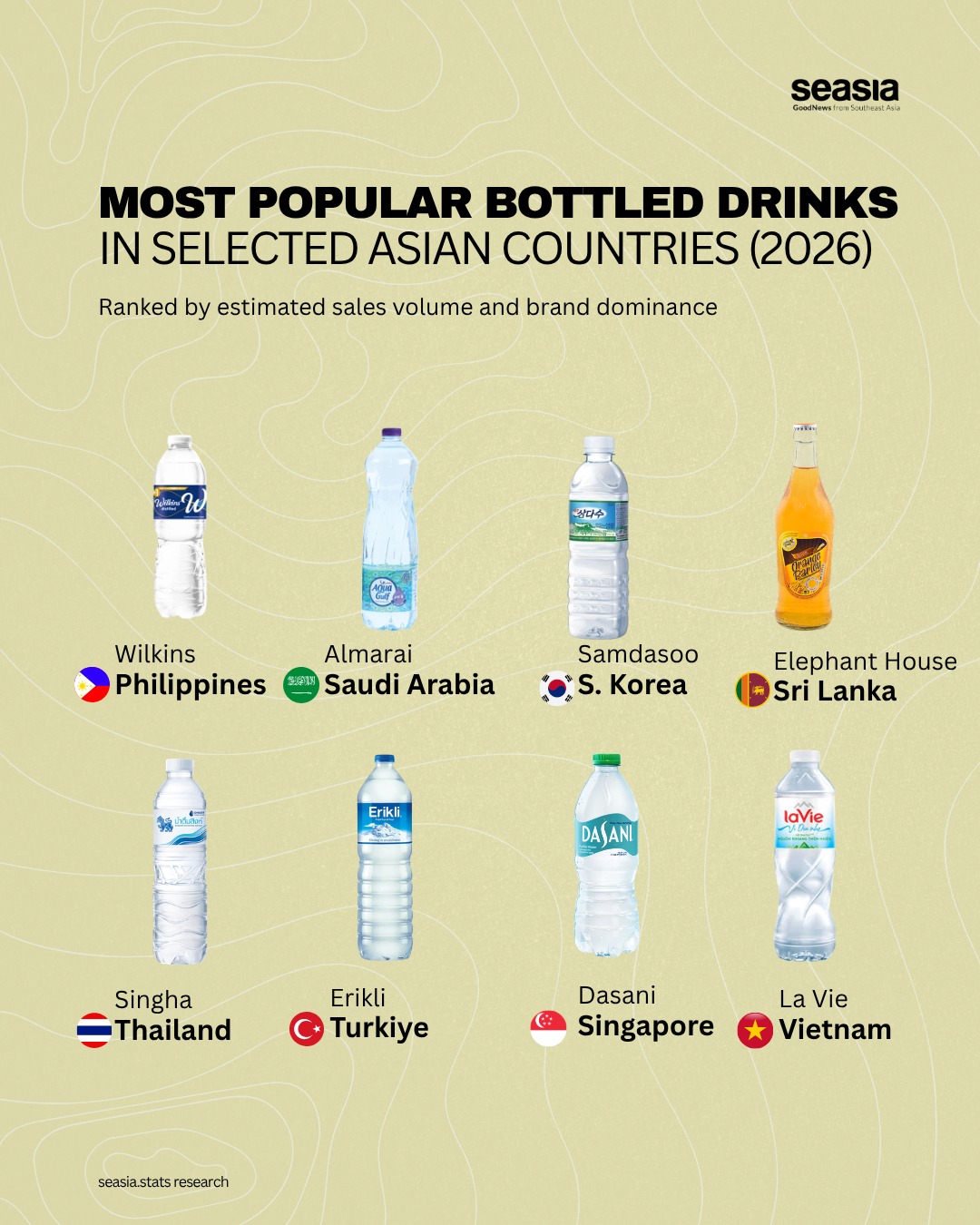
Japan stands apart with Oi Ocha, the bottled green tea that reflects something deeper than beverage preference: it reflects cultural continuity. In Japan, bottled drinks are not merely about refreshment but also about ritual, taste, and everyday refinement. Unsweetened tea remains a deeply normalized choice, making Oi Ocha’s place at the top feel entirely natural.
Australia and Pakistan tell a different story, with Coca-Cola and Pepsi respectively holding the lead. In those markets, global soft drink culture remains exceptionally resilient, suggesting that bottled beverage consumption there is shaped less by hydration-first behavior and more by taste-driven habit and strong legacy branding.
Then there is Sri Lanka, where Elephant House breaks the bottled-water pattern altogether. Its success hints at how nostalgia, local flavor, and emotional attachment can still outweigh the functional logic of water.
A Market Shaped by Trust, Climate, and Culture
What this list ultimately shows is that bottled drinks are never just about what people are thirsty for. They are about what people trust, what they grew up with, what is affordable, and what feels familiar.
And in Southeast Asia especially, that makes bottled beverages a surprisingly intimate reflection of everyday life: hot streets, quick lunches, long rides home, and the little purchases that quietly define how a region lives.


