

In 2025, the story of global population growth is being written in just a handful of countries. From South Asia to Africa and Southeast Asia, these nations account for a significant share of the world’s newborns—shaping future economies, labor markets, and social systems. The latest estimates show a clear trend: population growth is increasingly concentrated in emerging economies with young populations and expanding urban centers.
India’s Unmatched Baby Boom
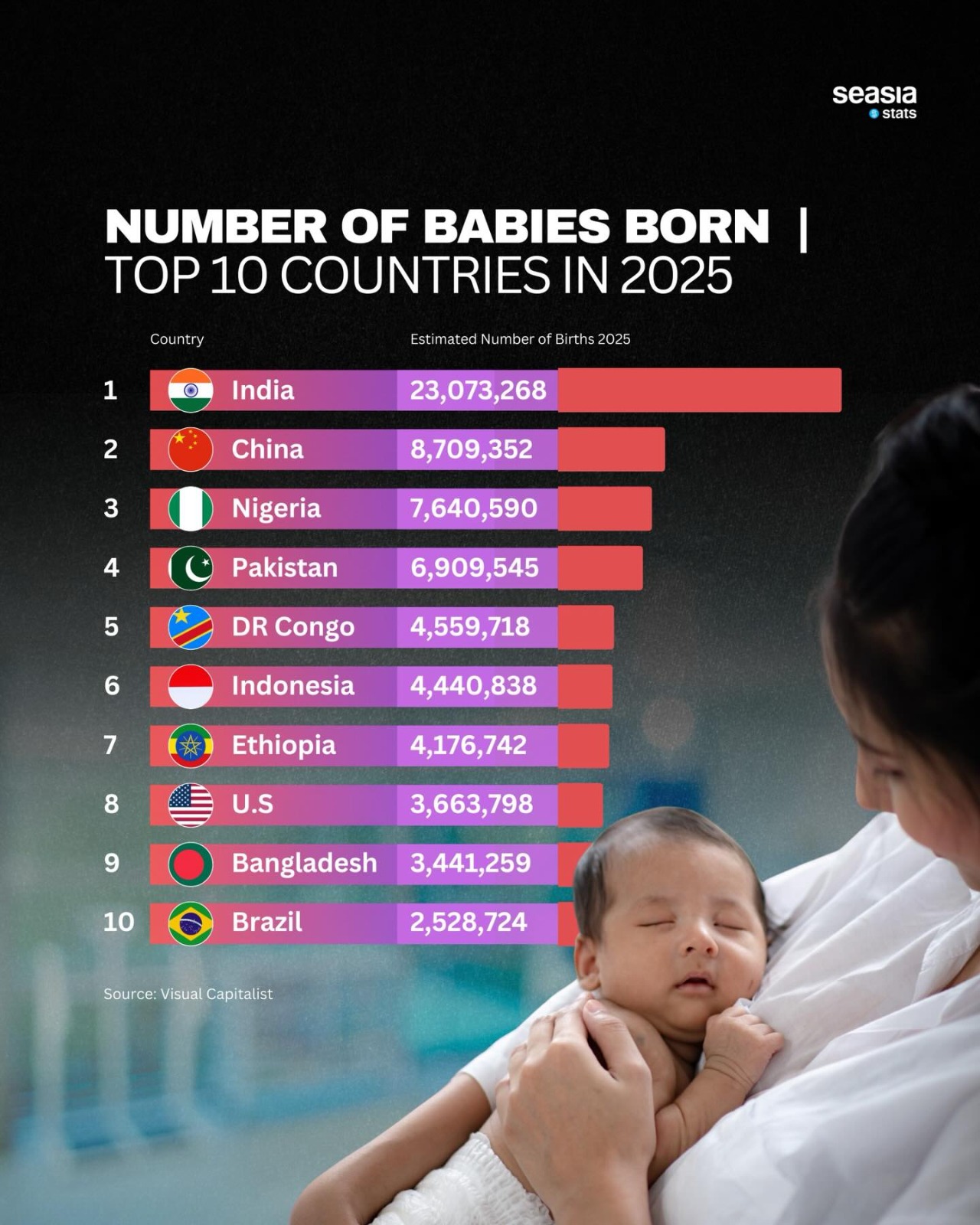
India stands firmly at the top of the global birth chart, with an estimated 23,073,268 babies born in 2025. This figure is nearly three times higher than China’s total, reflecting India’s position as the world’s most populous country and one of its youngest major populations. High fertility rates in certain regions, combined with steady improvements in healthcare access, continue to support this growth.
China follows in second place with 8,709,352 births, a figure that remains significant despite the country’s aging population and declining fertility trends. Meanwhile, Nigeria’s 7,640,590 births highlight Africa’s rapidly expanding demographic influence, with the continent expected to drive much of global population growth over the next century.
The Rising Middle Tier of High-Growth Nations
Beyond the top three, several large developing nations continue to shape global birth trends. Pakistan ranks fourth with 6,909,545 births, followed by the Democratic Republic of Congo at 4,559,718. These countries represent regions where young populations and higher fertility rates remain the norm.
Southeast Asia plays a key role in this middle tier. Indonesia, the region’s largest country, ranks sixth globally with 4,440,838 births, reflecting its large population base and relatively stable fertility levels. Ethiopia, with 4,176,742 births, rounds out the top seven, reinforcing Africa’s demographic momentum.
Southeast Asia’s Demographic Landscape
While Indonesia is the only Southeast Asian country in the global top ten, the region as a whole contributes significantly to global births. Countries such as the Philippines and Vietnam continue to record millions of births annually, supported by young populations and expanding urban economies. The Philippines, in particular, maintains one of the highest fertility rates in ASEAN, while Vietnam’s steady population growth is linked to improved healthcare and economic stability.
Elsewhere in Southeast Asia, nations like Malaysia, Thailand, and Cambodia are experiencing slower but still meaningful population growth. Thailand’s fertility rate has declined in recent decades, yet its total births remain substantial due to its large population. Cambodia and Laos, meanwhile, continue to see steady increases driven by rural population dynamics.
Western Nations and Emerging Giants
Among developed economies, the United States is the only Western nation to appear in the top ten, with 3,663,798 births, placing it eighth globally. Its ranking reflects both its large population and relatively higher fertility rate compared to other developed countries.
Bangladesh and Brazil complete the list, with 3,441,259 and 2,528,724 births respectively. These countries represent a mix of dense population centers and emerging middle-income economies, where population growth remains a key factor in long-term development planning.
A New Global Demographic Balance
Taken together, these ten countries account for a substantial portion of the world’s new population in 2025. The trend is clear: future population growth is increasingly centered in Asia and Africa, with Southeast Asia playing a vital supporting role.
This demographic shift will shape everything from global labor markets to urbanization patterns and economic development in the decades ahead. As millions of new lives begin each year in these regions, they represent not just statistics—but the next generation that will define the world’s future.


