

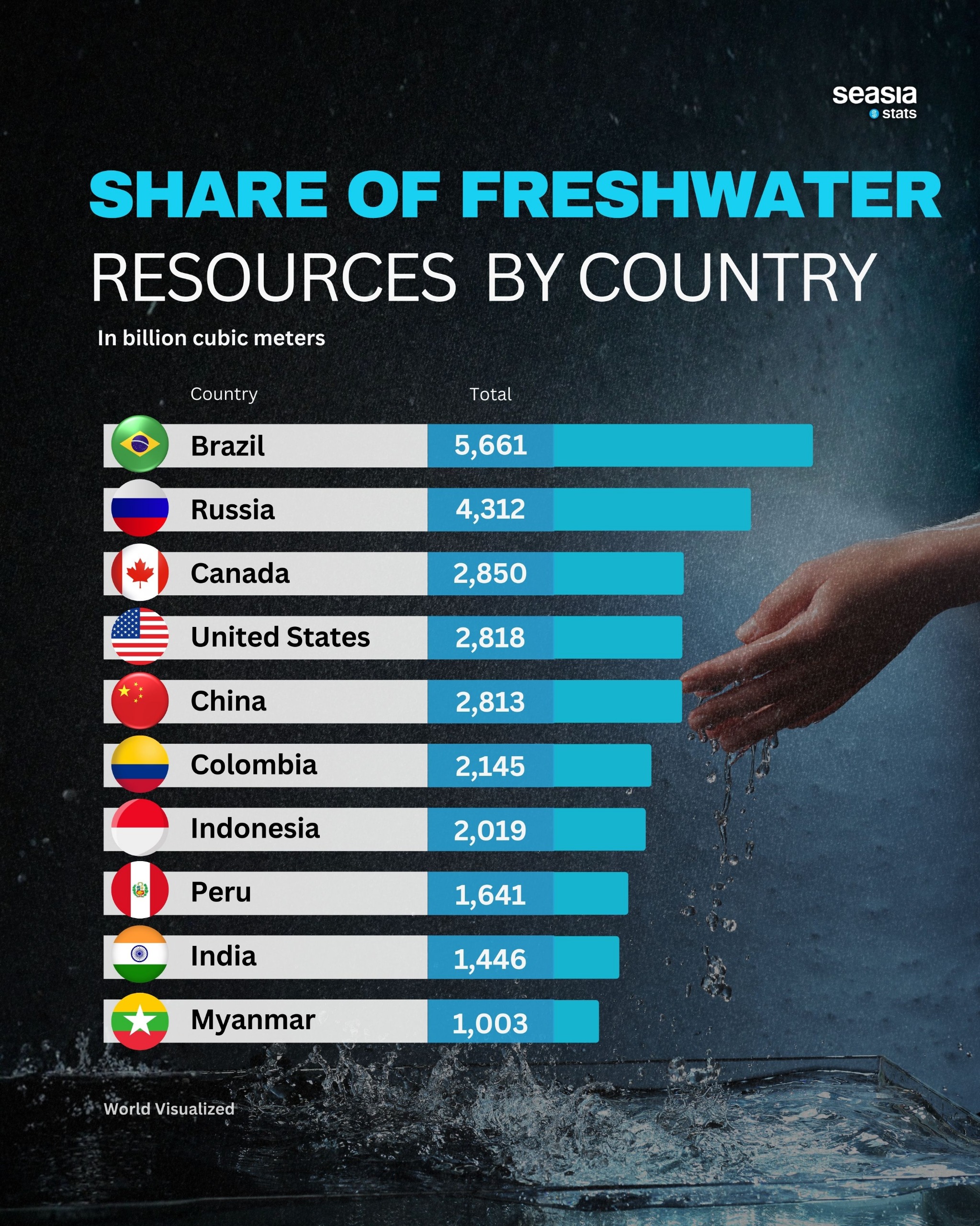
Freshwater is one of the planet’s most valuable forms of wealth—more strategic than oil in some places, more politically sensitive than land, and far more unevenly distributed than most people realize. The latest ranking highlighted by Seasia Stats, based on World Visualized data, is a reminder that while some countries sit atop immense reserves of rivers, lakes, and rainfall, abundance does not always translate into security.
The Countries That Hold the Most Water
Brazil leads the world by a wide margin with 5,661 billion cubic meters of freshwater resources, followed by Russia at 4,312 billion cubic meters. Together, they represent two of the planet’s most important hydrological giants. Brazil’s dominance is closely tied to the Amazon Basin, while Russia’s strength lies in its enormous river systems and freshwater lakes, including Lake Baikal.
Canada, the United States, and China form a second tier, all clustered just above or around 2,800 billion cubic meters. These are countries with enormous geographic scale, diverse climates, and highly developed agricultural and industrial systems that depend heavily on water. But even in water-rich nations, access and distribution are often deeply uneven.
The World Resources Institute has repeatedly warned that water stress is not simply about how much freshwater a country has in total, but how much of it is available where and when people actually need it. In other words, water abundance on paper does not guarantee water resilience on the ground.
Southeast Asia’s Hidden Water Power
This is where Southeast Asia becomes especially interesting. Indonesia ranks seventh globally with 2,019 billion cubic meters of freshwater, while Myanmar also appears in the top ten with 1,003 billion cubic meters. These are not small numbers. In fact, they place both countries among the world’s most naturally water-endowed nations.
Indonesia’s water wealth comes from a combination of tropical rainfall, volcanic landscapes, mountain-fed river systems, and one of the largest archipelagic ecosystems on Earth. Yet this abundance exists alongside a very real vulnerability: water is not evenly distributed across the islands, and rapid urbanization has strained supply systems in major cities like Jakarta.
Myanmar’s position is similarly striking. The country’s river systems—especially the Ayeyarwady, Chindwin, and Salween—give it enormous freshwater potential. But infrastructure, governance, and conflict have all limited how effectively that resource can be managed and equitably used.
This is one of the central paradoxes of water in Southeast Asia: some countries are rich in water resources, but poor in water security.
Plenty of Water, Growing Pressure
That paradox is becoming harder to ignore. Across Southeast Asia, water demand is rising due to urban expansion, industrialization, hydropower development, and agricultural pressure. The Mekong region, in particular, has become one of the world’s most closely watched freshwater zones.
Reuters has reported extensively on how hydropower dams, changing rainfall patterns, and upstream-downstream tensions are reshaping the Mekong’s flow, affecting livelihoods from Laos and Thailand to Cambodia and Vietnam. That means freshwater is no longer just an environmental issue. It is becoming a geopolitical one.
Indonesia faces its own version of this challenge. Despite huge national water reserves, pollution, groundwater depletion, and climate-related rainfall variability are increasingly affecting long-term water management. Water-rich countries, in other words, can still become water-stressed if planning fails.
The New Meaning of Water Wealth
What this ranking ultimately shows is that freshwater wealth is not just about volume. It is about stewardship. Countries with large reserves now face a more urgent question: can they protect and manage what they have before scarcity, pollution, and climate disruption catch up with them?
For Southeast Asia, that question is becoming more important every year. Indonesia and Myanmar may sit among the global leaders in freshwater resources, but their future advantage will depend not on how much water they possess, but on how wisely they use it.
In the twenty-first century, water is no longer just a natural gift. It is a test of governance, resilience, and survival.


