

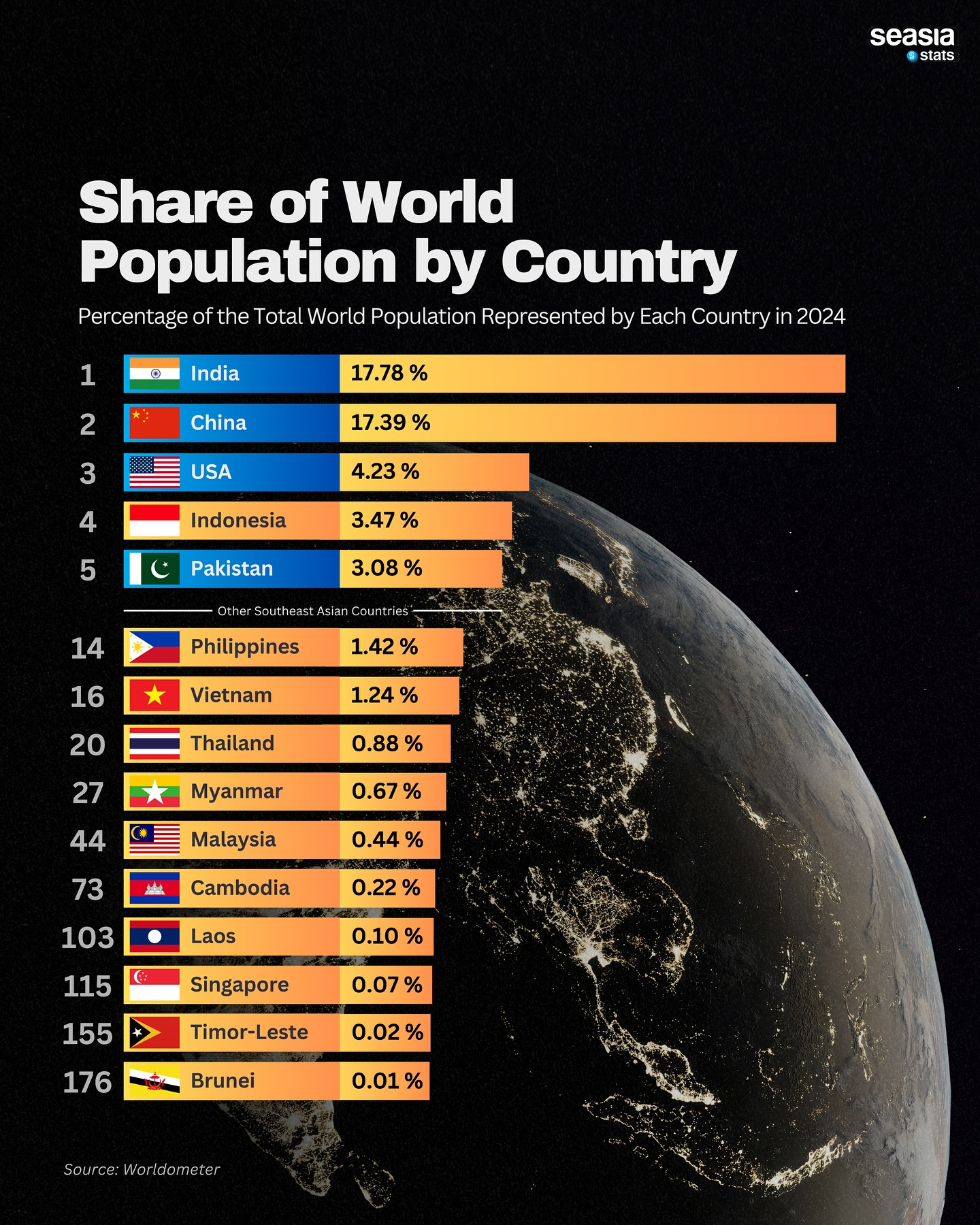
As of 2024, Southeast Asia continues to play a significant role in the global population landscape, with several countries contributing sizable shares to the world's total population. This distribution of global population highlights the demographic importance of the region, particularly Indonesia, which stands as the most populous country in Southeast Asia and the 4th largest population globally.
Indonesia Leads Southeast Asia in Population
According to data from Worldometer, Indonesia, with its vast population, accounts for 3.47% of the world's total population. This makes Indonesia the 4th most populous country in the world, after India, China, and the United States. With over 273 million people, Indonesia's population is a major demographic force, not only in Southeast Asia but also globally.
Other Key Southeast Asian Contributors
Following Indonesia, the Philippines holds the 14th spot globally, contributing 1.42% to the world's population. The Philippines’ population growth has remained steady, positioning it as a significant player in both regional and global demographics.
Viet Nam is close behind at 16th place, representing 1.24% of the world's population. Both the Philippines and Viet Nam have large, youthful populations that continue to drive economic and social developments within the region.
Southeast Asia's Smaller Populations
While Indonesia, the Philippines, and Viet Nam are among the most populous countries in the region, other Southeast Asian nations contribute smaller shares to the global population. Thailand ranks 20th globally, accounting for 0.88% of the world's population. Myanmar, Malaysia, Cambodia, and Laos follow, with shares ranging from 0.67% to 0.10%.
At the lower end of the spectrum, smaller nations such as Singapore (0.07%), Timor-Leste (0.02%), and Brunei Darussalam (0.01%) have minimal contributions to the global population but are important regional players in terms of culture, economics, and geopolitics.
Southeast Asia's Demographic Significance
Southeast Asia’s combined population represents a significant portion of the global population. With Indonesia leading the region, followed by other key players like the Philippines and Viet Nam, Southeast Asia's demographic dynamics are critical to understanding global population trends. These countries, with their large populations, are also crucial for global economic growth, consumption, and labor markets.
Understanding the distribution of the global population helps in planning for future challenges, such as resource allocation, urbanization, and international development. As Southeast Asia continues to grow and evolve, its demographic influence on the world stage will undoubtedly expand.


