

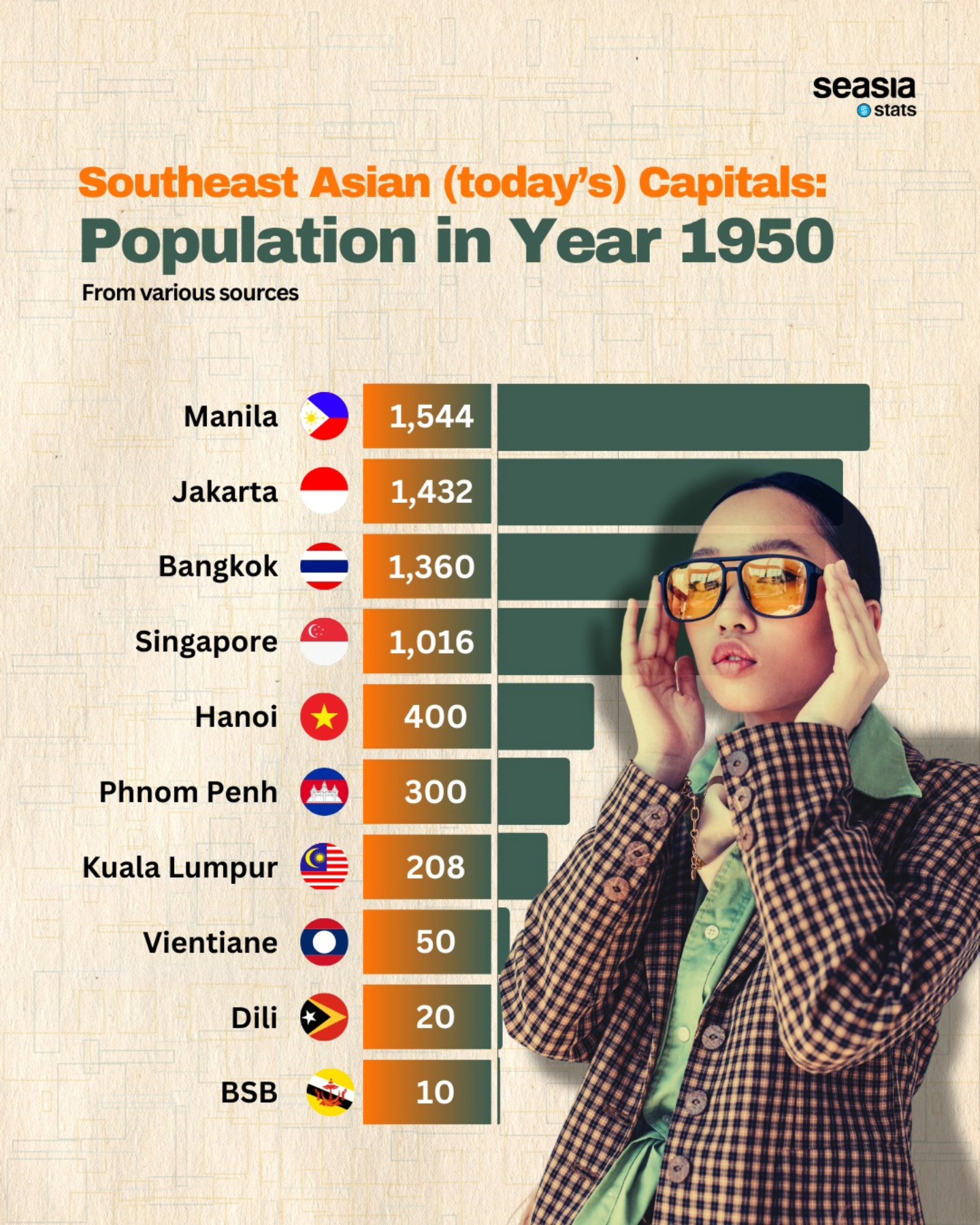
In 1950, Southeast Asia was undergoing profound demographic changes as countries moved toward independence, reshaping their political and urban landscapes. The capitals of these nations stood as key centers of cultural, political, and economic activity, each reflecting its unique trajectory of development.
Jakarta and Manila: Regional Giants
Jakarta, the capital of Indonesia, had a population of approximately 1,432,085 in 1950. Already a bustling urban center, Jakarta symbolized Indonesia's economic and political ambitions as the country embraced independence. Its growth marked the early stages of its transformation into Southeast Asia's largest metropolitan area.
Similarly, Manila, the capital of the Philippines, was one of the largest cities in the region, with an estimated population of 1,544,000. Manila's strategic location and role as the country's administrative and economic core made it a dynamic hub for Southeast Asia during this transformative period.
Bangkok and Singapore: Cultural and Trade Hubs
In Bangkok, Thailand’s capital, around 1,360,000 residents called the city home in 1950. Its position as the cultural and political heart of the nation was well-established, with steady growth fueled by its prominence in the region.
Further south, Singapore thrived as a global trading port with a population of approximately 1,016,000. Its strategic location and robust trade networks positioned it as a crucial economic player, laying the groundwork for its later emergence as a global financial hub.
Emerging Capitals: Hanoi, Phnom Penh, and Kuala Lumpur
In northern Viet Nam, Hanoi had an estimated population of 400,000, serving as a significant cultural and administrative center during a time of political transition. In Cambodia, Phnom Penh was experiencing rapid growth, with a population of about 300,000, reflecting its role as a central hub as the country emerged from colonial rule.
Meanwhile, Kuala Lumpur in British Malaya, with a population of 176,000 (in 1947), was smaller in comparison. However, its importance as a trading and administrative center ensured steady urbanization, setting the stage for its later expansion.
Smaller Capitals: Vientiane, Bandar Seri Begawan, and Dili
Vientiane, the capital of Laos, had a modest population of 50,000, underscoring the nation’s predominantly rural character. In Brunei, Bandar Seri Begawan had only about 10,000 residents, reflecting the small size and population of the country at the time.
Further east, Dili, the capital of Timor-Leste under Portuguese colonial rule, housed approximately 20,000 people. Though modest in size, Dili served as an administrative center, with its growth tied to the region's broader colonial dynamics.
The capitals of Southeast Asia in 1950 showcased varying degrees of urbanization and population growth, reflecting the diverse cultural, economic, and political contexts of the region. From the bustling streets of Manila and Jakarta to the quieter administrative hubs like Vientiane and Bandar Seri Begawan, these cities formed the backbone of a region in transition, setting the stage for Southeast Asia's modern evolution.


