

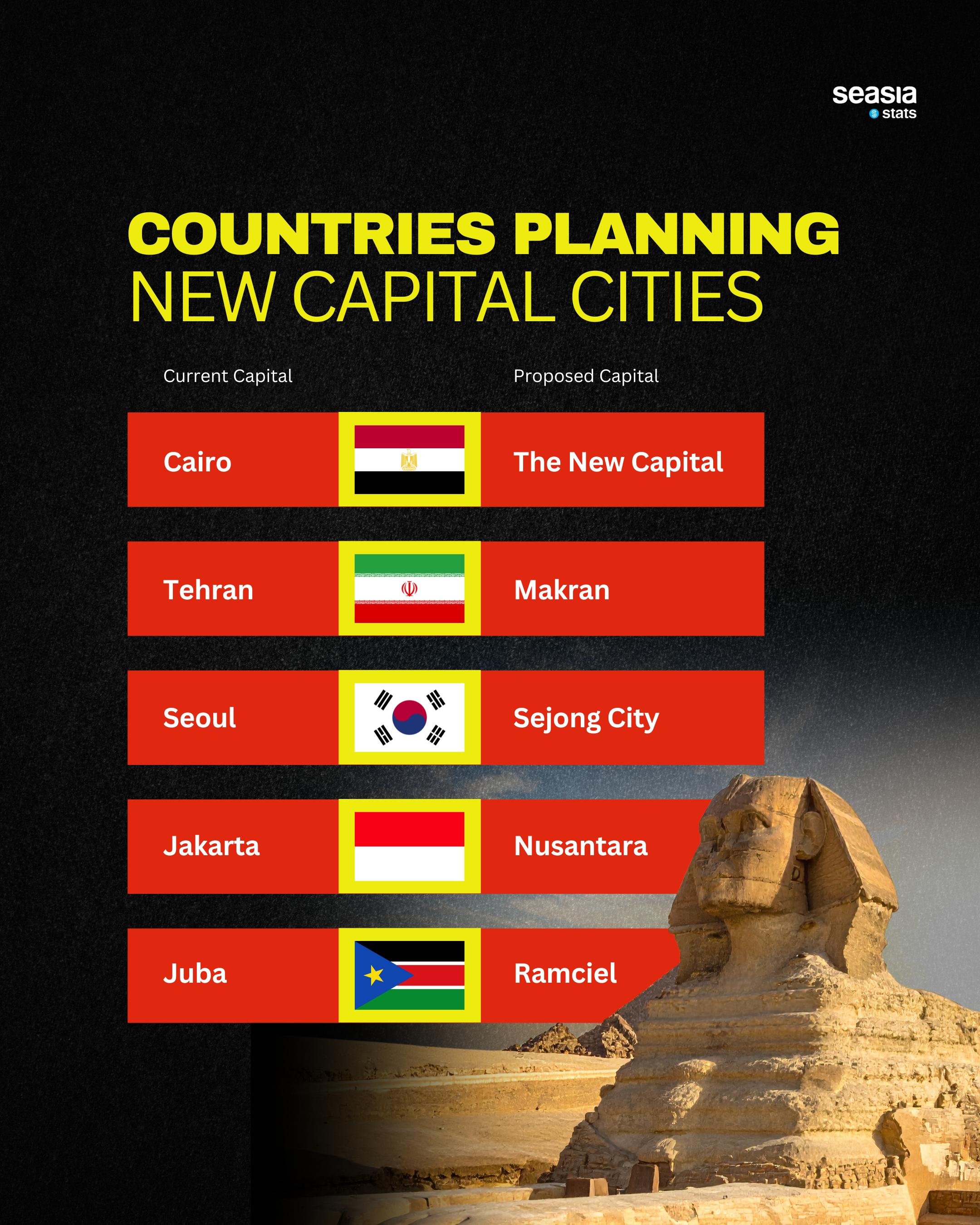
Around the world, a quiet but dramatic transformation is underway. Governments are redrawing their political maps—not by changing borders, but by relocating their capitals. From Southeast Asia to Africa and the Middle East, countries are investing billions to build entirely new administrative cities, driven by climate threats, overcrowding, and the desire for a fresh national beginning.
Why Nations Abandon Old Capitals
Building a new capital is one of the most ambitious decisions a country can make. Historically, the strategy has been used to escape urban decay, reduce congestion, and rebalance political power. Brazil’s Brasília and Nigeria’s Abuja were carved from the interior to ease pressure on coastal cities, while Australia’s Canberra and Pakistan’s Islamabad were designed to resolve regional rivalries and improve security.
These projects are never just about buildings—they are statements of national intent, signaling modernization, unity, and long-term planning.
Indonesia’s Nusantara: Southeast Asia’s Boldest Move
The most closely watched capital relocation today is Indonesia’s Nusantara, a planned city rising in East Kalimantan on the island of Borneo. With an estimated cost of US$32 billion, Nusantara is designed as a “forest city,” integrating government offices with green space, renewable energy, and smart infrastructure.
Jakarta’s chronic congestion, pollution, and land subsidence—parts of the city are sinking by more than 10 centimeters a year—made relocation increasingly unavoidable. Nusantara is intended not only to relieve Jakarta, but also to shift economic gravity away from Java and promote more balanced national development.
Within Southeast Asia, Indonesia’s move is unprecedented in scale and ambition.
Egypt, Iran, and South Sudan Follow Suit
Indonesia is not alone. Egypt is rapidly developing its New Administrative Capital east of Cairo, a vast desert city designed to house ministries, embassies, and up to 6 million residents. The project aims to modernize Egypt’s bureaucracy and ease pressure on overcrowded Cairo.
Iran has proposed relocating its capital from Tehran to the Makran region, citing earthquake risk, congestion, and strategic access to the Indian Ocean. Meanwhile, South Sudan plans to move its capital from Juba to Ramciel, a more central location envisioned as a symbol of national unity and stability.
Southeast Asia: Climate Pressure Forces Rethinking
Climate change is increasingly driving capital city debates across Southeast Asia. Thailand has openly discussed the possibility of relocating its capital as Bangkok continues to sink and faces rising sea levels. While no final decision has been made, studies into alternative inland sites are underway.
In Malaysia, although Kuala Lumpur remains the official capital, administrative functions have already shifted to Putrajaya, reflecting a partial decentralization model. Myanmar made a similar move earlier by relocating its capital to Naypyidaw, a purpose-built city designed for security and administrative control.
These examples show that Southeast Asia is experimenting with multiple models—from full relocation to split-capital systems.
New Capitals as National Reset Buttons
Beyond infrastructure, new capitals serve as symbolic reset buttons. Uzbekistan’s New Tashkent, currently under construction, is designed as a modern administrative extension to handle rapid population growth. Equatorial Guinearecently completed its move to Ciudad de la Paz, officially relocating its capital inland in early 2026 to improve accessibility and spur regional development.
A Trend Shaped by the Future
Relocating a capital is risky, expensive, and politically sensitive—but for many nations, standing still is riskier. As megacities strain under population growth, climate threats, and outdated infrastructure, new capitals offer a chance to reimagine governance itself.
In the 21st century, power is no longer just inherited—it is being rebuilt, city by city.


