

More than three decades after the end of the Cold War, communism has largely faded as a governing system. Yet in 2026, five countries remain officially ruled by a single Communist Party, each following its own path while maintaining firm political control. From global manufacturing hubs to some of the world’s most closed economies, these states offer sharply different interpretations of what communist rule looks like in the modern era.
A Small Club With Very Different Models
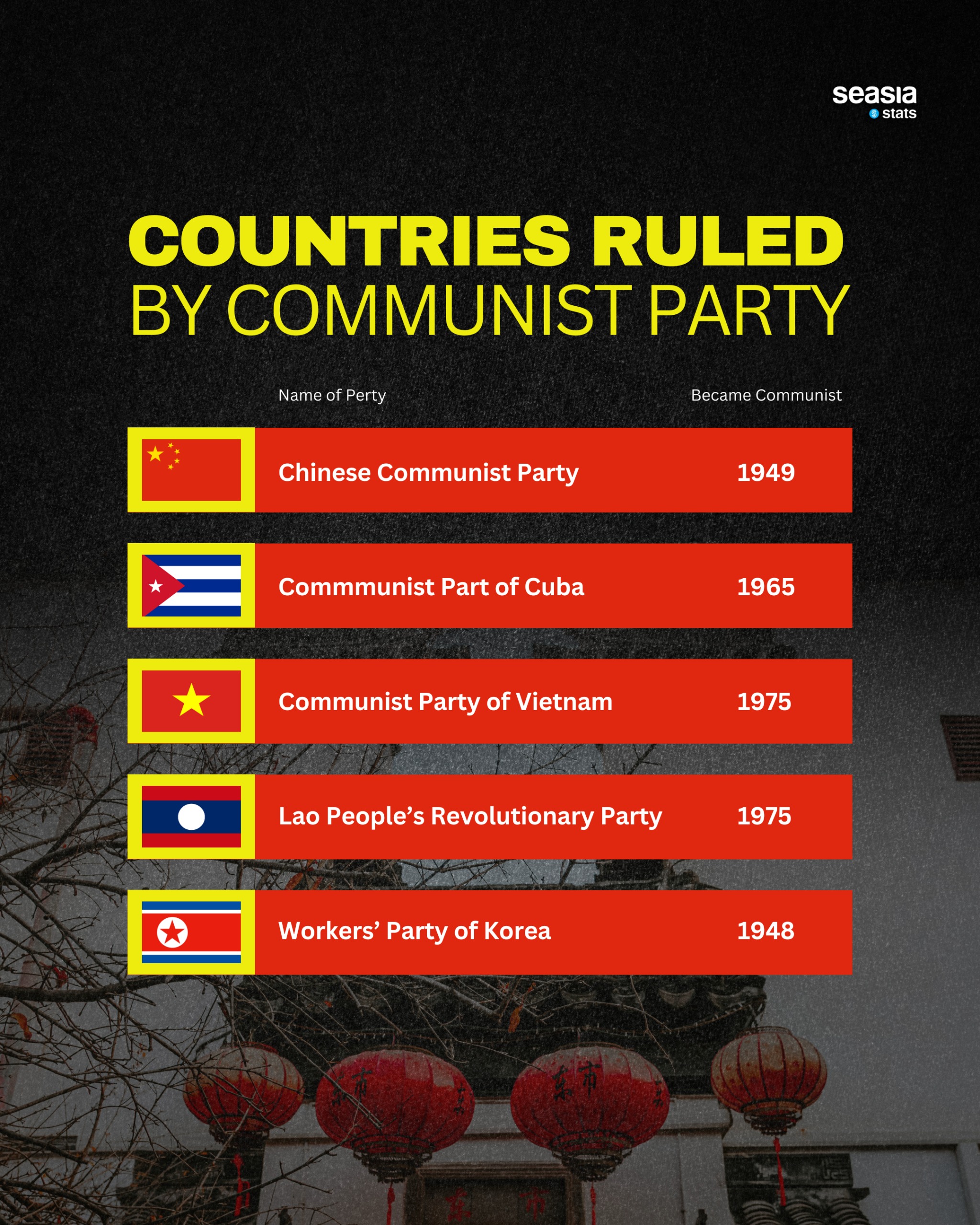
Today’s communist-led countries are China, Vietnam, Laos, Cuba, and North Korea. What unites them is not economic structure, but politics: in all five, the ruling Communist Party holds supreme authority over the state, with no legal path to multiparty competition. Beyond that shared framework, their economic systems diverge dramatically.
China: Market Power Under Party Control
The most prominent example is China, governed by the Communist Party of China (CPC) since 1949. Over the past four decades, China has embraced market reforms that transformed it into the world’s second-largest economy. Private enterprise, global trade, and foreign investment are central to its growth.
Yet politically, the CPC maintains strict control. The party dominates the military, judiciary, media, and digital space, framing stability and national security as core priorities. China’s model—often described as “socialism with Chinese characteristics”—has become one of the most influential governance systems of the 21st century.
Vietnam and Laos: Southeast Asia’s Socialist Reformers
In Southeast Asia, Vietnam and Laos represent a distinct category: market-oriented socialist states.
Vietnam, ruled by the Communist Party of Vietnam since reunification in 1975, has emerged as one of the world’s fastest-growing manufacturing and export economies. Its Đổi Mới reforms opened the door to private business, foreign investment, and global supply chains—while keeping political power firmly centralized.
Neighboring Laos, governed by the Lao People’s Revolutionary Party, follows a similar but smaller-scale path. Its economy relies heavily on hydropower, mining, and regional trade, particularly with China and Thailand. While economic liberalization exists, political authority remains tightly held.
Together, Vietnam and Laos illustrate how communist rule in Southeast Asia has adapted pragmatically to globalization without loosening party control.
Cuba: Gradual Change Under Pressure
In the Caribbean, Cuba is governed by the Communist Party of Cuba, which formally assumed sole leadership in 1965. For decades, Cuba operated under a highly centralized socialist model. However, persistent economic pressure, U.S. sanctions, and declining state revenues have forced gradual reform.
In recent years, Cuba has expanded space for small private businesses, cooperatives, and limited market activity. While these changes aim to stabilize the economy, the political system remains firmly one-party, with no indication of structural liberalization.
North Korea: Ideology Above All
North Korea, led by the Workers’ Party of Korea since 1948, stands apart even within this small group. Its guiding philosophy, Juche, blends Marxism-Leninism with extreme nationalism and dynastic leadership.
The result is the world’s most isolated economy, dominated by state ownership, military priorities, and near-total control over information and movement. Unlike China or Vietnam, North Korea has shown little sustained interest in market reform.
Communism in the 21st Century
That only five countries remain under Communist Party rule highlights how rare the system has become. Yet their survival also shows its flexibility. From China’s industrial might to Vietnam’s export-driven growth and Laos’ regional integration, communism today is less about uniform economics and more about political monopoly.
In Southeast Asia especially, the model has evolved—not disappeared—shaped by pragmatism, geography, and the pressures of a globalized world.


