

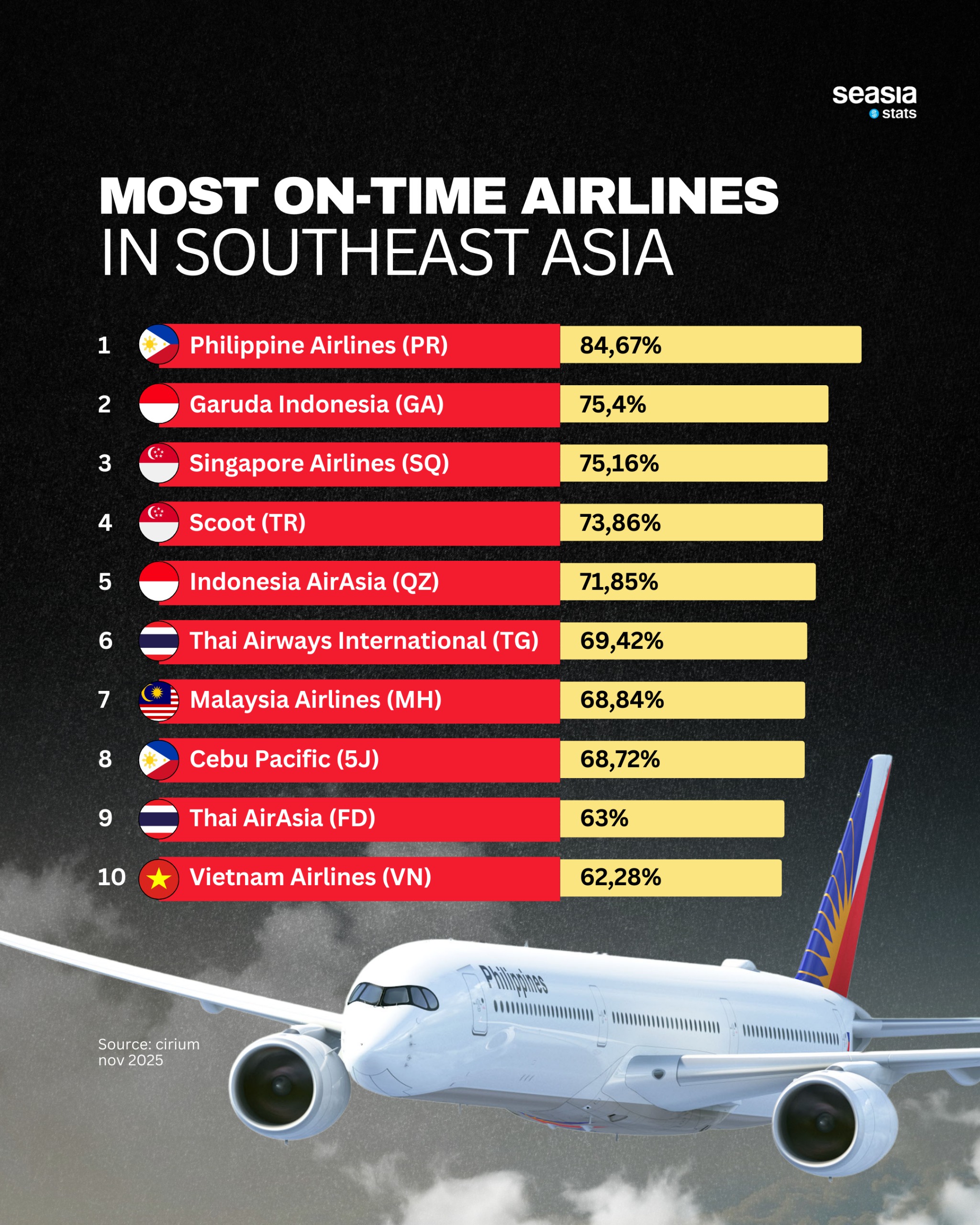
In a region known for busy skies, rapid growth, and weather-related disruptions, punctuality is no small achievement. Yet in 2025, Southeast Asian airlines have quietly emerged as some of the most reliable carriers in the world, consistently outperforming global peers on on-time arrivals. New data from aviation analytics firms show that operational discipline—not just scale—is becoming the region’s competitive advantage.
Philippine Airlines Leads the Region
At the top of the rankings is Philippine Airlines (PAL), which has firmly established itself as Southeast Asia’s most punctual carrier. In 2025, PAL recorded an on-time arrival rate of 83.12%, earning the title of most on-time airline in the Asia-Pacific region from Cirium.
What makes the achievement especially notable is PAL’s operating environment. Manila Ninoy Aquino International Airport, one of Asia’s most congested hubs, is notorious for slot constraints and weather delays. Despite these challenges, PAL maintained consistently strong performance across domestic and international routes—proof that operational planning and execution can overcome infrastructure limits.
Garuda Indonesia: A Global Benchmark
If any airline symbolizes punctuality excellence, it is Garuda Indonesia. The national carrier frequently tops globalpunctuality rankings, not just regional ones. In mid-2025, Garuda achieved an extraordinary 98.39% on-time performance, the highest recorded worldwide during that period.
Garuda’s success is mirrored by its low-cost subsidiary, Citilink, which regularly posts on-time rates above 85%. Together, they highlight Indonesia’s growing reputation for aviation reliability—especially impressive given the country’s vast archipelago and complex operational geography.
Singapore Airlines and the Discipline Advantage
Singapore Airlines (SIA) continues to uphold its reputation for precision. In Cirium’s 2025 Asia-Pacific review, SIA ranked fourth overall, with a punctuality score of 78.58%. While Singapore Changi Airport is less constrained than some regional hubs, SIA’s performance reflects rigorous scheduling discipline, strong ground operations, and fleet reliability.
Low-cost sibling Scoot also features prominently, proving that punctuality is not exclusive to premium carriers.
The Rise of Low-Cost Reliability
One of the most striking trends in Southeast Asia is the reliability of low-cost carriers. Thai AirAsia has repeatedly led the b udget segment, often recording on-time arrival rates above 84% in monthly regional rankings. Indonesia AirAsiaand Cebu Pacific also appear consistently in the top tier, supported by simplified fleets and high-frequency route structures.
This challenges the assumption that low fares come at the expense of punctuality. In Southeast Asia, efficiency and affordability increasingly go hand in hand.
Solid Performers Across the Region
Other national carriers round out the rankings. Malaysia Airlines and Vietnam Airlines typically post on-time rates between 70% and 78%, placing them in the region’s reliable mid-tier. Thai Airways International, while undergoing restructuring and fleet renewal, continues to maintain respectable performance despite operational complexity.
What’s Driving Southeast Asia’s Punctuality Edge
Several factors explain the region’s strong showing: younger fleets, disciplined turnaround processes, and an intense competitive environment that rewards efficiency. Airlines have also invested heavily in data-driven scheduling and crew management—critical in a region prone to weather disruptions.
Reliability as a Regional Strength
In 2025, Southeast Asia is no longer just one of the world’s fastest-growing aviation markets—it is one of the most dependable. From flag carriers like Philippine Airlines and Garuda Indonesia to low-cost giants like AirAsia, punctuality has become a defining feature of the region’s airlines.
For travelers, that means one simple thing: getting there on time is no longer the exception—it’s the standard.


