

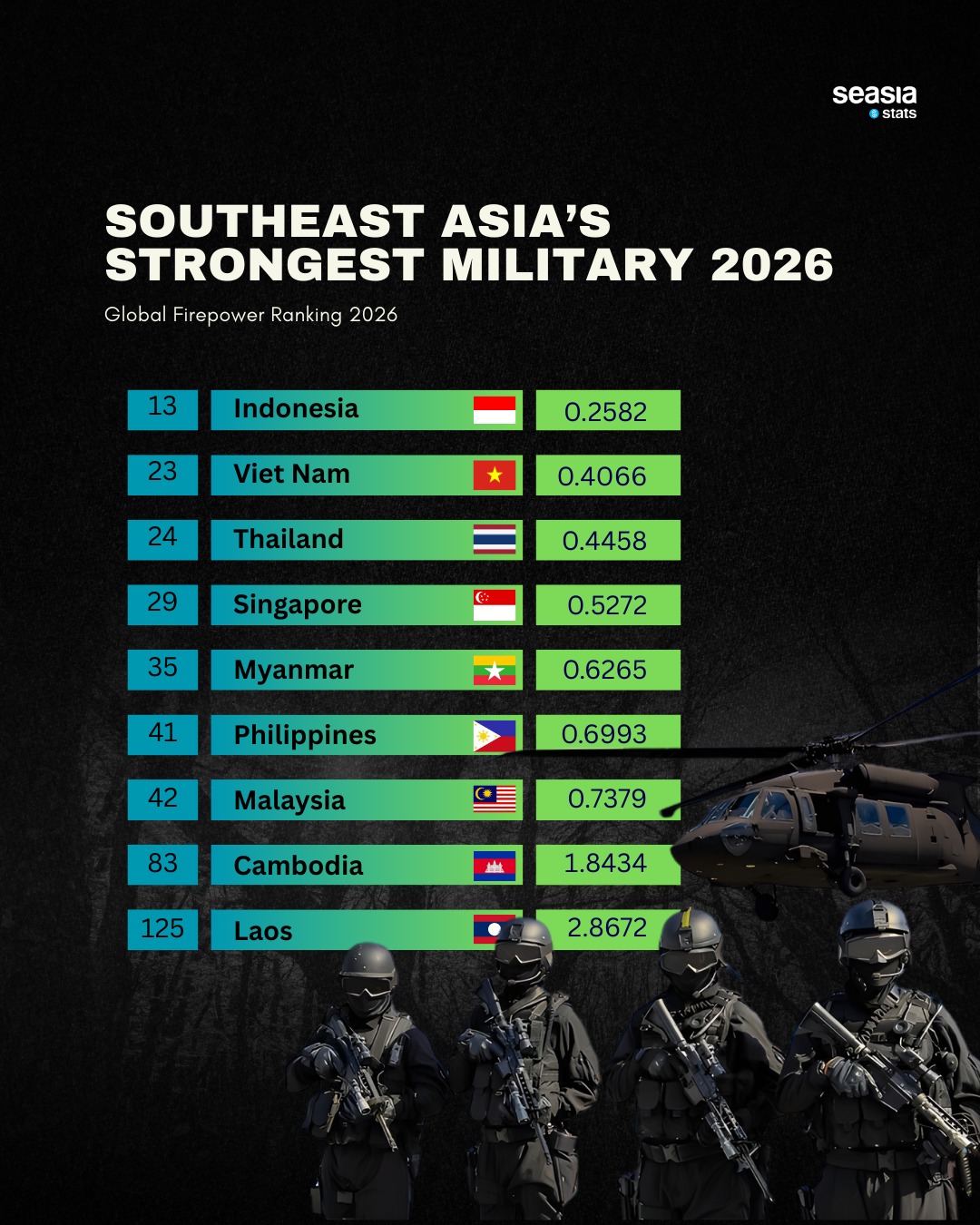
In an era of shifting geopolitics and evolving security challenges, military capability remains a key indicator of national strength and strategic influence. Across Southeast Asia, countries continue to modernize their armed forces, balancing traditional defense priorities with new technological capabilities. According to the 2026 Global Firepower (GFP) ranking, the region features a diverse range of military capabilities—from large personnel-based forces to technologically advanced defense systems.
Indonesia Leads Southeast Asia’s Military Strength
Indonesia stands as the strongest military power in Southeast Asia, ranking 13th globally with a Power Index (PwrIndx) score of 0.2582. Its military strength is driven by several factors, including its vast archipelagic geography, a large population capable of supporting significant military manpower, and an expanding naval presence.
Indonesia’s armed forces—known as the Tentara Nasional Indonesia (TNI)—draw from a personnel pool exceeding one million individuals, including active troops, reserves, and paramilitary units. As the world’s largest archipelagic state, Indonesia places particular emphasis on maritime defense, investing heavily in naval modernization, patrol vessels, submarines, and coastal defense systems to protect its extensive territorial waters.
The country has also increased investments in domestic defense industries, including aircraft maintenance, naval shipbuilding, and armored vehicle production, reflecting its ambition to achieve greater strategic independence.
Vietnam and Thailand Form the Regional Top Tier
Following Indonesia, Vietnam ranks 23rd globally with a Power Index of 0.4066, making it the second-strongest military in Southeast Asia. Vietnam’s defense capabilities are built on a combination of large manpower reserves, extensive military training traditions, and a sizable inventory of conventional weapons.
Vietnam has historically focused on territorial defense and coastal protection, maintaining a capable naval force and missile systems designed to secure its maritime boundaries.
Thailand, ranked 24th globally with a Power Index of 0.4458, completes the region’s top tier. Thailand’s military benefits from decades of modernization programs, strong training frameworks, and strategic partnerships with several international defense partners. The Thai armed forces operate a diverse fleet of aircraft, armored vehicles, and naval vessels, allowing them to maintain operational flexibility across land, air, and sea domains.
Technological Powerhouses and Mid-Tier Forces
In the middle tier of Southeast Asia’s military rankings is Singapore, placed 29th globally with a Power Index of 0.5272. Despite its relatively small size and population, Singapore maintains one of the most technologically advanced armed forces in the region.
Singapore’s military strategy prioritizes cutting-edge technology, including advanced fighter jets, cyber defense capabilities, precision weapons systems, and modern naval platforms. The city-state also maintains a robust national service program, ensuring a steady supply of trained personnel.
Following Singapore is Myanmar, ranked 35th globally, with a Power Index of 0.6265. Myanmar’s military strength largely stems from its large troop numbers and established command structure.
The Philippines, ranked 41st globally, has steadily improved its capabilities through modernization programs focused on naval and air defense. Investments in new patrol ships, fighter aircraft, and coastal surveillance systems reflect the country’s growing emphasis on maritime security.
Malaysia, ranked 42nd globally, maintains a balanced force structure that combines naval capabilities, modern aircraft, and regional defense cooperation.
Emerging and Smaller Defense Forces
At the lower end of the regional ranking are Cambodia and Laos, which place 83rd and 125th globally, respectively. While their military capabilities are more limited compared to larger neighbors, both countries maintain armed forces focused primarily on internal security and territorial defense.
Across Southeast Asia, military development reflects the diverse strategic priorities of each nation. Larger countries emphasize manpower and territorial protection, while smaller states often invest in technology and strategic alliances.
As the region continues to grow economically and geopolitically, Southeast Asia’s military landscape will likely evolve further—balancing defense modernization with the long-standing regional commitment to stability and cooperation.


