

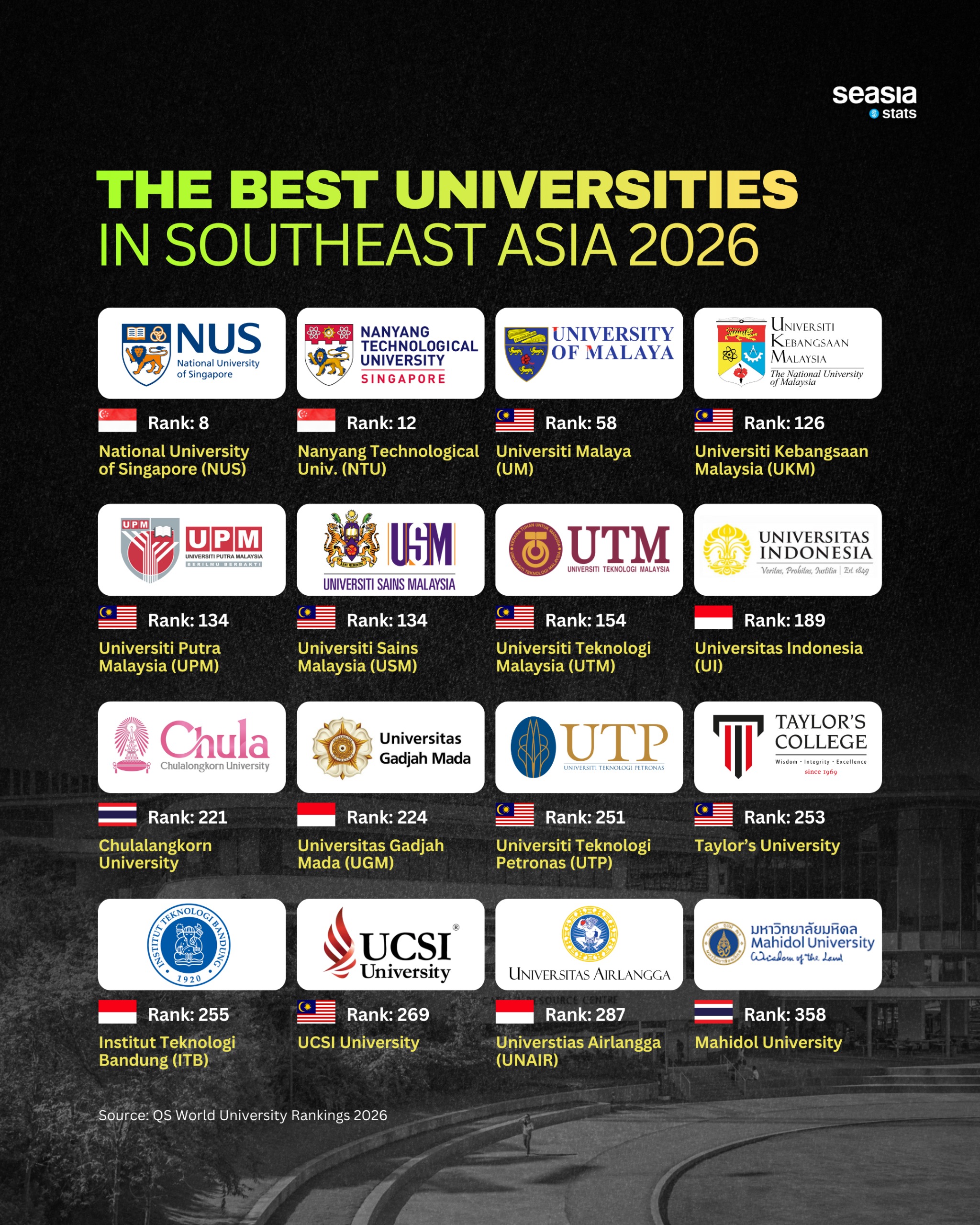
Higher education in Southeast Asia is undergoing a quiet transformation. Once overshadowed by Western and East Asian institutions, universities across the region are now climbing global rankings, attracting international students, and driving research that shapes Asia’s future. The QS World University Rankings 2026 highlight just how far the region has come—and which institutions are leading the charge.
Singapore: The Undisputed Regional Powerhouse
At the top of Southeast Asia’s academic hierarchy sits National University of Singapore, ranked an impressive 8th globally. NUS has become a benchmark for Asian universities, excelling in research output, employer reputation, and international collaboration. Its strength lies in interdisciplinary work, particularly in technology, medicine, and sustainability.
Close behind is Nanyang Technological University, ranked 12th worldwide. NTU’s rapid rise reflects Singapore’s long-term investment in science, engineering, and innovation-driven education. Together, NUS and NTU firmly place Singapore among the world’s elite education hubs.
Malaysia: A Deep and Diverse Academic Ecosystem
Malaysia emerges as the most represented country on the list, reflecting depth rather than just a single standout institution. Leading the way is University of Malaya, ranked 58th globally, making it one of Asia’s strongest public universities.
Supporting UM are Universiti Kebangsaan Malaysia (Rank 126), Universiti Putra Malaysia (Rank 134), and Universiti Sains Malaysia (Rank 134). Institutions like Universiti Teknologi Malaysia (Rank 154) and Universiti Teknologi Petronas (Rank 251) strengthen Malaysia’s reputation in engineering, science, and applied research.
Private institutions such as Taylor's University (Rank 253) and UCSI University (Rank 269) also signal a maturing higher education market with global ambitions.
Indonesia: Rising Academic Confidence
Indonesia places several universities on the list, reflecting its growing investment in research and global engagement. Universitas Indonesia ranks 189th, making it the country’s top institution. It is followed by Universitas Gadjah Mada(Rank 224), Institut Teknologi Bandung (Rank 255), and Universitas Airlangga (Rank 287).
These universities are increasingly visible in areas such as public health, engineering, and social sciences—fields closely tied to Indonesia’s national development goals.
Thailand: Legacy Institutions with Global Reach
Thailand’s presence is led by Chulalongkorn University (Rank 221) and Mahidol University (Rank 358). Both institutions carry long academic traditions and are especially well regarded in medicine, life sciences, and public policy.
What the Rankings Reveal About Southeast Asia
The QS World University Rankings 2026 tell a clear story: Southeast Asia is no longer just catching up—it is consolidating. Singapore dominates at the top, Malaysia provides breadth and consistency, while Indonesia and Thailand show steady upward momentum. As governments continue investing in research, internationalization, and talent, Southeast Asia’s universities are poised to play a far bigger role in shaping global knowledge flows in the decade ahead.


