

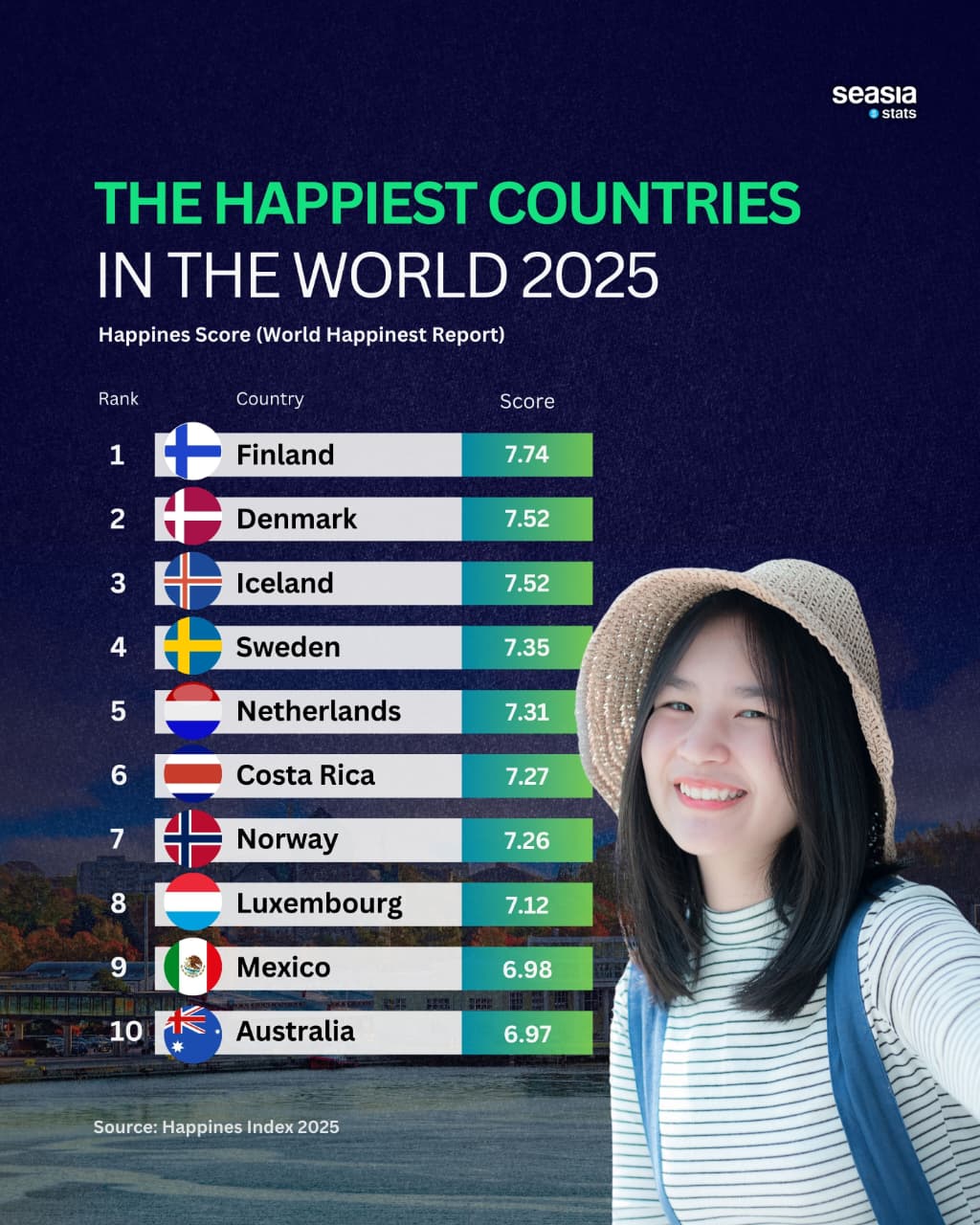
Happiness is one of the world’s most debated measurements—intangible, deeply personal, yet increasingly quantified. The latest World Happiness Report 2025, as highlighted by Seasia Stats, once again places Northern Europe firmly at the top. But beyond the rankings lies a bigger story: what actually makes societies feel content, and where Southeast Asia fits into that global picture.
The Nordic formula that keeps winning
Finland’s continued reign as the happiest country in the world, with a score of 7.74, is no longer surprising—it is almost expected. Denmark and Iceland follow closely, tied at 7.52, reinforcing a pattern that has defined global happiness rankings for years.
What makes these countries stand out is not wealth alone. The World Happiness Report consistently emphasizes factors such as social trust, strong public institutions, access to healthcare, and a sense of security. As the report famously notes, “Happiness is strongly linked to trust, social connections, and the quality of governance.” It is a reminder that prosperity without stability or trust rarely translates into life satisfaction.
In Finland, for example, citizens benefit from high-quality education, low corruption, and a robust welfare system. But perhaps more importantly, there is a cultural emphasis on balance—between work and life, ambition and contentment. That balance is something many fast-growing economies are still trying to achieve.
A broader geography of happiness
While Europe dominates the top ten, the presence of Costa Rica and Mexico adds an important dimension. These countries challenge the assumption that happiness strictly follows income levels. Costa Rica, ranked sixth, has long been cited as an example of how environmental quality, community ties, and a slower pace of life can contribute to well-being.
Mexico, at ninth, reflects a similar pattern. Despite economic disparities, strong family networks and social cohesion often play a central role in how people perceive their lives. As one recurring insight from global studies suggests, happiness is not just about what people have, but about how they relate to one another.
Australia’s presence in tenth place further broadens the map, showing that high living standards combined with relative social stability continue to produce strong well-being outcomes outside Europe.
Southeast Asia’s quiet resilience
Southeast Asia does not appear in the global top ten, but that does not mean the region lacks happiness. In fact, it presents a more nuanced and complex picture. Countries like Indonesia, Vietnam, and Thailand often rank in the middle tiers globally, reflecting both progress and persistent challenges.
What stands out in Southeast Asia is the strength of community life. In Indonesia, for instance, concepts like “gotong royong” emphasize mutual cooperation and shared responsibility, creating social bonds that are difficult to measure but deeply felt. Similarly, in countries like the Philippines, family and faith continue to shape everyday life in ways that contribute to emotional resilience.
However, the region also faces structural challenges that affect happiness scores. Rapid urbanization, income inequality, traffic congestion, and access to public services all play a role. Unlike Nordic countries, where systems are mature and widely accessible, Southeast Asian nations are still in transition—building infrastructure, expanding healthcare, and strengthening governance.
Growth, expectations, and the future of well-being
One of the most interesting dynamics in Southeast Asia is the relationship between growth and expectations. As economies expand and living standards improve, expectations rise just as quickly. That can create a paradox: even as conditions improve, satisfaction does not always increase at the same pace.
This is where the global happiness rankings offer a useful lens. They suggest that long-term well-being depends not just on economic growth, but on how that growth is distributed, experienced, and supported by institutions.
For Southeast Asia, the opportunity is clear. The region already has strong social foundations—family ties, cultural identity, and community networks. If these are matched with better public services, stronger governance, and more inclusive growth, the gap with the world’s happiest nations could begin to narrow.
Because in the end, happiness is not a fixed destination. It is a moving balance between progress and connection, ambition and contentment—and every region is still finding its own way there.


