

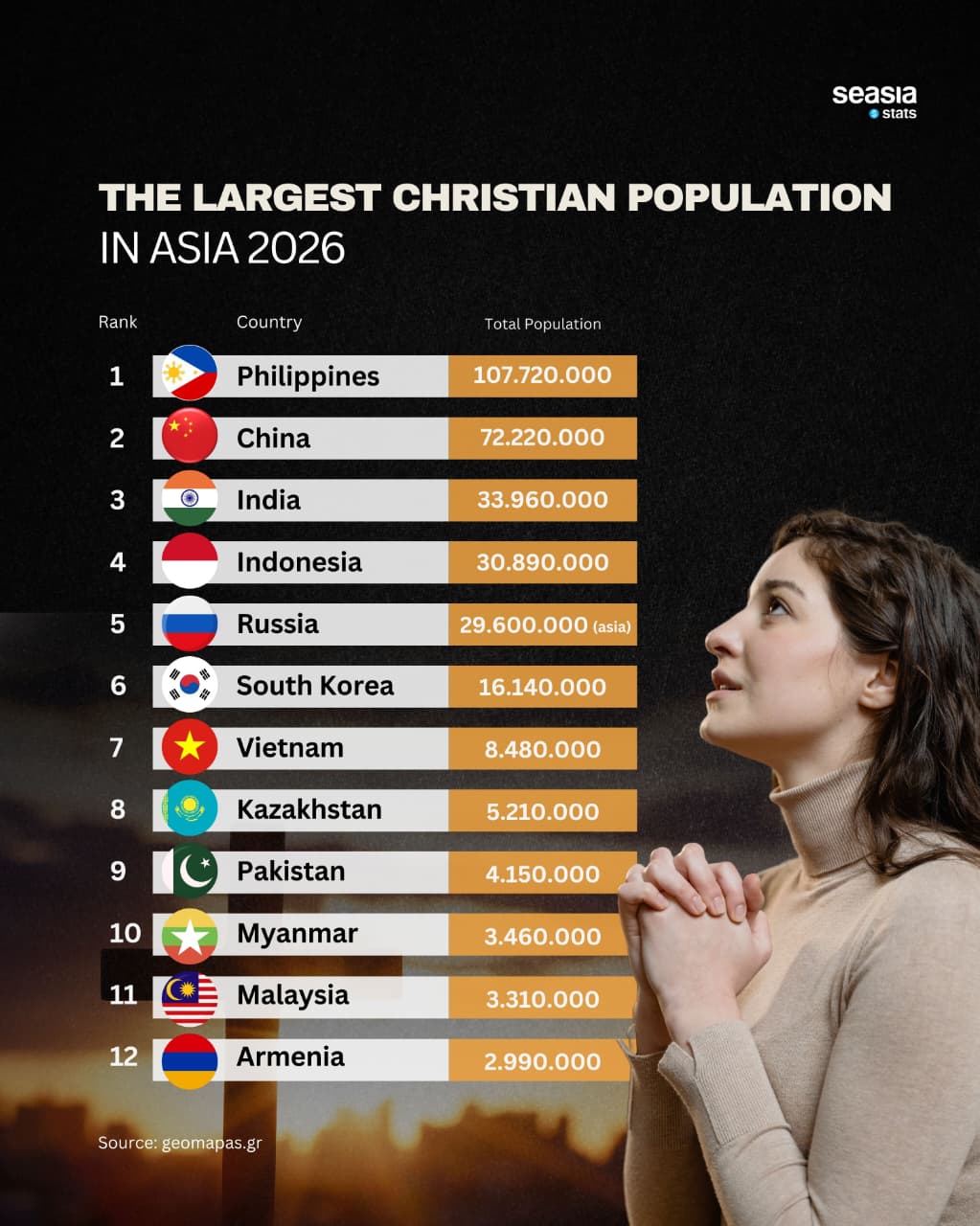
Christianity in Asia is often misunderstood as a small or peripheral faith. In reality, it is one of the continent’s most deeply rooted and demographically significant religious traditions—woven into colonial history, missionary networks, indigenous communities, migration, and modern nation-building. The latest ranking shared by Seasia Stats highlights just how substantial that presence remains in 2026, with the Philippines standing firmly at the top and Southeast Asia playing a far larger role in Asia’s Christian story than many outsiders realize.
The Philippines remains Asia’s Christian heartland
With more than 107.7 million Christians, the Philippines continues to hold the largest Christian population in Asia. The figure reflects not only the country’s size, but also the depth of Christianity’s place in Filipino public life—from church-centered towns and Holy Week processions to political rhetoric and family tradition. Christianity in the Philippines is not merely a religious identity; it is one of the strongest cultural foundations of the nation.
That scale also gives the Philippines an outsized role in global Christianity. Vatican data released in 2025 noted that the Philippines remains one of Asia’s major Catholic strongholds, with around 93 million Catholics alone, underlining its continuing importance in the wider Christian world. Vatican statistics also noted that Asia’s Catholic population continues to grow, even if modestly.
This helps explain why the Philippines is not just Asia’s largest Christian country by numbers—it is arguably one of the most visibly Christian societies anywhere in the world.
Southeast Asia is more Christian than many assume
One of the most striking elements of the ranking is how strongly Southeast Asia appears across the list. Indonesia ranks fourth with around 30.89 million Christians, Vietnam comes seventh with 8.48 million, Myanmar is tenth with 3.46 million, and Malaysia follows with 3.31 million. Even in countries where Christians are minorities, their communities are often historically rooted, regionally concentrated, and culturally influential.
Indonesia is especially important here. It is widely known as the world’s largest Muslim-majority country, but far less often acknowledged as home to one of Asia’s biggest Christian populations. That says something important about Southeast Asia itself: it is not a region defined by a single religious identity, but by coexistence, layered histories, and plural societies.
Pew Research has consistently emphasized that while Christians make up a minority share in much of Asia, countries such as Indonesia, India, and China still contain very large Christian populations in absolute terms because of their enormous national populations. It also notes that the Philippines remains the largest Christian population in the Asia-Pacific region.
That context matters. A country does not need to be majority-Christian to be central to Christianity’s future.
China, India, and Indonesia tell a different story
After the Philippines, the ranking turns toward the giants of Asia: China, India, and Indonesia. Their Christian communities are smaller in percentage terms, but enormous in raw population. That distinction is crucial.
China’s place on such lists often sparks debate because measuring religion there is notoriously difficult. Pew Research said in 2025 that while many headlines have speculated about explosive Christian growth in China, survey-based estimates suggest a far smaller Christian population than some viral claims imply. Even so, it remains one of Asia’s most consequential Christian landscapes because even a small percentage of China’s population translates into tens of millions of people.
India tells a similarly complex story. Christians are a relatively small minority nationally, but they are deeply established in states and communities with long histories, especially in the south and northeast. Indonesia, too, reflects a Christianity that is regionally vibrant—particularly in eastern provinces and among long-standing ethnic communities.
Southeast Asia’s Christian map is shaped by history and geography
To understand Christianity in Southeast Asia, it helps to stop thinking in national averages alone. The region’s Christian presence is often strongest in specific islands, borderlands, urban centers, and highland communities. In Indonesia, Christian populations are especially prominent in places such as North Sulawesi, Papua, East Nusa Tenggara, and parts of Maluku. In Vietnam, Catholicism remains visible in both major cities and older parish communities. In Myanmar, Christianity is especially important among several ethnic minority groups. In Malaysia, Christian communities are particularly significant in East Malaysia.
This means Christianity in Southeast Asia is not marginal. It is geographically embedded and historically durable.
More than a minority story
Ultimately, this ranking reveals something bigger than numbers. Christianity in Asia is not just surviving—it remains socially significant, demographically substantial, and regionally diverse. And nowhere is that clearer than in Southeast Asia, where Christian communities continue to shape national identity, education, civil society, and cultural life.
The continent’s Christian future will not be written only in Europe or the Americas. Much of it is already being lived—in Filipino cathedrals, Indonesian seminaries, Vietnamese parishes, and the quiet but enduring faith communities scattered across Southeast Asia.


