

Oceans and seas cover more than two-thirds of the Earth’s surface, shaping global climate, sustaining marine ecosystems, and supporting international trade routes that connect continents. While oceans often receive the most attention, regional seas also play a critical role in the planet’s environmental balance and economic activity. Some of these seas span millions of square kilometers, rivaling the size of large countries and influencing the lives of hundreds of millions of people along their coasts.
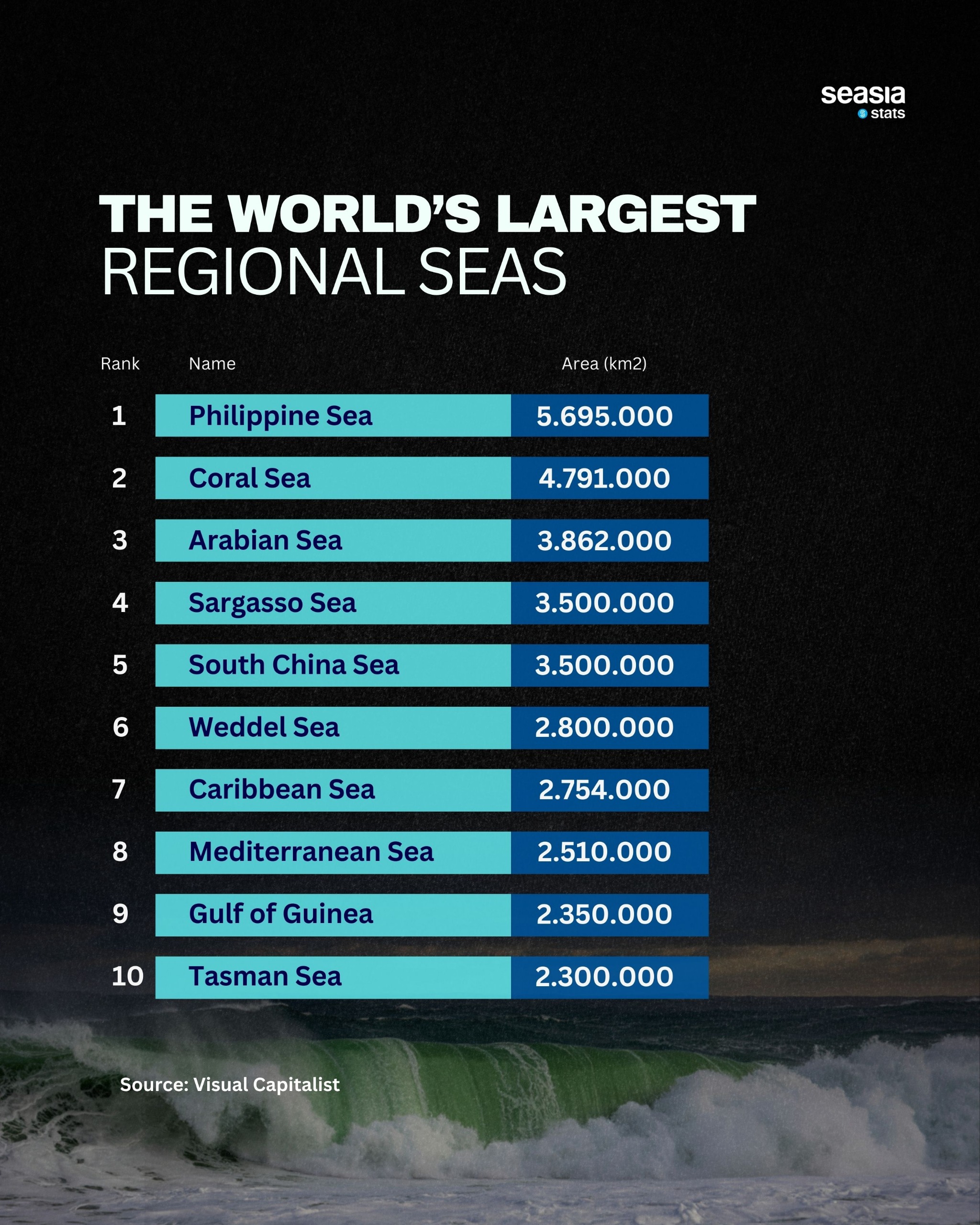
According to data compiled by Visual Capitalist and highlighted by Seasia Stats, several regional seas stand out for their immense size and global importance. These bodies of water are not only vast in scale but also rich in biodiversity, strategic trade routes, and cultural significance for surrounding nations.
The Philippine Sea: The World’s Largest Regional Sea
At the top of the list is the Philippine Sea, the largest regional sea on Earth, covering an impressive 5.695 million square kilometers. Located in the western Pacific Ocean, it is bordered by the Philippines, Taiwan, Japan, and the Mariana Islands.
The Philippine Sea is particularly famous for containing the Mariana Trench, the deepest point on Earth, where the ocean floor plunges nearly 11 kilometers below sea level. This massive sea plays a vital role in the ecosystems and economies of surrounding countries, including the Philippines, Japan, and Taiwan.
For Southeast Asia, the Philippine Sea is especially significant as it influences regional fisheries, ocean currents, and maritime trade routes that connect the Pacific to Southeast Asian waters.
The Coral Sea and Arabian Sea
The Coral Sea ranks second among the world’s largest regional seas, covering about 4.791 million square kilometers. Located off the northeastern coast of Australia, the Coral Sea is globally renowned for its rich biodiversity and its connection to the Great Barrier Reef, the world’s largest coral reef system.
This sea supports countless marine species and is considered one of the most ecologically important marine regions on the planet.
In third place is the Arabian Sea, which spans 3.862 million square kilometers in the northern Indian Ocean. This sea has historically been one of the most important maritime trade corridors in the world, linking South Asia, the Middle East, and East Africa.
Major shipping routes crossing the Arabian Sea facilitate the movement of energy supplies, manufactured goods, and agricultural products across three continents.
The South China Sea and Its Global Significance
Two seas share the fourth and fifth positions in terms of size: the Sargasso Sea and the South China Sea, each covering roughly 3.5 million square kilometers.
The Sargasso Sea, located in the North Atlantic Ocean, is unique because it is defined not by land boundaries but by ocean currents. These currents create a vast floating ecosystem famous for its dense mats of sargassum seaweed.
The South China Sea, meanwhile, holds immense strategic importance for Southeast Asia. Surrounded by countries such as Vietnam, the Philippines, Malaysia, Brunei, and Indonesia, this sea is one of the busiest maritime corridors in the world. A significant portion of global trade flows through its waters every year.
Beyond commerce, the South China Sea is also rich in fisheries and natural resources, making it vital to food security and economic development for many Southeast Asian nations.
Other Major Regional Seas Around the World
Several other large regional seas complete the global top ten. The Weddell Sea, located in the Southern Ocean near Antarctica, covers about 2.8 million square kilometers and plays a crucial role in regulating global ocean circulation and climate systems.
The Caribbean Sea, spanning 2.754 million square kilometers, is one of the most culturally and economically significant seas in the Western Hemisphere, supporting tourism, fisheries, and shipping.
Next comes the Mediterranean Sea, with 2.510 million square kilometers, historically known as a cradle of ancient civilizations and still one of the busiest maritime regions in the world.
The Gulf of Guinea in West Africa covers approximately 2.350 million square kilometers, serving as an important hub for energy exports and international shipping.
Finally, the Tasman Sea, located between Australia and New Zealand, rounds out the top ten with an area of 2.3 million square kilometers.
Seas That Shape Regions and Economies
Together, these vast regional seas demonstrate the enormous influence that marine environments have on global ecosystems and human societies. From the fisheries that feed millions of people to the shipping routes that power international trade, seas remain essential to the functioning of the modern world.
For Southeast Asia in particular, seas like the Philippine Sea and the South China Sea are central to regional livelihoods, biodiversity, and geopolitical dynamics. As coastal populations grow and maritime trade expands, the importance of protecting and sustainably managing these oceans will only become more critical in the decades ahead.


