

In today’s fast-moving digital world, laptops have become essential tools for work, study, and entertainment. From students in Jakarta to entrepreneurs in Singapore, millions rely on powerful portable devices to stay connected. According to Seasia Stats, a handful of global tech giants dominate this crucial market, with Asia and the United States leading the race in innovation and production.
Lenovo Leads the Global Laptop Market
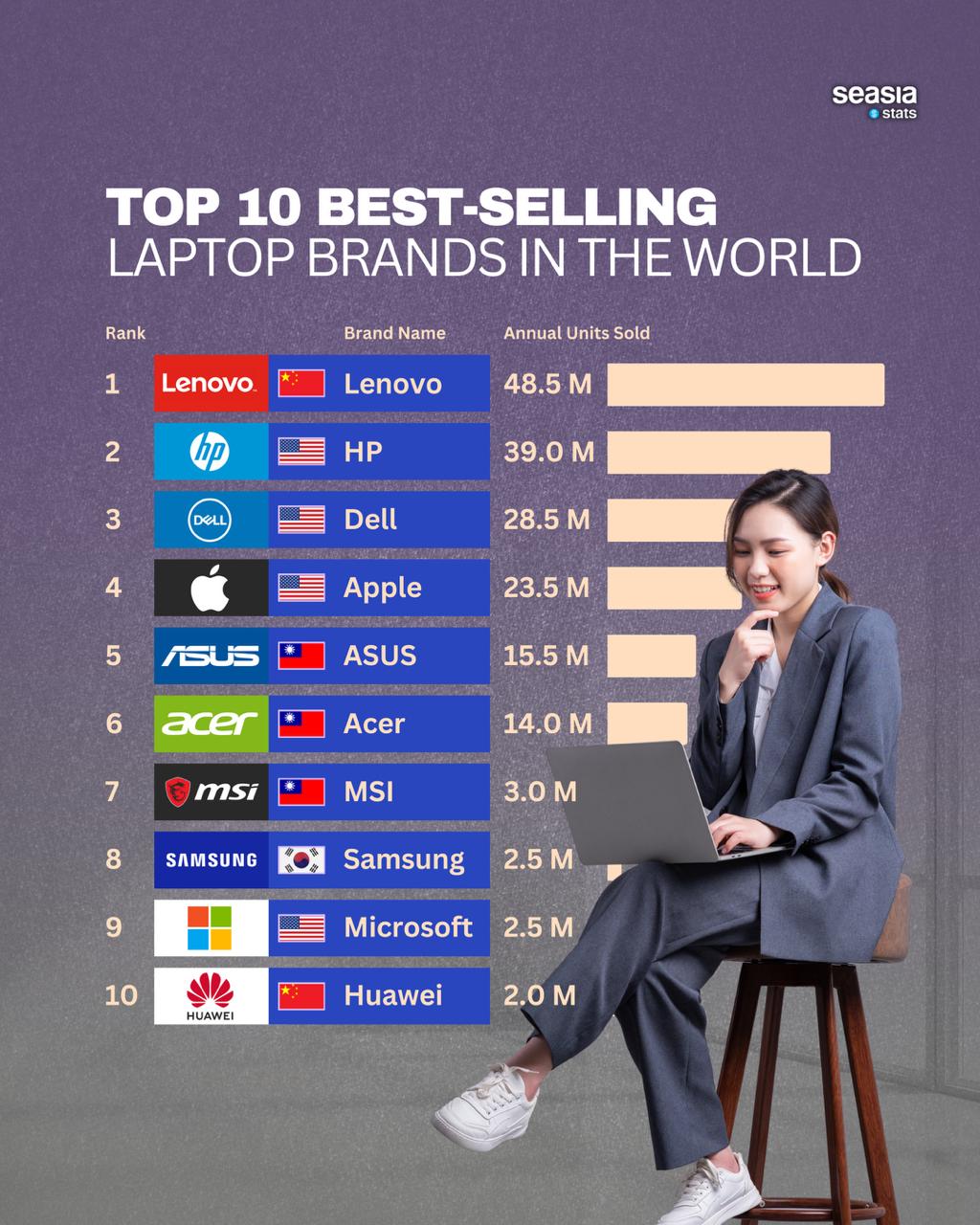
At the top of the global rankings stands Lenovo, the Chinese technology powerhouse that has firmly secured first place with 48.5 million laptops sold annually. Its success lies in its wide product range—from affordable student devices to premium business machines like the ThinkPad series. Lenovo’s strong manufacturing base in Asia and its deep partnerships across emerging markets, including Southeast Asia, have helped it build a massive global footprint.
American Tech Giants Hold Strong Positions
Following Lenovo are three major U.S. companies that continue to shape the modern computing experience. HP ranks second with 39.0 million units sold, thanks to its diverse product lineup and strong presence in both corporate and home markets. Dell takes third place with 28.5 million units, driven by its reliable business laptops and customizable systems. Apple secures fourth place with 23.5 million units, maintaining its premium status through the MacBook lineup, which is especially popular among creative professionals and students.
Across Southeast Asia, these American brands remain highly visible. In countries such as Singapore and Malaysia, Apple laptops are widely used in education and creative industries, while Dell and HP maintain strong enterprise demand in Indonesia, Thailand, and the Philippines.
Taiwanese Innovation in the Middle Tier
In the middle of the rankings, Taiwanese brands ASUS and Acer demonstrate the strength of Asia’s hardware innovation. ASUS, with 15.5 million units sold, is known for its gaming laptops and sleek ultrabooks, while Acer, at 14.0 million units, is a favorite for affordable yet reliable consumer devices.
Both brands have particularly strong market penetration in Southeast Asia, where competitive pricing and gaming culture are major drivers. Indonesia, Vietnam, and Thailand, for instance, have rapidly growing gaming communities that favor ASUS’s ROG series and Acer’s Predator lineup.
Specialized and Emerging Global Players
Further down the list are brands catering to niche or specialized markets. MSI, with 3.0 million units sold, focuses heavily on gaming and high-performance systems. South Korea’s Samsung and the United States’ Microsoft are tied with 2.5 million units each, offering premium ultrabooks and productivity devices such as the Galaxy Book and Surface lineup.
Huawei rounds out the top ten with 2.0 million units sold globally. Despite geopolitical challenges, the Chinese brand continues to grow its presence, particularly in Asia, where its sleek MateBook series appeals to young professionals.
Southeast Asia’s Growing Laptop Market
Southeast Asia is emerging as one of the fastest-growing laptop markets in the world. Rising digital economies in Indonesia, Vietnam, and the Philippines, combined with remote work trends and expanding education access, have significantly boosted demand. Governments across the region are also investing in digital literacy programs, further increasing the need for affordable computing devices.
Retail trends show that Lenovo, ASUS, and Acer dominate sales in Indonesia and Vietnam, while Apple and Dell maintain premium market segments in Singapore and Malaysia. Meanwhile, Thailand’s growing creative economy has driven strong demand for high-performance laptops suited for design, media, and gaming.
The Future of Global Computing
As technology continues to evolve, the competition among laptop brands will intensify. With Southeast Asia becoming a key battleground for market growth, manufacturers are increasingly tailoring their products to meet local needs—balancing performance, affordability, and portability.
From global tech giants to regional innovators, the laptop industry reflects a broader story of digital transformation. And as millions more people come online across Southeast Asia, these devices will remain at the heart of education, business, and creativity for years to come.


