

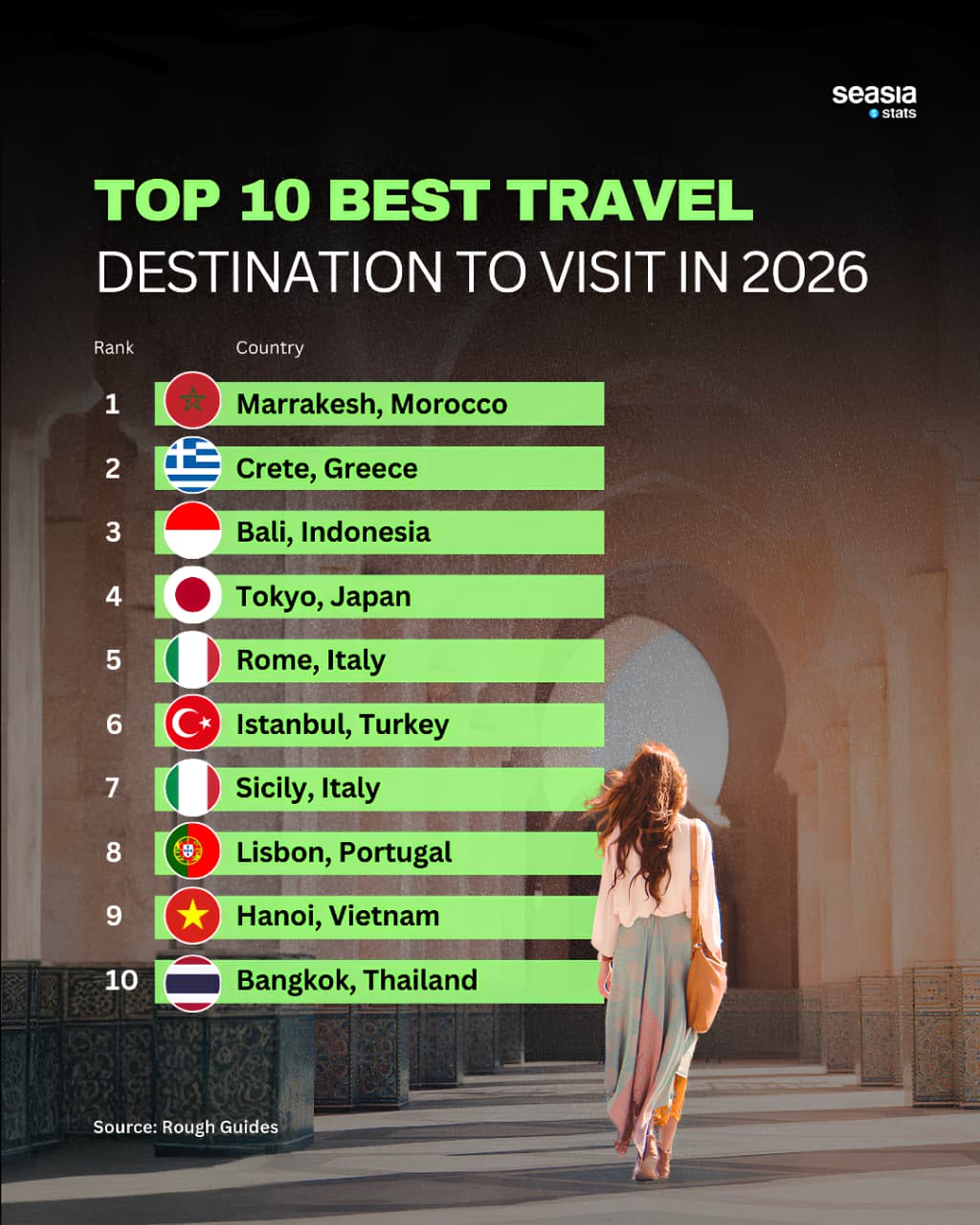
Travel in 2026 is no longer just about ticking destinations off a list—it’s about immersion, contrast, and storytelling. The latest ranking from Rough Guides, highlighted by Seasia Stats, reflects exactly that shift. From ancient medinas to tropical islands and hyper-modern cities, this year’s top destinations reveal a world where culture and experience matter more than ever.
Where Tradition Meets Timeless Appeal
At the top of the list sits Marrakesh, a city that feels like stepping into a living painting. Its labyrinthine souks, desert palette, and centuries-old riads offer travelers something increasingly rare: a sense of discovery that cannot be replicated. Crete follows closely, blending Mediterranean calm with mythological depth, while Bali secures third place—once again proving that Southeast Asia remains central to global travel dreams.
Bali’s enduring popularity is no accident. It offers a rare balance: spiritual retreats in Ubud, surf culture in Canggu, and luxury escapes in Nusa Dua. As Condé Nast Traveler once described it, Bali is “a destination that reinvents itself for every kind of traveler,” a sentiment that continues to hold true as visitor numbers rebound strongly post-pandemic.
Southeast Asia’s Strong Presence on the Global Stage
Beyond Bali, Southeast Asia continues to shine with Hanoi and Bangkok rounding out the top ten. These cities represent two very different but equally compelling travel narratives.
Hanoi is a city of layers. French colonial architecture, centuries-old temples, and buzzing street life coexist in a way that feels both chaotic and poetic. It’s the kind of place where a simple walk can turn into a cultural deep dive. Meanwhile, Bangkok remains one of the world’s most dynamic urban playgrounds, where rooftop bars, night markets, and ornate temples all compete for attention.
The region’s strength lies in its accessibility and diversity. Within a few hours’ flight, travelers can move from tropical beaches to highland retreats, from megacities to quiet heritage towns. As CNN Travel once noted, Southeast Asia continues to attract global visitors because it offers “high value, cultural richness, and unmatched variety in a relatively compact region.”
Global Icons That Continue to Inspire
The middle of the ranking features cities that have long defined global tourism. Tokyo stands as a symbol of precision and innovation, where tradition and technology coexist seamlessly. Rome and Sicily remind travelers of Europe’s enduring romance, where history is not preserved in museums alone but lived in everyday streets.
Istanbul, straddling two continents, continues to captivate with its unique identity—part European, part Asian, entirely its own. Lisbon, meanwhile, has emerged as one of Europe’s most charming capitals, blending old-world aesthetics with a growing creative scene.
The New Traveler’s Mindset
What ties these destinations together is not geography, but experience. Today’s travelers are seeking meaning: food that tells a story, neighborhoods that feel authentic, and moments that feel personal rather than curated.
Southeast Asia, in particular, is well-positioned to meet this demand. Countries like Indonesia, Vietnam, and Thailand are not just destinations—they are ecosystems of culture, cuisine, and connection. Whether it’s a sunrise over Bali’s rice terraces, a bowl of pho in Hanoi, or a late-night tuk-tuk ride through Bangkok, the region delivers experiences that linger long after the journey ends.
A World Open Again
Ultimately, this list is less about ranking and more about rediscovery. It reflects a world that is fully open again, where travelers are eager to explore not just new places, but new perspectives. And in that global story, Southeast Asia remains not just relevant—but essential.


