

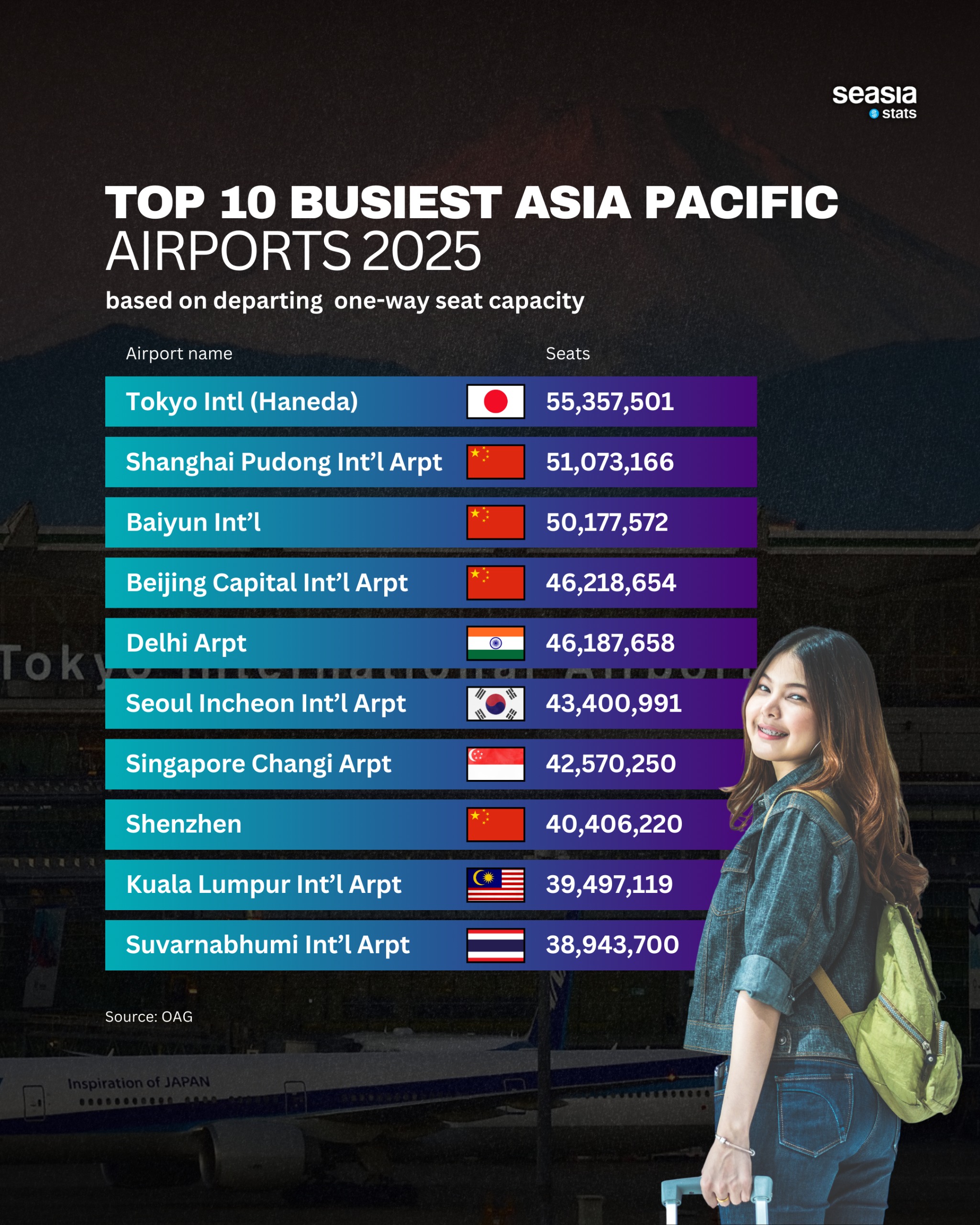
Air travel across the Asia Pacific region has roared back with remarkable strength, and the latest 2025 figures from the Official Airline Guide (OAG) show a dynamic aviation landscape led by powerful hubs in Japan, China, India, and Southeast Asia. From massive domestic networks to fast-growing international connections, these airports are more than transit points—they are engines of regional mobility, tourism, and economic growth.
Japan Holds the Crown
At the top of the rankings stands Tokyo International Airport (Haneda), maintaining its position as the busiest airport in Asia Pacific with more than 55.3 million departing one-way seats. Haneda’s strength lies in its seamless blend of domestic and international operations. As a gateway to one of the world’s largest economies, it benefits from strong domestic demand and a growing influx of global visitors returning to Japan.
Its efficiency, connectivity, and proximity to central Tokyo make it a preferred hub for both business and leisure travelers—solidifying Japan’s leadership in regional aviation.
China’s Aviation Powerhouses
China continues to dominate the aviation map with four airports in the top ten. Shanghai Pudong and Guangzhou Baiyun take second and third place, handling 51.0 million and 50.1 million seats respectively. These mega-hubs serve as critical gateways for both international trade and tourism, connecting China to the world.
Beijing Capital International Airport ranks fourth, though some of its traffic has shifted to the newer Beijing Daxing International Airport, reflecting China’s strategy to expand capacity across multiple hubs.
Meanwhile, Shenzhen Bao’an International Airport has emerged as one of the fastest-rising airports in the region. With over 40.4 million seats, Shenzhen’s climb reflects the city’s rapid growth as a global technology and innovation center.
India’s Meteoric Rise
India’s aviation sector is one of the most exciting stories of the decade, and Indira Gandhi International Airport in Delhi embodies that growth. Jumping from ninth place in 2019 to fifth place in 2025, Delhi now handles 46.2 million seats.
This surge is fueled by a rapidly expanding middle class, competitive domestic carriers like IndiGo, and increased connectivity across South Asia and beyond. India is quickly establishing itself as a major aviation powerhouse in Asia Pacific.
Southeast Asia’s Strategic Gateways
Southeast Asia remains a vital aviation crossroads, linking East Asia, South Asia, and Oceania. Three major airports in the region secured spots in the top ten:
-
Singapore Changi Airport (7th) – 42.5 million seats
-
Kuala Lumpur International Airport (9th) – 39.5 million seats
-
Bangkok Suvarnabhumi Airport (10th) – 38.9 million seats
These hubs play a crucial role in facilitating tourism, business travel, and regional connectivity. Changi continues to stand out as a global benchmark for passenger experience, while Kuala Lumpur and Bangkok serve as key low-cost carrier and transit hubs for millions of travelers annually.
Other rising Southeast Asian airports—such as Jakarta Soekarno-Hatta, Manila Ninoy Aquino, and Ho Chi Minh City’s Tan Son Nhat—are also expanding capacity and upgrading infrastructure, signaling strong future competition in the rankings.
A Region of Growth and Connectivity
The 2025 rankings highlight a region in motion. From Japan’s stability and China’s scale to India’s rapid rise and Southeast Asia’s connectivity, Asia Pacific’s busiest airports reflect broader economic and social transformations.
As travel demand continues to rebound and expand, these aviation hubs will remain critical gateways—connecting cultures, driving tourism, and powering economic growth across one of the most dynamic regions in the world.


